

Uber
Two men stood on a Paris street in 2008, watching taxis ignore their outstretched arms. Travis Kalanick and Garrett Camp were attending a tech conference. They needed a ride. The city's transport system didn't care.
Most people would have grumbled and walked. These two saw a $100 billion opportunity.
The Impossible Simplicity of Uber
The concept was almost stupidly simple: summon a car with your phone. But simple ideas that reorganize entire industries rarely stay simple for long.
Kalanick and Camp returned to San Francisco and started building what would become UberCab — later shortened to Uber. They launched in 2010 with a handful of cars and a single city. The value proposition was immediate and undeniable: push a button, get a ride, pay seamlessly.
"We were just trying to solve our own problem. We had no idea how big it would become."
The growth that followed defied conventional expansion models. Within twelve months, Uber had moved to New York. Then Chicago. Then Paris — the city where the frustration first struck. The pattern was consistent: enter a market, face regulatory resistance, grow anyway.
But growth at this velocity creates its own problems. And Uber's approach to solving those problems would nearly destroy the company.
The Kalanick Doctrine
Travis Kalanick didn't just run Uber — he embodied its early philosophy. Aggressive expansion. Regulatory arbitrage. Move fast and break things, even if those things were city transportation systems that had operated the same way for decades.
The internal language reflected this mindset. In 2014, Kalanick told employees, "We're in a political campaign, and the candidate is Uber and the opponent is an asshole named Taxi." Subtle messaging was not part of the playbook.
This approach worked — initially. By 2015, Uber operated in over 300 cities worldwide. Its valuation hit $50 billion. The company had successfully redefined urban mobility and created an entirely new category of employment. Millions of people could earn money driving their own cars.
But cultures that prize aggression above all else tend to metastasize. The same "always be hustlin'" mentality that powered Uber's expansion also fostered an internal environment where ethical boundaries became suggestions.
The Reckoning
2017 arrived like a reckoning. Sexual harassment allegations surfaced. A video emerged of Kalanick berating an Uber driver over fare cuts. Google's Waymo accused Uber of stealing self-driving car technology. Each scandal reinforced the others, creating a narrative of systemic dysfunction.
Kalanick was forced out. The company that had disrupted every market it entered suddenly faced its own disruption — from within.
The board brought in Dara Khosrowshahi, former CEO of Expedia. His first assessment was blunt: "The culture and approach that got Uber to this point is not what will get us to the next level."
The Khosrowshahi Reset
Khosrowshahi inherited a company with spectacular growth metrics and a toxic brand. The 2019 IPO reflected this tension — shares fell on the first day of trading. Growth without governance had reached its natural endpoint.
The new CEO began systematically rebuilding. He expanded Uber Eats, positioning the company for the delivery economy that would explode during COVID-19. He cut unprofitable operations and focused on markets where Uber could achieve sustainable economics. Most importantly, he changed how decisions were made.
"The days of growth at all costs are over," Khosrowshahi declared.
In 2022, Uber reported its first full year of profitability on an adjusted basis. The transformation was complete — not just financially, but culturally. The company that once celebrated breaking rules now emphasized building sustainable systems.
The Platform Economy Blueprint
Today's Uber demonstrates how platform businesses achieve durability. The company runs over 1,000 experiments simultaneously, testing everything from interface changes to new service categories. This experimental velocity allows rapid iteration while maintaining operational stability.
Their data advantage has become nearly insurmountable. Every ride generates information about traffic patterns, demand fluctuations, and user preferences. This data feeds algorithms that optimize routes, predict surge pricing, and improve matching efficiency. Competitors can copy features, but they cannot replicate dataset depth.
The business model has also evolved beyond transportation. Uber Eats now represents a significant revenue stream, leveraging the same driver network and technological infrastructure. The platform economics — where marginal transactions become increasingly profitable — finally began to work.
Strategic Lessons
Culture compounds — positively or negatively. Uber's early "meritocracy" and "always be hustlin'" values drove exceptional growth but also created systematic blind spots around ethics and sustainability. Culture isn't just about values posted on walls; it's about the decisions people make when no one is watching.
Data becomes a moat when it reaches sufficient scale. Uber's vast repository of movement data, behavioral patterns, and demand signals creates competitive advantages that are difficult to replicate. This information enables better route optimization, demand prediction, and service improvement — creating a self-reinforcing cycle.
Sometimes leadership must fire itself. Kalanick's departure wasn't just a personnel change — it was an organizational recognition that the skills required to build a company differ from those needed to sustain it. Founders who recognize this transition and act accordingly often save their companies.
Platform businesses require patience for profitability. Uber spent over a decade losing money while building network effects and market position. The eventual profitability demonstrated that some business models require extended investment periods before economics align.
The story that began with two frustrated travelers in Paris ultimately reshaped how billions of people move through cities. But perhaps the most important lesson from Uber's journey is this: revolutionary ideas often require evolutionary leadership to reach their full potential.
Free playbook
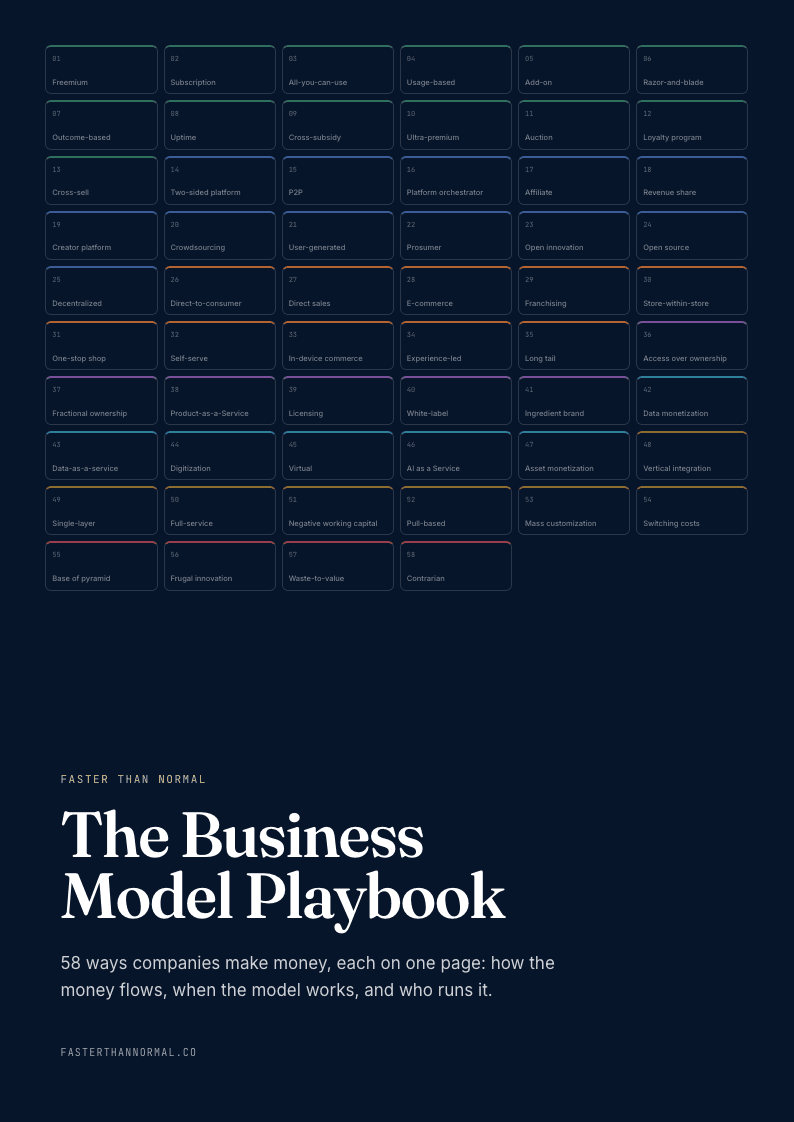
Get The Business Model Playbook
58 business models, one visual page each: how the money flows, the metrics that matter, and who runs it. Free when you join the Faster Than Normal email.
Free. No spam. Unsubscribe anytime.