

Trust in Calendar, Meaningful Connections, & More
To-do lists reflect your aspirations. Calendars determine your outcomes. The difference between these two tools explains why so many capable people struggle to execute on their priorities.
The Calendar-First Framework
Most professionals operate with an inverted hierarchy of trust. They treat their to-do list as scripture and their calendar as a suggestion. This is backwards. Your calendar is the only document that reflects physics — the immutable constraint of time itself.
Cal Newport's research on deep work revealed a pattern among high performers: they schedule their most important work like they schedule their most important meetings. No negotiation. No hoping it happens. Block the time, protect the boundaries, execute the work.
The implementation requires three shifts in behavior:
Time-boxing over task-listing. Instead of "finish quarterly report," your calendar shows "quarterly report research, 9-11 AM" and "quarterly report draft, 2-4 PM." Specificity creates accountability.
Deep work protection. Your calendar should include buffer zones around cognitively demanding tasks. Back-to-back meetings followed by strategic planning is a recipe for shallow output. Block transition time.
Calendar review as daily practice. Most people review their calendar passively — checking what's next, not optimizing what's possible. Spend five minutes each morning asking: Does today's schedule reflect today's priorities?
The constraint forces clarity. When you must choose between competing priorities for the same two-hour block, the decision becomes concrete. Abstract importance gives way to actual trade-offs.
Building Meaningful Connections
Surface-level networking optimizes for quantity. Meaningful connections optimize for depth. The difference lies not in the people you meet but in the questions you ask.
Move beyond occupational small talk. Instead of "What do you do?" try "What problem are you most excited to solve right now?" The first question gets you a job title. The second gets you insight into someone's intellectual curiosity.
Ask about inflection points. "What change in your career surprised you the most?" or "What belief have you changed your mind about recently?" These questions reveal how someone thinks, not just what they've done.
Focus on learning, not pitching. The most magnetic people in any conversation are those who are genuinely curious about others' experiences. They ask follow-up questions. They remember details from previous conversations. They create space for others to be interesting.
The paradox: trying to be impressive makes you forgettable. Trying to be impressed makes you memorable.
"Empathy is about understanding others' pain without experiencing it yourself."
— Zainab Salbi, humanitarian and author
The Two-Wolf Problem
An old Cherokee chief taught his grandson about the internal battle between two wolves — one representing negative emotions like anger and envy, the other embodying positive traits like compassion and hope. When asked which wolf wins, the chief replied: "The one you feed."
This parable persists because it captures a fundamental truth about attention as a scarce resource. Your emotional state follows your mental focus. Ruminate on perceived slights, and resentment compounds. Practice gratitude, and appreciation expands.
The feeding happens through micro-choices. Which news stories do you consume? Which conversations do you replay? Which future scenarios do you visualize? Each decision is a small vote for the wolf you want to strengthen.
Consider your information diet. The Cherokee chief's metaphor applies beyond emotions to inputs generally. Reading only confirmatory sources feeds intellectual complacency. Engaging exclusively with optimists feeds unrealistic expectations. Balance requires intentional curation.
Energy follows attention. You become what you consistently focus on — not through mystical thinking, but through practical habit formation. Your brain optimizes for pattern recognition. Feed it patterns of curiosity, and you become more curious. Feed it patterns of criticism, and you become more critical.
The question is not whether both wolves exist within you. They do. The question is which one you're choosing to strengthen through the accumulation of daily choices.
Weekly Recommendations
How to Write Something Compelling by Justin Mikolay examines the mechanics of clear, compelling communication through the lens of Naval Ravikant's writing style.
Blueprint by Bryan Johnson documents his systematic approach to reversing biological aging through measurement, experimentation, and optimization.
Poetry and Ambition by Donald Hall argues for pursuing greatness over comfort in creative work — a principle that extends far beyond poetry.
Free playbook
Get The Business Model Playbook
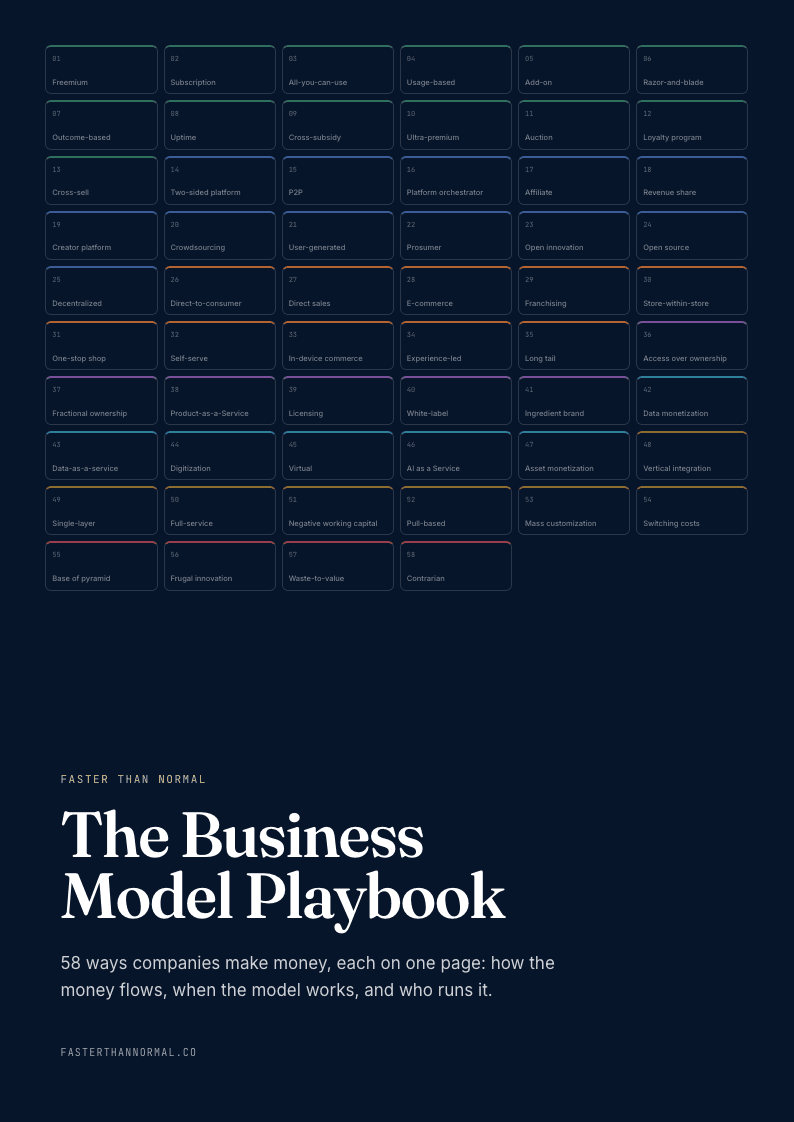
58 business models, one visual page each: how the money flows, the metrics that matter, and who runs it. Free when you join the Faster Than Normal email.
Free. No spam. Unsubscribe anytime.