

🎁A Special Gift...and 60 more Mental Models!
After five weeks of curating 800+ resources across domains that matter to high-performing operators, we're sharing something unprecedented: a crowdsourced database of the best thinking on the internet. This isn't another listicle. It's a living repository of insights from exceptional minds, organized into categories that solve real problems — communication, effectiveness, learning, career strategy, mental models.
The majority of these resources emerged from conversations with world-class operators who've navigated the problems you're facing. We simply curated what worked. Good answers shouldn't be hard to find, and there are usually shortcuts to achieving what you want — all it takes is the right advice at the right time.
The database covers being effective, communication mastery, learning frameworks, mental models, career optimization, and strategic thinking. These resources are designed for sharing — if someone you know would benefit, pass it along.
Cognitive Mechanisms That Drive Decision-Making
Pattern Recognition and Mental Simulation
Pattern Matching represents how our brains associate new information with stored patterns. This mechanism drives decision-making across every domain, but it can mislead when we match current situations to superficially similar past experiences without accounting for crucial differences. Check your pattern matching against objective data whenever possible.
Mental Simulation is your mind's ability to imagine specific actions and simulate probable outcomes before acting. The most effective operators deliberately cultivate this skill — they run scenarios, stress-test assumptions, and explore second and third-order effects before committing resources. How often do you actually simulate the full consequences of your choices?
Interpretation and Reinterpretation kicks in when information is incomplete. We fill gaps using prior knowledge, which can create persistent blind spots. Reinterpretation — changing your beliefs about past events — becomes a powerful tool for processing negative experiences and extracting useful lessons.
The Mechanics of Motivation and Control
Motivation emerges when your emotional brain connects with your action-oriented brain without conflict or confusion about the best path forward. This happens when you're either moving toward something genuinely desirable or away from something genuinely threatening. Manufactured motivation rarely sustains under pressure.
Inhibition is your ability to override natural inclinations and habits. Willpower fuels this process, but it's a finite resource that depletes with use. The most effective approach: design systems that require minimal willpower rather than relying on constant self-control.
Status and Threat Response
Status Signals are tangible indicators of intangible qualities — rare items, awards, recognition. The more attractive an option appears in terms of status, the more likely it contains hidden drawbacks and the more likely you'll ignore those drawbacks. Status Malfunction explains why prestigious opportunities often disappoint while meaningful work gets overlooked.
Threat Lockdown occurs when your mind enters protective mode after detecting external threats. To escape this state, you must convince your nervous system that the threat no longer exists or never existed to the extent you believed. This requires evidence, not willpower.
Information Processing Limitations
Cognitive Scope Limitation forces us to simplify overwhelming information, which leads to decisions based on incomplete pictures. Stalin allegedly said, "One death is a tragedy. A million deaths is a statistic." Our minds struggle with scale, complexity, and abstract consequences.
Association drives our pattern-seeking behavior, but it often creates connections between logically unrelated elements. We see patterns everywhere, even when none exist.
Absence Blindness prevents us from noticing what's working well. We notice referees only when they make mistakes, praise only poor performance, and focus on problems while ignoring successes. Fair judgment requires conscious attention to both positive and negative performance.
Perception and Judgment Biases
The Challenge of Accurate Assessment
False Precision occurs when numerical data implies better accuracy than reality warrants. More data doesn't always mean more useful data. The Weber-Fechner Law explains why we only perceive changes in stimuli when they equal or exceed the original stimulus. Small improvements often go unnoticed; dramatic changes grab attention disproportionately.
Congruence Bias drives us to test our initial hypothesis while neglecting alternatives. We design experiments to confirm existing beliefs rather than discover new truths. Continued Influence Effect means exposure to misinformation continues shaping beliefs even after correction — particularly relevant in our current information environment.
Bucket Error happens when multiple distinct concepts get incorrectly lumped together in our thinking. You might believe you can't become a writer because you make spelling mistakes, when writing ability and spelling accuracy are separate variables with different solutions.
Narrative and Social Influence
Law of Narrative Gravity explains why public perception bends toward established stories. The more widely accepted a narrative becomes, the more it attracts supporting facts and shapes interpretation of new information. This is why controlling your narrative — as a company or individual — matters more than having perfect execution.
Anecdotal Fallacy substitutes personal experience for systematic evidence. Your individual experience, while vivid and memorable, is usually less accurate than quantitative measures across larger populations.
Anthropomorphism leads us to attribute human traits to non-human entities, which helps make sense of complex behaviors but misleads when human-like qualities are actually absent. Markets, algorithms, and organizations aren't people, despite how we talk about them.
Memory and Learning Mechanisms
How We Store and Retrieve Information
Magic Number (7±2) represents the limit of working memory — most people can hold seven items (plus or minus two) in active attention. Information overload degrades performance. When presenting complex ideas, strip them to essential components.
Serial Recall Effect makes us remember first and last items in a sequence better than middle items. Primacy Effect specifically explains why information at the beginning gets stored in long-term memory more easily — it requires less cognitive processing when your brain isn't managing multiple items simultaneously.
Levels of Processing Effect shows that deeper encoding through meaningful association creates stronger memories than repetition alone. Simply reviewing material repeatedly helps, but connecting new information to existing frameworks or personal experience works better.
Memory Inhibition is your brain's ability to suppress irrelevant information so you can focus on what matters. Effective remembering requires both activating relevant information and inhibiting irrelevant details.
Decision-Making Under Uncertainty
Risk Perception and Behavioral Adaptation
Risk Compensation describes how people adjust behavior based on perceived risk levels — becoming more careful when they sense danger and less careful when they feel protected. Counterintuitively, this can lead to riskier behavior in supposedly safe environments.
Ambiguity Bias makes us avoid options with missing or unclear information, even when those options might be optimal. We prefer known probabilities to unknown possibilities, which can prevent us from pursuing genuinely superior alternatives.
Planning Fallacy consistently leads us to underestimate completion time for future tasks, despite knowing that previous projects took longer than expected. Optimism bias drives this error.
Investment and Resource Allocation
Disposition Effect drives premature selling of winning investments while holding losing positions too long. We lock in gains to ensure profit but avoid realizing losses in hope of recovery.
Mental Accounting assigns different values to identical amounts of money based on subjective criteria. This explains why people spend more with credit cards than cash — the money feels different even though the value is identical.
Diderot Effect creates consumption spirals where acquiring one new possession drives demand for complementary purchases. We buy things our previous selves never needed to feel satisfied or complete.
Social Psychology and Group Dynamics
Status and Perception in Groups
Cheerleader Effect makes individuals appear more attractive in groups because our minds summarize rather than process every detail. We categorize information as group characteristics rather than individual traits.
Lake Wobegon Effect leads most people to believe they're above average in achievements and capabilities. Mathematical impossibility doesn't prevent this widespread self-assessment error.
Swimmer's Body Illusion confuses traits with results. Professional swimmers succeed because they already have the right body type, not because swimming creates that body type. Identify and play to your existing strengths rather than trying to develop traits through activity.
Influence and Persuasion
Premack Principle uses high-probability behaviors to reinforce low-probability behaviors. You want to play video games; you're allowed to play after eating vegetables. The desired activity becomes the reward for the required activity.
Reverse Psychology works by stating the opposite of your true intent, leading people to behave as you actually want without direct requests.
Effort Justification causes people to elevate the attractiveness of goals that required significant sacrifice to pursue. "We come to love what we suffer to achieve." This can trap us in pursuing objectives that aren't actually worthwhile.
Systematic Thinking Errors
Reasoning and Logic Failures
Masked Man Fallacy incorrectly infers knowledge (or lack thereof) across different descriptions of the same entity. "I know who my father is. I don't know who the masked man is. Therefore, my father is not the masked man."
Appeal to Probability Fallacy treats probable outcomes as certain. "If I keep doing this long enough, I will probably succeed; therefore, I will succeed." Probability isn't certainty.
Appeal to Novelty Fallacy assumes newer equals better without evidence. Good things tend to persist for reasons; established approaches often outperform fashionable alternatives.
Systems and Structure
Chesterton's Fence warns against reforming systems before understanding why they exist in their current form. Making good decisions requires understanding previous decisions. If you don't know how you got here, you risk making things worse.
Delmore Effect describes how we spend more time solving simple problems while avoiding complex ones. Understanding complexity requires sustained attention, and time spent on difficult problems increases solution probability.
System Justification drives us to defend and support existing arrangements as good, fair, and legitimate — sometimes at the expense of individual interests when better alternatives exist.
Practical Applications
Organizational Decision-Making
HIPPO Problem (Highest Individually Paid Person's Opinion) leads to suboptimal decisions when authority trumps evidence. Objective analysis should prevail over subjective opinions, regardless of who offers them.
Streetlight Effect causes us to search for information where it's easiest to look rather than where it's most likely to be found. Most people use only the first page of Google results regardless of accuracy, which can skew knowledge across entire fields.
Armchair Fallacy makes us overconfident in criticizing others' work even when we're less informed than they are. Creating is exponentially harder than criticizing.
Language and Communication
Sapir-Whorf-Korzybski Hypothesis suggests that the language you speak affects how you understand the world. Different language patterns yield different thought patterns. The frameworks you use to describe problems influence the solutions you can conceive.
Vividness Illusion makes dramatic, personal, emotional information more influential than accurate evidence. Compelling stories feel more believable than statistical truth.
Sensemaking drives us to rationalize decisions and justify choices through comforting narratives. We need explanations for events and resist accepting uncertainty, but we should always consider alternative outcomes and not underestimate the role of chance.
The final principle: Believe First and Doubt Later captures our natural tendency to find believing easier than doubting. We must believe first to understand, which makes us naturally lenient with others' reasoning. With unfamiliar people and new information, deploy caution before acceptance.
Free playbook
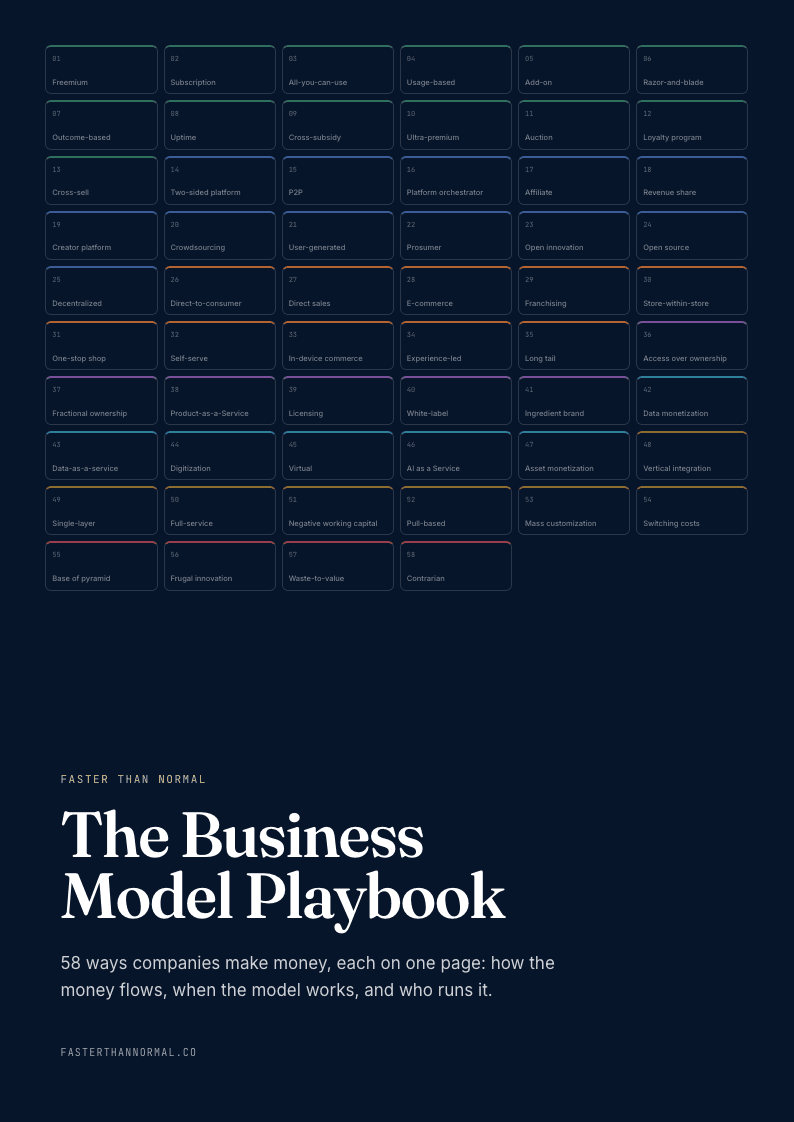
Get The Business Model Playbook
58 business models, one visual page each: how the money flows, the metrics that matter, and who runs it. Free when you join the Faster Than Normal email.
Free. No spam. Unsubscribe anytime.