

Rose Blumkin, Poliheuristic Decision Theory and Habits of Highly Effective Leaders
Rose Blumkin built Nebraska Furniture Mart from $500 in borrowed money into North America's largest furniture retailer. Warren Buffett paid $60 million for the company in 1983, calling the purchase one of his best decisions. Mrs. B, as she was known, worked until age 103 — not from necessity, but from devotion. "This is my baby," she said, "and I want to see it grow up."
Her story intersects with Fitbit's trajectory in surprising ways. Both enterprises succeeded by making the complex simple, the intimidating approachable. Both understood that execution trumps perfection every time.
The Immigrant's Algorithm
Rose Blumkin arrived in America in 1917, speaking no English, carrying no formal education. She could neither read nor write in her adopted language. Yet she could calculate complex furniture pricing in her head faster than competitors using calculators. Her business philosophy distilled into four words: "Sell cheap, tell truth."
This wasn't folksy wisdom. It was strategic positioning. While competitors loaded up on margin and marketing, Mrs. B built her advantage on operational efficiency and trust. She slept on a cot in the store. She knew every piece of inventory personally. She eliminated every cost that didn't serve the customer directly.
The formula worked because it addressed the furniture industry's core dysfunction: customers expected to be cheated. High prices, pushy salespeople, hidden fees — the entire category had trained consumers for combat. Mrs. B offered something revolutionary: transparency at scale.
Buffett recognized this immediately. "She was selling merchandise at prices competitors couldn't match, and her customers knew they could believe what she told them." The moat wasn't just low prices — it was institutional honesty in a dishonest industry.
When Perfection Becomes the Enemy
Fitbit's founders, James Park and Eric Friedman, faced a different challenge in 2007. The technology for fitness tracking existed. The market demand was clear. But the execution path was murky. They could spend years perfecting their device, or they could ship something imperfect and iterate.
They chose iteration. The first Fitbit was buggy, limited, frustrating. It barely worked. But it worked enough to prove the concept and attract early adopters who became evangelical users. Park later reflected: "We knew we had to get something out there quickly. Perfect was the enemy of shipped."
This decision pattern appears across breakthrough companies. Amazon's first website looked amateur compared to established retailers. Facebook launched only at Harvard, with features that would seem primitive today. Tesla's original Roadster had quality issues that would sink a traditional automaker.
The pattern holds because early markets reward learning speed over product polish. Fitbit's buggy first device generated user feedback that informed every subsequent iteration. By the time Apple entered the wearables market, Fitbit had accumulated millions of usage hours across hundreds of thousands of customers.
The Architecture of Simplicity
Both companies succeeded by making complex systems feel effortless to use. Mrs. B's customers never saw the intricate supplier relationships, inventory management, and cost optimization that enabled her low prices. They experienced only the outcome: quality furniture at fair prices, sold by people who wouldn't lie to them.
Fitbit transformed boring health statistics into an addictive game. Steps became points. Daily goals became achievements. Health monitoring became social competition. The underlying technology — accelerometers, wireless data transmission, battery management — disappeared behind the simple joy of hitting 10,000 steps.
This simplicity emerged from complexity, not despite it. Mrs. B's "simple" philosophy required sophisticated operations. Fitbit's "simple" interface required advanced engineering. Neither company achieved simplicity by doing less — they achieved it by hiding more.
Poliheuristic Decision Theory in Practice
Both entrepreneurs demonstrated what psychologists call poliheuristic decision-making: using mental shortcuts for initial option screening, then applying rigorous analysis to remaining choices. Mrs. B didn't evaluate every possible business model for furniture retail. She quickly eliminated high-overhead, high-margin approaches based on her instinct for what customers actually wanted. Then she optimized ruthlessly within her chosen model.
Park and Friedman followed the same pattern. They didn't analyze every possible health technology opportunity. They quickly focused on fitness tracking based on Park's personal experience with weight loss. Then they executed with venture-backed precision — raising $400,000 from friends and family, launching at TechCrunch50, securing Series A funding, scaling to IPO.
The heuristic phase feels intuitive, almost casual. The optimization phase requires systematic thinking. Most entrepreneurs get stuck in one phase or the other — either never committing to a direction, or committing without adequate analysis.
The Execution Premium
Larry Page's observation about Tesla captures the central challenge: "Invention is not enough. Tesla invented the electric power we use, but he struggled to get it out to people. You have to combine both things: invention and innovation focus, plus the company that can commercialize things and get them to people."
Mrs. B and the Fitbit founders understood this instinctively. Neither created breakthrough technology. Mrs. B sold furniture — hardly a novel concept. Fitbit tracked steps — pedometers had existed for decades. Their innovation was executional: how to deliver familiar value in unfamiliar ways.
The execution premium explains why copycat competitors rarely succeed. Competitors could observe Mrs. B's low prices and honest sales approach. They couldn't replicate the operational discipline that made those approaches sustainable. Competitors could copy Fitbit's features. They couldn't copy the years of user behavior data that made those features compelling.
Leadership Habits That Scale
Research on highly effective leaders reveals consistent patterns that both Mrs. B and Fitbit's founders demonstrated:
Time allocation discipline. Mrs. B worked until 103 not because she had to, but because she allocated her time toward her highest-impact activity: growing the business she'd built. Effective leaders protect their time allocation from drift.
Decision velocity over decision perfection. Both companies succeeded by making reversible decisions quickly and irreversible decisions carefully. Mrs. B could adjust pricing daily. She couldn't easily change her fundamental business model. Fitbit could iterate on features rapidly. They couldn't easily pivot away from fitness tracking.
Systems thinking. Neither leader optimized individual components in isolation. Mrs. B's pricing strategy only worked because of her inventory management, supplier relationships, and operational efficiency. Fitbit's social features only worked because of their data accuracy, battery life, and app design.
Authentic differentiation. Both companies built advantages around their founders' genuine strengths rather than pursuing generic "best practices." Mrs. B's immigrant work ethic and Park's personal health journey became organizational DNA.
The Question of Creative Constraint
The most interesting leaders operate with what appears to be a paradox: they're simultaneously highly disciplined and highly creative. Mrs. B's creativity emerged from her constraint — how to sell furniture cheaper than anyone else. Fitbit's innovation came from their constraint — how to make health monitoring addictive rather than annoying.
This suggests that the question "If you could spend 30 minutes today creating whatever you want, what would you create?" might be less useful than "Given your specific constraints, what's the most creative solution you could implement?"
Mrs. B didn't dream of building whatever she wanted. She dreamed of building the best furniture business within her constraints. Those constraints — limited capital, no formal education, intense competition — forced innovations that abundant resources might have prevented.
The same pattern appears across successful entrepreneurs. Jeff Bezos didn't build whatever he wanted — he built the best online bookstore, then expanded from that foundation. Steve Jobs didn't create whatever he wanted — he made computers that worked the way he thought they should work.
Unbounded creativity produces art projects. Bounded creativity produces business breakthroughs.
The convergence between Mrs. B's century-long career and Fitbit's decade-long sprint to acquisition reveals something essential about sustainable success: it emerges from the systematic application of simple principles rather than the sporadic application of complex strategies.
Both created lasting value by solving real problems for real people, then optimizing their solutions relentlessly. Both understood that execution quality matters more than idea novelty. Both built cultures that could outlast their founders — Mrs. B's principles guided Nebraska Furniture Mart decades after her death, while Fitbit's user-centric design philosophy continues within Google.
The lesson isn't to copy their specific tactics. It's to adopt their approach: identify clear principles, commit to them completely, then optimize everything else around delivering consistent value to the people who matter most.
Free playbook
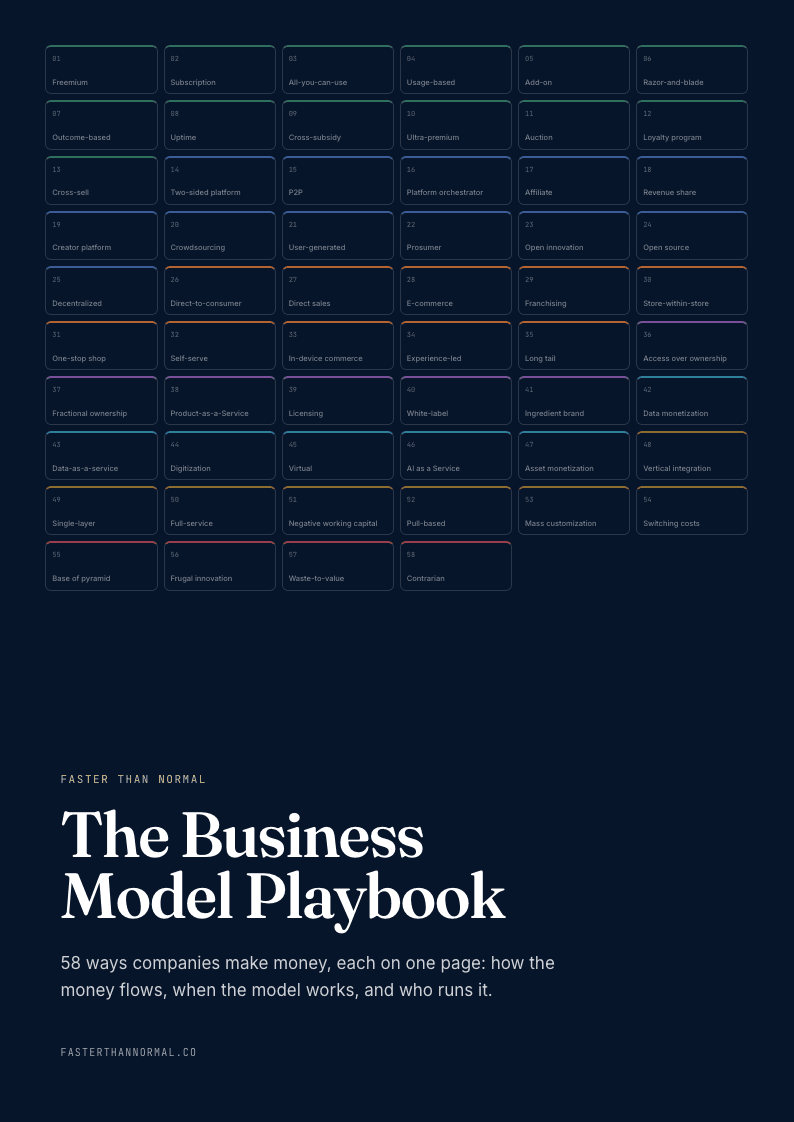
Get The Business Model Playbook
58 business models, one visual page each: how the money flows, the metrics that matter, and who runs it. Free when you join the Faster Than Normal email.
Free. No spam. Unsubscribe anytime.