

Modality Effect, Next-in-Line Effect, Placement Bias & More
Human cognition operates through predictable patterns—biases, heuristics, and mental shortcuts that shape every decision. Understanding these patterns transforms how you process information, remember experiences, and influence outcomes. This compendium examines 60 psychological mechanisms that govern thought and behavior, offering operational insights for high-performance environments.
Memory and Information Processing
Modality Effect
Mixed-mode learning—combining visual and auditory inputs—dramatically outperforms single-channel information delivery. Your working memory capacity expands when information arrives through multiple sensory pathways simultaneously. The implications are immediate: complex presentations, training programs, and knowledge transfer systems should layer visual and auditory components rather than relying on text alone.
Processing Difficulty Effect
Counterintuitively, information that requires more cognitive effort to process becomes more memorable. The brain's struggle to decode meaning creates stronger neural pathways. This challenges the conventional wisdom of simplifying everything—sometimes making your message slightly harder to parse makes it stick. The key is strategic difficulty, not confusion.
Spacing Effect
Distributed learning sessions create exponentially stronger memory retention than concentrated study periods. Cramming fails because it exploits short-term memory systems while ignoring long-term consolidation processes. Apply this to skill development, employee training, and knowledge acquisition—space repetitions over weeks rather than cramming into days.
Testing Effect
Active recall—retrieving information from memory rather than passive review—significantly improves long-term retention. This principle underlies effective flashcard systems like Anki and explains why self-testing outperforms re-reading materials. Build retrieval practice into any learning system you design or use.
Picture Superiority Effect
Images are dual-encoded in memory as both visual representations and verbal descriptions, while words receive single encoding. This creates a substantial recall advantage for visual information. For presentations, documentation, or communication strategies, supplement key points with relevant imagery rather than relying on text alone.
Verbatim Effect
People remember the gist of information—its general meaning—far better than exact wording. This has profound implications for how you structure important communications. Focus on creating memorable narratives and conceptual frameworks rather than perfect phrasing. The story survives; the syntax doesn't.
Attention and Performance Biases
Next-in-Line Effect
Recall degrades significantly for events immediately before or after a public performance. When you're mentally rehearsing your presentation or processing feedback, you're functionally blind to surrounding information. Schedule important conversations away from high-stakes performances, and don't expect team members to absorb critical information right before they present.
Von Restorff Effect
Items that "stand out like a sore thumb" achieve disproportionate attention and memory retention. In information design, meeting agendas, or strategic communications, make your most important points visually distinctive. The isolation effect works because the brain prioritizes processing unusual patterns.
Suffix Effect
Irrelevant information at the end of a sequence impairs recall of the actual final items. If you end meetings with administrative announcements, attendees will struggle to remember your closing strategic points. Structure your communications so the most important elements aren't followed by throwaway content.
Telescoping Effect
Time perception distorts systematically: recent events feel more distant than they are, while remote events seem more recent. This affects project planning, risk assessment, and performance evaluation. Build explicit timeline references into strategic planning processes rather than relying on subjective time estimates.
Social and Behavioral Psychology
Asch Negative vs. Positive
Social conformity operates along a spectrum. Asch-positive individuals follow group consensus over personal judgment; Asch-negative individuals maintain independent positions despite social pressure. Neither approach is universally superior—the key is conscious choice about when to conform and when to dissent. Most high-performers trend Asch-negative but must recognize when group wisdom exceeds individual insight.
Deindividuation
Group immersion can dissolve individual identity and personal responsibility, leading to behavior that contradicts personal values. This explains both toxic team dynamics and breakthrough collaborative sessions. The variable is consciousness—teams that explicitly discuss individual contributions and accountability avoid the negative aspects while preserving collaborative benefits.
Enclothed Cognition
Clothing systematically influences psychological states and task performance. What you wear affects how you think and act, not just how others perceive you. This extends beyond formal business attire—different clothing can enhance creativity, analytical thinking, or confidence depending on personal associations and cultural context.
Nudging
Environmental design shapes behavior more powerfully than conscious intention. Small changes in choice architecture—default options, positioning, timing—create large behavioral shifts. This applies to personal productivity systems, organizational culture, and customer experience design. The question isn't whether you're nudging; it's whether you're nudging intentionally.
Decision-Making and Reasoning
Meehl Pattern
Domain experts often underperform simple statistical models when making complex predictions. Expertise can become a liability when it leads to overthinking patterns that algorithms handle more effectively. This doesn't diminish the value of expert judgment—it defines its proper scope. Use expertise for pattern recognition and context; use data for prediction and optimization.
Protect Yourself From Bad Advice
All advice reflects the adviser's incentive structure. Before accepting recommendations from salespeople, colleagues, or consultants, map their motivations clearly. This isn't cynicism—it's operational reality. The best advisers acknowledge their incentives explicitly and help you evaluate advice accordingly.
Influence Yourself
Once you identify your primary motivational drivers—money, status, autonomy, responsibility—you can engineer environments that activate them consistently. Most people remain unconscious of their deepest motivators and wonder why willpower fails. Discover what actually drives you, then structure your work and life to trigger those motivations systematically.
Doubt/Avoidance Tendency
Stress creates pressure for rapid decisions, often leading to poor choices made simply to eliminate uncertainty. High-pressure environments demand deliberate decision-making protocols. Build systematic delays into stressful decision points—even 24 hours can dramatically improve judgment quality when anxiety is high.
Cognitive Biases and Illusions
Source Confusion
You often remember information without recalling its origin, leading to equal confidence in facts from vastly different quality sources. This creates vulnerability to misinformation and overconfidence in unreliable data. Combat this by systematically tracking information sources and updating confidence levels based on source reliability.
Illusion of Asymmetric Insight
You believe you understand others better than they understand themselves, while simultaneously believing they can't understand your complexity. This illusion impairs negotiation, team dynamics, and relationship management. Effective leaders assume others possess internal complexity they can't fully perceive.
Introspection Illusion
You believe you understand your own motivations and preferences, but research shows people routinely confabulate explanations for their emotional states and decisions. This has profound implications for self-knowledge and personal development. Trust behavioral data about yourself more than introspective analysis.
Energy and Performance Management
Ego Depletion
Willpower draws from a limited cognitive resource that depletes with use. Decision-making, self-control, and complex thinking all drain the same mental energy reserve. High-performers minimize inconsequential decisions to preserve cognitive resources for high-impact choices. This principle underlies the effectiveness of routines, systems, and automation.
Caveman Syndrome
Human psychology evolved for environments that no longer exist. We're optimized for scarcity, physical danger, and small social groups—not abundance, information overload, and complex organizations. Modern performance requires conscious adaptation to override evolutionary programming that's become counterproductive.
Performance Requirements
Physical infrastructure determines cognitive performance. Sleep, exercise, nutrition, sunlight exposure, and media consumption patterns directly impact thinking quality. Treating these as optional lifestyle choices rather than performance requirements creates unnecessary cognitive handicaps.
Perceptual Control Systems
Reference Level
Every behavioral system operates within acceptable perception ranges. When perceptions stay within these boundaries, no action occurs. When they're violated, change follows automatically. Understanding your reference levels—for income, relationships, work quality, lifestyle—explains when you'll act and when you'll remain passive.
Guiding Structure
Environmental structure shapes behavior more powerfully than conscious intention. If you want to change behavior sustainably, modify the surrounding systems rather than relying on willpower. This applies to personal habits, organizational culture, and customer behavior.
Conservation of Energy
Humans naturally avoid energy expenditure unless reference levels are violated. This explains why people remain in "good enough" situations for years without pursuing excellence. If you want to drive change—in yourself or others—you must either violate existing reference levels or establish new, higher standards.
The mind operates through predictable patterns, not random inspiration. Understanding these patterns provides operational advantage in decision-making, learning, influence, and performance optimization. The question isn't whether these biases affect you—it's whether you'll leverage them consciously or remain subject to their unconscious influence.
Free playbook
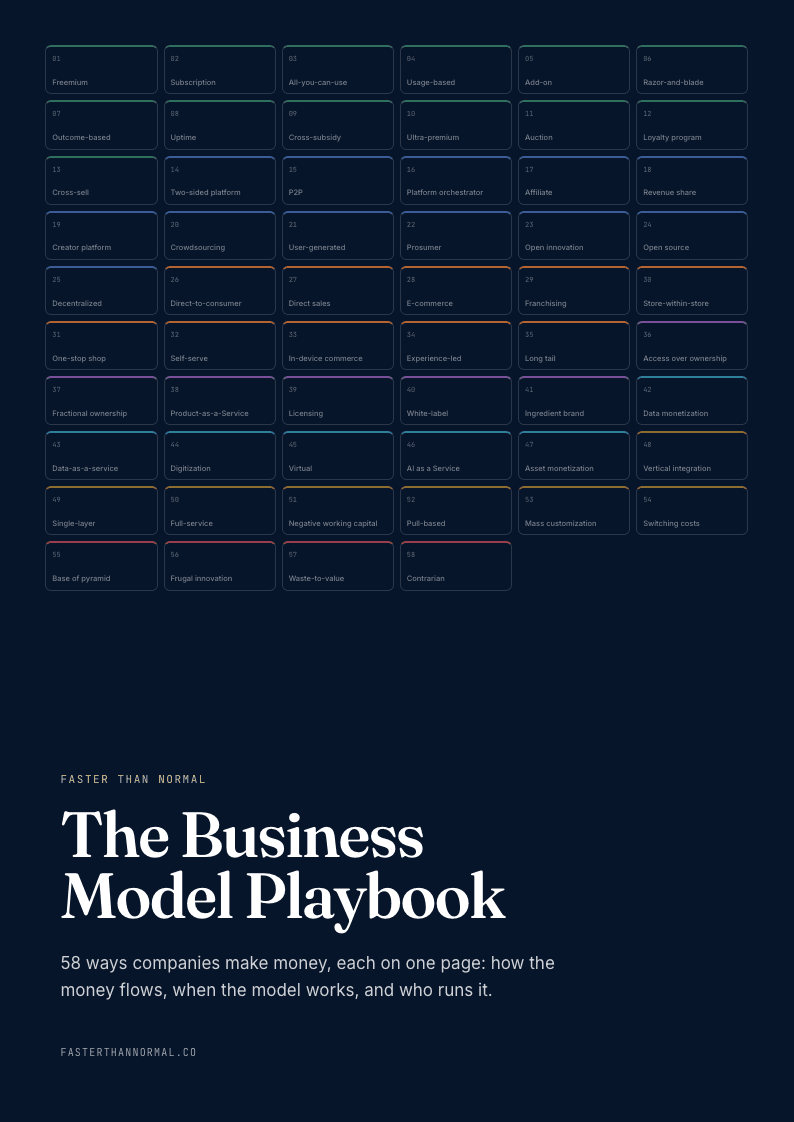
Get The Business Model Playbook
58 business models, one visual page each: how the money flows, the metrics that matter, and who runs it. Free when you join the Faster Than Normal email.
Free. No spam. Unsubscribe anytime.