

Lucille Ball, Systems Thinking and Optimizing Your Time & Energy
Lucille Ball understood something that modern entrepreneurs often miss: the highest leverage comes not from working harder, but from building systems that work without you. By 1962, she had become the first woman to run a major television production company—not through accident, but through deliberate systems thinking that transformed individual talent into institutional capability.
The Ball Method: From Performer to Producer
Ball's trajectory reveals a pattern worth studying. She didn't stumble into business success; she engineered it through what we now recognize as systems thinking. When "I Love Lucy" debuted in 1951, Ball wasn't just perfecting her physical comedy—she was observing how television production worked, identifying bottlenecks, and designing better processes.
The breakthrough came when she realized that owning the means of production mattered more than perfecting the performance. Desilu Productions became her vehicle for this insight. While other stars negotiated for higher salaries, Ball negotiated for ownership of her shows and the infrastructure to produce them. The difference compounded: higher salaries are linear income, but ownership creates exponential returns.
Her quote—"The more things you do, the more you can do"—captures the essence of systems leverage. Each capability you build becomes a platform for building the next one. Ball leveraged her comedy expertise into production knowledge, production knowledge into business acumen, business acumen into industry influence. The system reinforced itself.
Systems Thinking as Competitive Advantage
Systems thinking operates on a simple premise: most problems are symptoms of underlying structures, not isolated events. Change the structure, and you change the outcomes systematically rather than sporadically.
Consider how this applies to your business. Revenue problems are rarely about sales technique—they're usually about lead generation systems, customer onboarding processes, or retention mechanics. Productivity problems aren't about individual effort; they're about workflow design, information architecture, and decision-making protocols.
The highest-performing individuals and organizations share this characteristic: they spend more time working on their systems than in them. Ball exemplified this. Rather than just being a better comedian, she built better production systems. Rather than negotiating better contracts, she created the infrastructure to own the entire value chain.
Three Levels of Systems Intervention
Level 1: Process optimization. Most people stop here. They improve existing workflows—faster email responses, better meeting agendas, more efficient task management. Valuable, but limited. This is about doing the same things better.
Level 2: Structural redesign. This is where leverage multiplies. You change how work flows through the organization, how decisions get made, how information moves. Ball operated at this level when she redesigned television production around ownership rather than talent contracts.
Level 3: Mental model transformation. The deepest intervention. You change the fundamental assumptions that shape how people think about the work itself. Ball did this by reframing television from entertainment to content production infrastructure.
The Novartis Case Study: Systems at Scale
Novartis demonstrates systems thinking in a different context. When the company formed through the 1996 merger of Ciba-Geigy and Sandoz, it wasn't just combining two pharmaceutical businesses—it was designing a new system for drug discovery and development.
Their approach reveals three systems principles worth emulating:
Strategic positioning through systems design. Rather than competing in crowded therapeutic areas, Novartis built systems optimized for rare diseases and gene therapies. This wasn't just market positioning; it was systems architecture. They developed research platforms, regulatory expertise, and commercial capabilities specifically for small patient populations with high unmet needs. The system itself became the competitive advantage.
Acquisition as capability integration. Most companies buy products or market access. Novartis buys systems. When they acquired smaller biotech companies, they weren't just purchasing drug candidates—they were integrating research platforms, technological capabilities, and specialized knowledge systems. Each acquisition strengthened the overall innovation system rather than just adding isolated assets.
Cultural systems for innovation. Their "unbossed" leadership model isn't management philosophy—it's systems design. By flattening hierarchies and distributing decision-making authority, they created a system where information flows faster and innovation emerges from multiple nodes rather than centralized command. Former CEO Joe Jimenez's insight—"We want to create an environment where people feel empowered to speak up"—describes a feedback system, not just a cultural value.
Optimizing Your Personal Operating System
The same principles apply to individual performance. Your time and energy are finite resources flowing through personal systems. Most optimization efforts focus on efficiency—better time management, productivity apps, workflow improvements. But the highest leverage comes from systems redesign.
Energy Architecture
Map your energy patterns across different types of work. Most people have 2-4 hours of peak cognitive performance daily, yet they spend this time on low-leverage activities—email, meetings, administrative tasks. The systems solution: redesign your daily architecture to align high-energy periods with high-leverage work.
This requires infrastructure changes, not just scheduling. You need systems that automatically handle routine decisions, capture and organize information, and batch similar activities. The goal isn't to be more disciplined; it's to design systems where the right behaviors happen by default.
Compound Benefits Framework
The most powerful systems create compound benefits—outcomes that build on themselves over time. This explains why some people seem to accelerate their results while others plateau despite similar effort.
Consider the question: "What can I do today that will make life easier ten years from now?" The answers usually involve building systems: developing expertise that compounds, creating assets that generate ongoing returns, or establishing relationships that strengthen over time.
Ball understood this intuitively. Every system she built at Desilu didn't just solve immediate problems—it created capabilities that enabled future opportunities. The production infrastructure she developed for "I Love Lucy" became the foundation for producing other shows, which generated the cash flow and expertise to expand further.
The Art of Making Art
Neil Gaiman's reflection on creative work reveals another systems principle: authenticity as sustainable competitive advantage. "The one thing that you have that nobody else has is you. Your voice, your mind, your story, your vision."
This isn't motivational advice—it's systems strategy. In any competitive field, sustainable advantage comes from building systems around your unique capabilities rather than trying to optimize generic best practices. The system should amplify what only you can do while systematizing everything else.
Gaiman's insight about uncertainty—"The things I've done that worked the best were the things I was the least certain about"—captures something crucial about systems design. The most powerful systems often feel risky because they're optimized for your specific context rather than proven templates. But that's exactly what makes them defensible.
Systems thinking isn't about complexity—it's about seeing the structures that create results, then designing better structures. Ball didn't become a television mogul through superior acting; she built systems that transformed individual talent into institutional capability. Novartis doesn't dominate rare disease markets through better science alone; they built systems optimized for that specific competitive landscape.
The opportunity is to apply this same thinking to your own work. Most people optimize for immediate efficiency. Systems thinkers optimize for long-term capability building. The difference compounds exponentially over time.
Free playbook
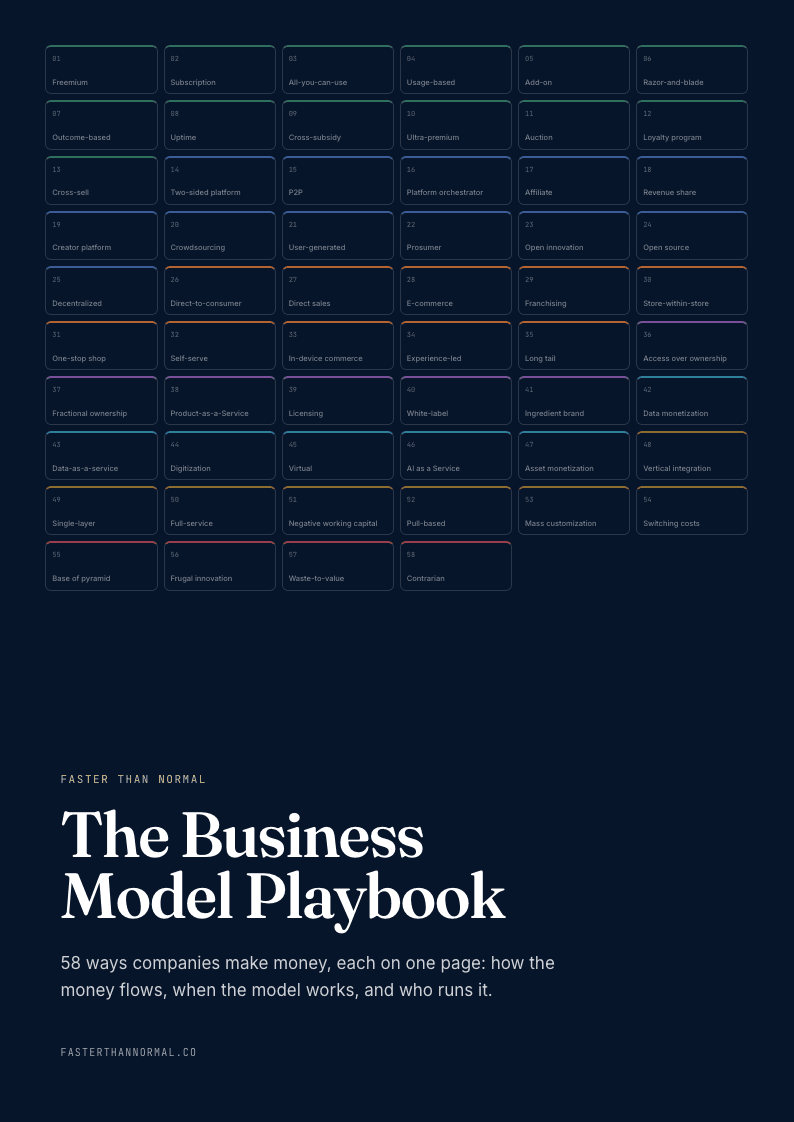
Get The Business Model Playbook
58 business models, one visual page each: how the money flows, the metrics that matter, and who runs it. Free when you join the Faster Than Normal email.
Free. No spam. Unsubscribe anytime.