

Kiran Mazumdar-Shaw, The Common Denominator Of Success and Thorough Year-End Review
In 1978, at twenty-five, Kiran Mazumdar-Shaw stood in a 3,000-square-foot garage in Bangalore holding a rejection letter from every bank in the city. The daughter of a brewmaster and a former biocon trainee at the University of Melbourne, she had returned to India with $500 and a plan to commercialize industrial enzymes — a field so niche that local financiers couldn't distinguish it from witchcraft. "You're a woman, you're not a qualified engineer, and this is a high-risk business," they told her, as though these three facts formed a syllogism against success.
What they missed — what most people miss when assessing entrepreneurs at the moment of inception — was the operational intensity behind her composure. Mazumdar-Shaw didn't brood over the rejections. She converted the garage into a laboratory, hired a retired brewery chemist, and began producing enzymes for the textile and food industries. The work was methodical: sourcing bacterial cultures, optimizing fermentation processes, packaging products in containers scrounged from local suppliers. Within a year, Biocon was profitable.
The Architecture of Vertical Integration
The enzyme business taught Mazumdar-Shaw something essential about biotechnology: the difference between having a good product and controlling the entire value chain. By the early 1990s, Biocon was generating steady revenues, but the margins were thin, the market fragmented. Western competitors with deeper pockets could undercut Indian suppliers overnight. The smart move — the conventional move — would have been to scale horizontally, capturing more of the existing enzyme market.
Instead, Mazumdar-Shaw pivoted into biopharmaceuticals. Where enzymes required weeks of fermentation, biologics demanded years of clinical trials. Where enzyme customers were price-sensitive textile manufacturers, pharmaceutical customers were patent-protected global giants with billion-dollar budgets. The capital requirements were exponentially higher, the regulatory hurdles byzantine, the competition entrenched.
— Kiran Mazumdar-ShawI believe that entrepreneurship is about being able to face failure, manage failure and succeed after failing.
The logic was counterintuitive but sound: biologics weren't just higher-margin products, they were intellectual property moats. A successful insulin biosimilar could generate revenue for decades while competitors spent years replicating the manufacturing process. Biocon began developing biosimilar versions of expensive drugs like insulin and monoclonal antibodies — generic versions of biologic medicines that offered the same efficacy at fraction of the cost.
The strategy required rebuilding the company from substrate up. New manufacturing facilities designed to FDA and European standards. New quality systems that could pass inspections from regulators who had never heard of Bangalore. New partnerships with hospitals and distributors who viewed Indian pharmaceuticals with institutional skepticism.
Going Public When Nobody Expected It
By 2004, Biocon had transformed from a garage-based enzyme supplier to a vertically integrated biopharmaceutical manufacturer with proprietary drug development capabilities. The IPO that year wasn't just successful — it was oversubscribed by a factor of 33, with shares pricing at the top of the range. Mazumdar-Shaw became India's richest woman practically overnight.
The market response revealed something deeper than investor enthusiasm: it reflected the emergence of Indian biotechnology as a legitimate competitor to Western pharmaceutical companies. Biocon wasn't just copying existing drugs at lower prices (though it was doing that). It was developing novel compounds, conducting clinical trials, and building the regulatory infrastructure to compete in the world's most heavily regulated industry.
The company's insulin biosimilar program exemplified this evolution. Rather than simply reverse-engineering Eli Lilly's Humalog, Biocon developed its own recombinant human insulin using proprietary fermentation processes. The result was a product that met international quality standards while selling at a fraction of the Western price — a combination that made insulin accessible to millions of diabetic patients who had been priced out of treatment.
The Philanthropic Logic of Market Creation
What distinguishes Mazumdar-Shaw from most pharmaceutical executives isn't just the scale of her success but the integration of profit motive with public health outcomes. Biocon's business model — producing high-quality biologics at dramatically lower prices — naturally aligns with improving healthcare access in emerging markets. This isn't corporate social responsibility layered onto a traditional business; it's a business model where social impact is integral to competitive advantage.
— Kiran Mazumdar-ShawI want to be remembered for making a difference in global healthcare.
The company's current valuation exceeds $4 billion, but the more interesting metric might be the number of patients who can now afford previously inaccessible treatments. Biocon's insulin reaches diabetic patients across Asia, Africa, and Latin America — markets that Western pharmaceutical companies had largely written off as commercially unviable.
Mazumdar-Shaw's approach to leadership reflects this same integration of pragmatism and idealism. She treats Biocon's 11,000 employees not as interchangeable resources but as stakeholders in a mission that transcends quarterly earnings. "I think, in terms of corporate philosophy, I've always believed that you've got to treat people in a very, very egalitarian manner," she says. This isn't management consulting speak — it's operational doctrine at a company where scientific breakthroughs depend on collaboration between PhDs and lab technicians, regulatory experts and manufacturing specialists.
The result is an organization that functions more like a research university than a traditional pharmaceutical company. Ideas flow upward from bench scientists. Cross-functional teams work on multi-year projects without rigid hierarchical oversight. The culture rewards intellectual curiosity and calculated risk-taking — traits that happen to be essential for competing in an industry where product development cycles stretch across decades.
Sephora and the Revolution in Beauty Retail
In 1970, Dominique Mandonnaud opened the first Sephora store in Limoges, France, with a radical proposition: let customers touch the merchandise. For decades, cosmetics retail had been built around the department store model — products locked behind glass counters, accessible only through sales associates who controlled every interaction. Customers pointed at items they wanted to examine; salespeople decided what they were allowed to try.
Mandonnaud, a former perfume retailer, understood that this model was optimized for the convenience of retailers, not the experience of customers. Sephora's open-sell environment invited customers to experiment, compare products side by side, and make purchasing decisions based on direct sensory experience rather than sales presentations. "We created a candy store for beauty," Mandonnaud says — a description that captures both the playful aesthetics and the fundamentally different relationship between customer and product.
The model worked because it aligned business incentives with customer psychology. Customers who could test products extensively were more likely to find items that actually worked for them, reducing returns and increasing satisfaction. The self-service format reduced labor costs while increasing inventory turnover. Most importantly, the open environment encouraged impulse purchases and cross-category exploration — customers who came for lipstick left with skincare, fragrance, and tools.
When LVMH acquired Sephora for $262 million in 1997, the company was generating strong revenues but remained largely confined to the French market. The expansion into the United States in 1998 — starting with a flagship store in New York City — tested whether the open-sell concept could translate across cultures and retail environments.
Omnichannel Integration Before It Had a Name
Under CEO Christopher de Lapuente, who joined in 2011, Sephora pioneered what would later be called omnichannel retail — the seamless integration of online and offline shopping experiences. But rather than treating digital as a separate channel, Sephora used technology to enhance the physical retail experience that had always been its competitive advantage.
The company's mobile app, launched in 2010, functions as an extension of the in-store experience rather than a replacement for it. Customers can scan barcodes to read reviews and compare products. They can access their purchase history and loyalty points. They can reserve products for in-store pickup or schedule consultations with beauty advisors.
— Mary Beth LaughtonWe don't think in channels. We think in customer journeys.
The Beauty Insider loyalty program, launched in 2007, exemplifies this integration. Points earned online can be redeemed in stores. Products tried in stores can be purchased online. Beauty classes offered in physical locations are supplemented by video content and tutorials accessible through the app. The program now has over 25 million active members — a customer database that would be the envy of any retailer.
What makes this integration genuinely valuable rather than merely convenient is the feedback loop between online and offline behavior. Sephora's data scientists can identify which products customers research online but purchase in stores (typically items where texture or color matching is crucial) versus which products they're comfortable buying sight unseen (replenishment purchases of familiar brands). This intelligence informs inventory allocation, store layout, and digital marketing spend.
The financial results reflect the effectiveness of this approach: Sephora's global revenues reached €5.2 billion in 2020, distributed across 2,700 stores in 35 countries. But the more telling metric might be customer lifetime value — Beauty Insider members spend significantly more per transaction and shop more frequently than non-members, suggesting that the omnichannel experience creates genuine loyalty rather than mere convenience.
The Common Denominator Albert Gray Discovered
In 1940, speaking to an audience of insurance salesmen in Philadelphia, Albert Gray articulated what he called "the common denominator of success" — a principle so fundamental that it applies across industries, centuries, and economic systems. Gray had spent years studying the habits of successful people, looking for the thread that connected high performers regardless of their background, education, or natural talent.
His conclusion was both simple and psychologically demanding: "The common denominator of success — the secret of success of every man who has ever been successful — lies in the fact that he formed the habit of doing things that failures don't like to do."
This wasn't about working harder or longer hours. It was about the willingness to consistently perform tasks that produce results but feel uncomfortable in the moment. Cold calls that might result in rejection. Practice sessions that expose weaknesses. Difficult conversations that might damage relationships. Financial planning that requires confronting uncertainty.
Gray illustrated the principle through the story of a young man whose motivation was entirely emotional: providing his children with educational opportunities he had been denied, giving his wife comforts that his own mother never enjoyed. "There's no inspiration in logic," the man told Gray. "There's no courage in logic. There's not even happiness in logic. There's only satisfaction."
The insight cuts against conventional wisdom about motivation and discipline. Most self-help literature assumes that successful people enjoy the activities that make them successful, or that they've developed superior willpower that makes difficult tasks feel easy. Gray argued the opposite: successful people feel the same resistance to unpleasant tasks as everyone else. They simply act despite the resistance rather than being controlled by it.
This willingness to act counter to immediate emotional impulses — to make sales calls when feeling rejected, to save money when wanting to spend, to practice skills when feeling discouraged — creates compound advantages over time. Each individual action might feel insignificant, but the cumulative effect of consistently choosing long-term benefit over short-term comfort produces exponential returns.
How Schools Systematically Eliminate Creativity
Sir Ken Robinson's 2006 TED talk "Do Schools Kill Creativity?" remains one of the platform's most-watched presentations, but its central argument has become more relevant as the economy increasingly rewards creative problem-solving over rote execution. Robinson's thesis isn't simply that schools fail to nurture creativity — it's that they actively suppress it through institutional structures that prioritize conformity, risk aversion, and narrow definitions of intelligence.
The evidence is architectural: visit any school and observe the hierarchy of subjects. Mathematics and languages at the top, sciences and humanities in the middle, arts at the bottom. Within the arts, music and visual art receive more funding and attention than drama and dance. The implicit message to students is clear — some forms of human intelligence matter more than others.
Robinson traces this hierarchy to the industrial origins of public education. Mass schooling emerged in the 19th century to meet the needs of factories that required workers capable of following instructions, arriving on time, and performing repetitive tasks without complaint. The system wasn't designed to cultivate innovation; it was designed to produce industrial compliance.
"Our education system is predicated on the idea of academic ability," Robinson observes. "And there's a reason. The whole system of public education around the world is a protracted process of university entrance. And the consequence is that many highly-talented, brilliant, creative people think they're not, because the thing they were good at at school wasn't valued, or was actually stigmatized."
The psychological damage isn't just individual — it's economic. As automation eliminates routine cognitive work, the skills that schools systematically undervalue (creativity, emotional intelligence, interdisciplinary thinking) become the primary sources of competitive advantage in the modern economy.
— Sir Ken RobinsonIf you were to visit education, as an alien, and say 'What's it for, public education?' I think you'd have to conclude the whole purpose of public education throughout the world is to produce university professors.
Robinson's critique extends beyond curriculum to pedagogy. Traditional teaching methods — lecture, memorization, standardized testing — train students to consume information passively rather than create knowledge actively. The students who succeed in this system aren't necessarily the most intelligent; they're the most compliant. They've learned to suppress curiosity, avoid mistakes, and optimize for external validation rather than intrinsic satisfaction.
The irony is that these same institutions claim to prepare students for a future that will reward exactly the qualities they systematically eliminate: the ability to ask questions that haven't been asked, to combine ideas from different disciplines, to persist through failure without external validation, to recognize patterns that aren't immediately obvious.
The solution isn't to eliminate schools but to redesign them around principles that acknowledge the full spectrum of human intelligence. This means creating environments where mistakes are treated as learning opportunities rather than failures, where students can pursue interests that don't fit traditional academic categories, where success is measured by growth rather than compliance.
Free playbook
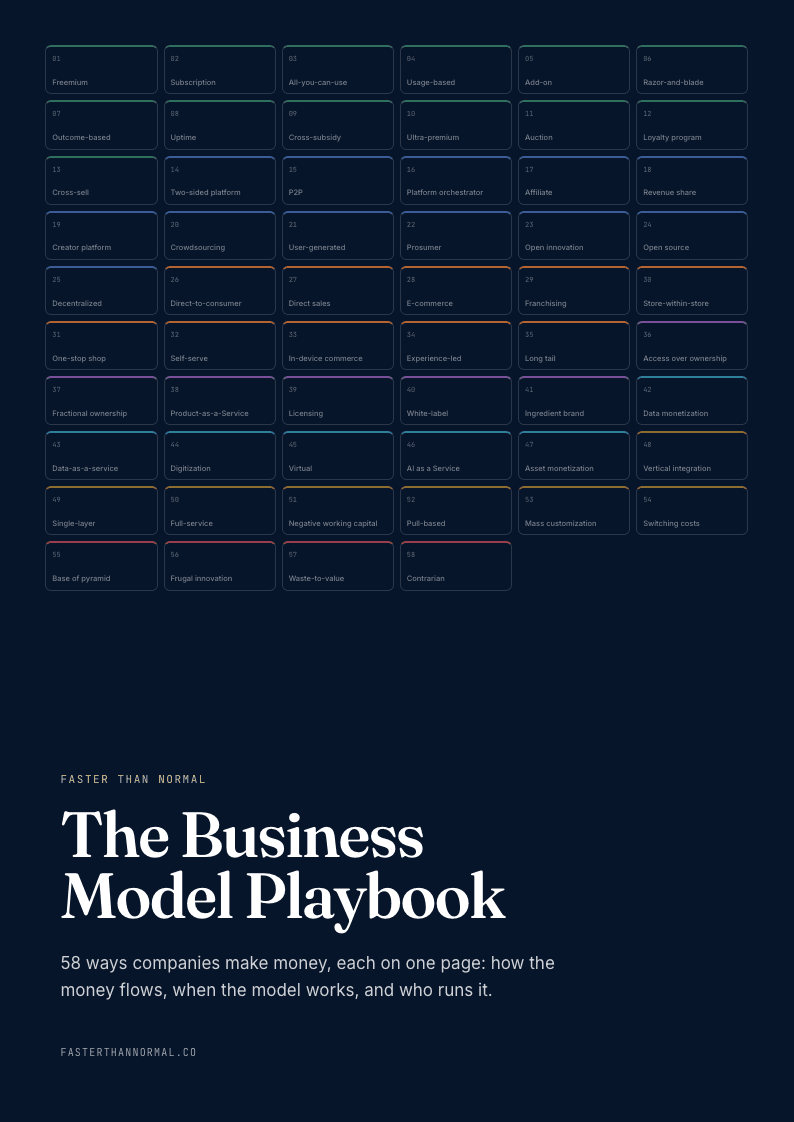
Get The Business Model Playbook
58 business models, one visual page each: how the money flows, the metrics that matter, and who runs it. Free when you join the Faster Than Normal email.
Free. No spam. Unsubscribe anytime.