

Karen Lynch, 6 Ways To Make Faster Decisions and Prolific Reader's Habits
Karen Lynch understands the brutal mathematics of creative work. The New York Times and USA Today bestselling author, known for her urban fantasy series Relentless, completed her first full-length novel at fourteen but has accepted an uncomfortable truth: "I'm a slow writer, but I don't have to like it." One book per year. That's her sustainable pace in an industry that rewards speed.
Lynch's trajectory from Newfoundland folklore to Charlotte-based literary success illustrates a counterintuitive principle—velocity isn't always about acceleration. Her German Shepherds keep her company during long writing sessions, and she bakes between chapters. The process matters more than the timeline.
The same tension between speed and sustainability shaped one of history's most contentious corporate rivalries.
The Brothers Who Split an Empire
Puma emerged from perhaps business history's most expensive family feud. Rudolf Dassler founded the company in 1948 after splitting from his brother Adolf, who established Adidas. The brothers had operated Gebrüder Dassler Schuhfabrik together until their relationship fractured beyond repair, dividing not just a business but the entire town of Herzogenaurach, Germany.
Rudolf's first move was tactical brilliance disguised as necessity. He couldn't compete on manufacturing scale—Adidas had captured that advantage. Instead, he focused on guerrilla marketing and unconventional sponsorship opportunities. When Tommie Smith raised a Puma Suede during his 1968 Olympic protest, the image became more powerful than any paid advertisement. The loophole in sponsorship rules became a cultural moment.
Puma's expansion into African football markets preceded the continent's emergence as a global talent pipeline by decades. The company understood that sports transcend borders before "global brand" became a consulting cliche. By 2022, annual revenues exceeded €9 billion—built on the foundation of a family argument that refused to resolve.
Six Mechanisms for Faster Decisions
Decision velocity separates high-performing operators from those who optimize for comfort. The framework below eliminates analysis paralysis without sacrificing judgment:
Time-Box Every Choice
Set artificial deadlines for decisions based on reversibility. Reversible decisions get 24 hours maximum. Irreversible decisions get proportional time but never exceed two weeks. The deadline forces clarity on what information actually matters versus what feels comprehensive.
Default to Action
When facing uncertainty, bias toward the choice that generates the most learning per dollar spent. Testing beats theorizing. Small experiments reveal market truth faster than extensive planning.
Use the 10-10-10 Rule
How will you feel about this decision in 10 minutes, 10 months, and 10 years? Most decisions that feel momentous in the present shrink dramatically over longer time horizons. This perspective shift eliminates false urgency.
Identify Your Limiting Factor
Every decision has one constraint that matters more than others—time, money, talent, or attention. Solve for the limiting factor first. Everything else is optimization theater.
Separate Reversible from Irreversible
Jeff Bezos's Type 1 and Type 2 decision framework remains the gold standard. One-way doors require careful deliberation. Two-way doors require speed. Most decisions are two-way doors disguised as one-way doors by overthinking.
Set Decision Criteria Upfront
Before gathering information, define exactly what conditions will trigger a "yes" or "no." This prevents moving goalposts and anchoring bias from contaminating your judgment.
Learning How to Learn
Richard Hamming spent his career solving problems others considered unsolvable. His insight on personal development cuts through decades of self-help abstraction:
"The struggle to success is what makes you what you will be. Remember, you all age, you have to live with yourself. There's no escaping living with yourself. Consider the kind of person you wish to be in your old age and start now being that kind of person."
Hamming understood that achievement generates temporary satisfaction, but the capability built during the struggle compounds indefinitely. The mathematician who cracked the Hamming Code didn't focus on the solution—he focused on becoming the type of person who could see solutions others missed.
The Prolific Reader's System
Reading volume doesn't equal comprehension, but systematic consumption creates pattern recognition that casual readers never develop. The most effective readers operate more like intelligence analysts than literature students.
Triage ruthlessly. Scan articles in 30 seconds to determine reading priority. Most content reveals its core argument in the first three paragraphs. Everything after that is either evidence or elaboration.
Read in clusters. Group similar topics together rather than jumping between subjects. Reading five articles about semiconductor supply chains in one session creates connections that reading them across five days cannot.
Extract immediately. Capture insights within 24 hours or lose them permanently. The brain's consolidation process requires active engagement, not passive consumption.
Connect to existing frameworks. Every new piece of information either confirms, refutes, or expands something you already believe. Make those connections explicit.
The goal isn't to read everything. The goal is to develop judgment that lets you identify the 20% of content that contains 80% of the actionable insight.
Digital Hygiene and Attention Architecture
Technology companies engineer products to capture attention, not optimize it. The result is cognitive infrastructure designed for their benefit, not yours. Reclaiming focus requires the same intentionality that companies apply to destroying it.
Attention spans haven't shortened—they've been systematically fragmented by notification systems and algorithmic feeds designed to maximize engagement time. The solution isn't willpower. The solution is better systems.
Create information diets. Just as you wouldn't eat every available food, don't consume every available information stream. Curate inputs based on their contribution to your specific objectives.
Use batch processing. Check email and social media at predetermined times rather than responding to every ping. Interrupt-driven work patterns prevent deep thinking.
Design friction. Make destructive behaviors slightly more difficult and productive behaviors slightly easier. The cumulative effect of small environmental changes exceeds the impact of major willpower interventions.
What core benefit are you delivering to your customers? This question cuts through feature lists, competitive positioning, and market research to expose the fundamental value exchange that determines whether your business survives or thrives.
Most companies can articulate what they do. Few can clearly state why it matters to the people paying them.
Free playbook
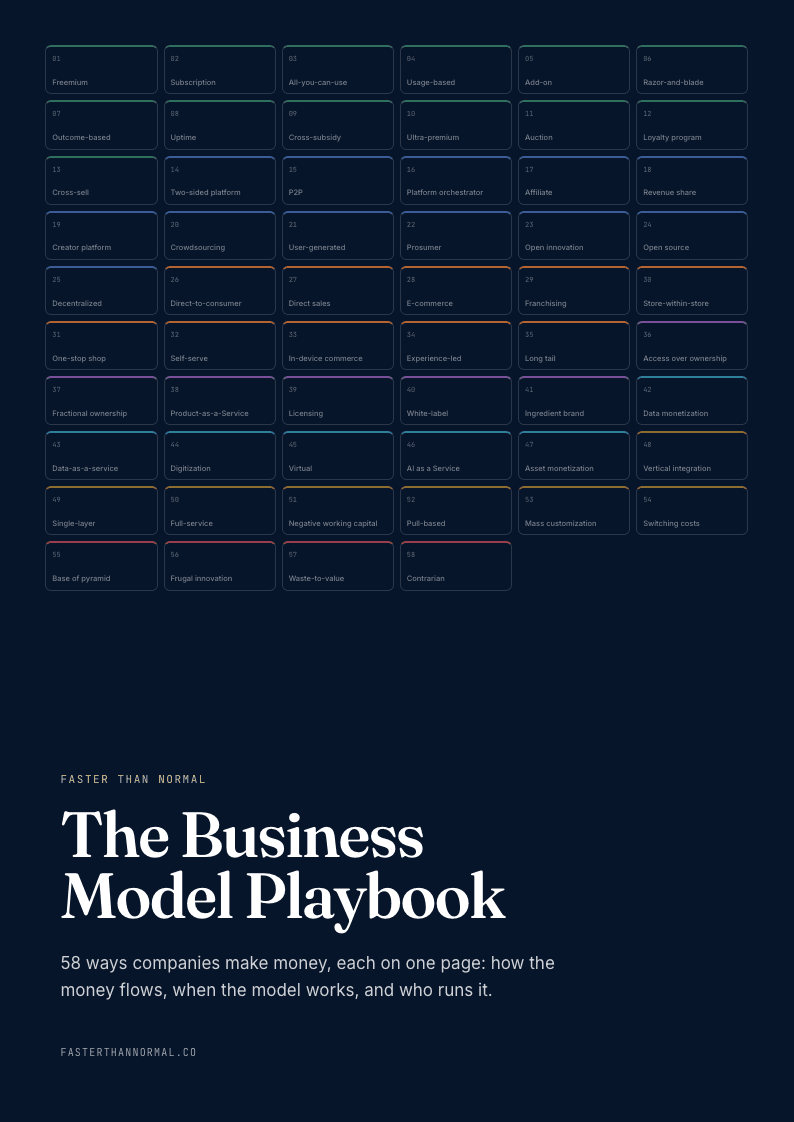
Get The Business Model Playbook
58 business models, one visual page each: how the money flows, the metrics that matter, and who runs it. Free when you join the Faster Than Normal email.
Free. No spam. Unsubscribe anytime.