

Judy Sheindlin, 9 Critical Thinking Behaviours and Streamlining Your Home With Technology
Judge Judy built her empire with three simple rules: spot the lie, cut through the noise, make a decision. At 81, she still arbitrates cases on "Judy Justice," proving that clarity of thought beats complexity every time.
Her approach to critical thinking mirrors what separates high-performers from the pack. Real analysis isn't about gathering endless data or impressing others with your process. It's about seeing what others miss and acting on it.
The Judge Who Broke Television
Judith Susan Sheindlin graduated as the only woman in her New York Law School class in 1965. She became a family court judge in 1982, where her reputation for swift, no-nonsense rulings caught the attention of television producers. "I was tougher than nails," she recalls of her courtroom tenure.
In 1996, Sheindlin launched "Judge Judy," which ran for 25 seasons and redefined daytime television. The show's appeal wasn't just entertainment—it was witnessing pure judicial efficiency. As author Brendan I. Koerner explains: "They get to see wrongdoers publicly humiliated by a strong authority figure."
Her method was deceptively simple. Listen to both sides. Identify who's lying. Rule accordingly. No deliberation, no second-guessing, no committee decisions. The average case took four minutes to resolve.
This streamlined approach generated massive returns. At her peak, Sheindlin earned $47 million annually, making her the highest-paid television personality. Her production company retained ownership of all episodes, creating a syndication goldmine worth hundreds of millions.
The lesson isn't about television—it's about decision architecture. Sheindlin understood that most disputes have obvious solutions once you strip away the emotional noise. Her catchphrase captures this perfectly: "Don't pee on my leg and tell me it's raining."
Panasonic's 107-Year Innovation Machine
While Sheindlin mastered individual decision-making, Panasonic built systems for organizational intelligence. Founded in 1918 by Konosuke Matsushita, the company started with duplex lamp sockets and grew into a $65 billion global enterprise employing 240,000 people.
Matsushita's breakthrough wasn't technological—it was structural. He created the "Proposal System," allowing any employee to submit ideas for new products or improvements. This wasn't suggestion box theater. Ideas were evaluated quickly, implementers were rewarded, and the best concepts reached market within months.
The results speak to the power of distributed intelligence. Panasonic survived World War II, Japan's economic collapse, and multiple technology transitions by tapping the collective problem-solving capacity of its entire workforce. As one executive noted: "Innovation is not just for R&D. It's everyone's job."
This principle extends beyond manufacturing. The highest-performing organizations treat critical thinking as a company-wide competency, not a leadership privilege. They create systems that surface insights from the edge, process them quickly, and act on the best ones immediately.
Nine Critical Thinking Behaviors That Matter
Most critical thinking frameworks are academic exercises—interesting in theory, useless under pressure. The behaviors that actually drive superior decisions are simpler and more actionable:
1. Question assumptions, especially your own. The most dangerous beliefs are the ones you never examine. Start every analysis by listing what you're assuming to be true.
2. Seek disconfirming evidence. Your brain wants to confirm what you already believe. Force it to look for data that proves you wrong.
3. Consider multiple perspectives. The person closest to a problem often sees it least clearly. Get input from people with different stakes in the outcome.
4. Distinguish correlation from causation. Two things happening together doesn't mean one caused the other. Look for actual causal mechanisms.
5. Identify your emotional investment. Strong feelings cloud judgment. Acknowledge when you want something to be true versus knowing it's true.
6. Use base rates. Individual cases feel unique, but patterns repeat. What usually happens in similar situations?
7. Think in probabilities, not certainties. Most decisions involve uncertainty. Assign percentages to different outcomes instead of pretending you know for sure.
8. Consider opportunity costs. Every choice eliminates alternatives. What are you giving up by picking this option?
9. Test your reasoning. Explain your logic to someone else. If you can't make it clear, you probably don't understand it yourself.
These aren't sequential steps—they're mental habits. The best decision-makers apply them automatically, without formal process or lengthy analysis.
Neil Gaiman's Radical Clarity
Writer Neil Gaiman offers perhaps the most practical advice for navigating uncertainty: pretend to be someone who knows what they're doing, then act accordingly.
"We're in a transitional world right now," Gaiman observes. "The rules, the assumptions, the now-we're supposed to's of how you get your work seen, and what you do then, are breaking down. The gatekeepers are leaving their gates."
His solution isn't complex strategic planning—it's confident experimentation. When asked how to tackle difficult projects, he suggests: "Pretend that you were someone who could do it. Not pretend to do it, but pretend you were someone who could. She put up a notice to this effect on the studio wall, and she said it helped."
This connects to Sheindlin's approach. Both understand that overthinking often masks indecision. The goal isn't perfect analysis—it's good enough judgment, applied quickly, with confidence in your ability to course-correct.
Technology as Thinking Tool
The best critical thinkers understand that intelligence isn't just mental—it's environmental. They optimize their physical and digital spaces to support clear reasoning.
Julian Shapiro's home automation system exemplifies this principle. Rather than adding complexity, his setup eliminates decision fatigue. Lights adjust automatically throughout the day. Temperature regulates itself. Security systems activate without input. These micro-optimizations preserve cognitive resources for decisions that actually matter.
The same logic applies to information systems. Nick Crocker's time-tracking method provides precise data about how attention gets allocated. This isn't productivity theater—it's creating feedback loops that expose the gap between intended and actual behavior.
The pattern is consistent: high-performers reduce cognitive overhead wherever possible, then apply their full mental capacity to problems that can't be automated or systematized.
The Action Question
Critical thinking without action is just elaborate procrastination. The most important question isn't "What should I think?" but "What should I do?"
Consider this month's challenge: What can you build in the next 30 days to finish the year with momentum? The question forces you to move from analysis to implementation, from considering options to committing to one.
Judge Judy's television empire started with a single decision: take the show offer and trust her judgment. Matsushita's business began with a commitment to manufacturing lamp sockets, despite having no factory or capital. Both understood that perfect information is impossible, but informed action is always available.
The goal isn't to think better—it's to think clearly enough to act decisively. Everything else is just sophisticated stalling.
Free playbook
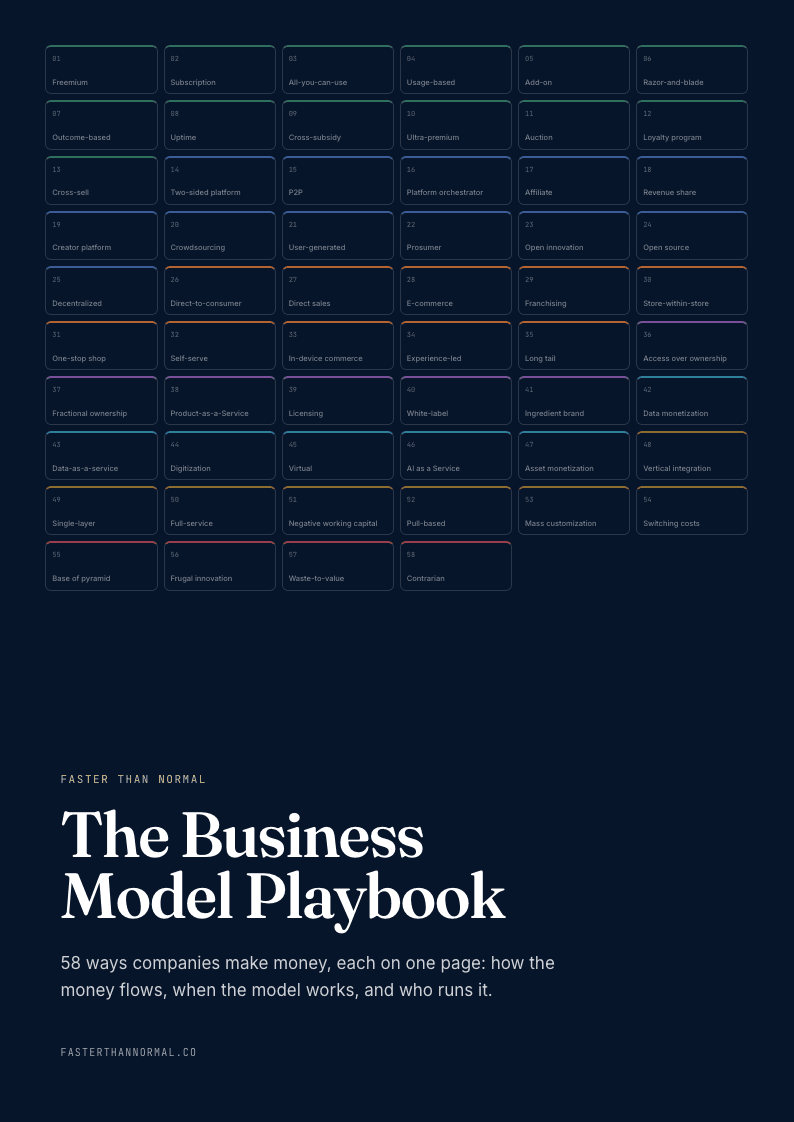
Get The Business Model Playbook
58 business models, one visual page each: how the money flows, the metrics that matter, and who runs it. Free when you join the Faster Than Normal email.
Free. No spam. Unsubscribe anytime.