

Johnelle Hunt, How To Find Your Purpose In Life and Systematic Approaches To Problem-Solving
Johnelle Hunt built one of North America's largest transportation empires with five trucks, a sharp pencil, and the conviction that every penny mattered. Monster Energy captured a third of the American energy drink market by going where Red Bull wouldn't: the extreme sports periphery where young men gathered to watch other young men defy gravity. Both stories reveal the same truth — excellence emerges not from grand strategies, but from disciplined execution of simple principles.
The Logistics Empire Built on Prudence
Johnelle Hunt co-founded J.B. Hunt Transport Services in 1961 with her husband in Heber Springs, Arkansas. Their initial fleet: five trucks and seven refrigerated trailers. By the time J.B. died in 2006, their company had become one of the largest transportation logistics operations in North America. Johnelle, managing books and office operations while her husband handled the road, became the largest individual shareholder.
"We were careful with our money. Every penny counted, especially in the early days," Hunt reflected. That financial discipline — tracking cash flow obsessively, reinvesting profits systematically — compounded over decades into market dominance.
The Hunt approach contained no revolutionary insights about logistics or transportation. They simply executed the fundamentals with religious consistency: treat customers right, manage cash carefully, grow deliberately. "Treat your customers right, and they'll keep coming back. It's as simple as that."
Simple, perhaps. But simplicity executed flawlessly over 45 years creates something that looks suspiciously like genius in retrospect.
Monster's Distribution Gambit
Monster Energy launched in 2002 with Rodney Sacks and Hilton Schlosberg targeting the space Red Bull had deliberately avoided: young male consumers who associated energy drinks with extreme sports, not Austrian sophistication. The brand identity was aggressive, edgy, unapologetically masculine. More importantly, Monster's distribution strategy was surgical.
Rather than compete with Red Bull on traditional advertising, Monster sponsored extreme sports events and athletes directly. They understood their target audience's interests and embedded the brand within those spaces. By 2012, Monster had captured 35% of the U.S. energy drink market.
But the critical moves were distribution partnerships. Monster's 2006 deal with Anheuser-Busch provided access to a vast retail network overnight. The 2015 switch to Coca-Cola — which acquired a 16.7% stake for $2.15 billion — delivered global reach without requiring massive infrastructure investment. As of 2025, Monster holds 30.1% of the American energy drink market with $7 billion in annual net sales.
The pattern is instructive: identify an underserved audience, immerse your brand in their world, then leverage partnerships to scale distribution faster than you could build it yourself.
Finding Purpose Through Structured Inquiry
Most approaches to discovering life purpose begin with introspection — often the wrong starting point. Purpose emerges from the intersection of capability, passion, and market need. But identifying that intersection requires a systematic approach.
The Japanese concept of ikigai provides one framework: the convergence of what you love, what you're good at, what the world needs, and what you can be paid for. But ikigai assumes you already know these four elements. Most people don't.
A more practical approach begins with inventory:
- Track your energy levels across different activities for two weeks. What tasks leave you energized versus drained?
- Identify moments when you lose track of time. Flow states reveal natural strengths.
- List problems you notice that others seem to ignore. Unique perspective often indicates unique opportunity.
- Consider feedback you receive consistently. Others often see our strengths more clearly than we do.
Purpose isn't discovered through meditation alone. It emerges from the intersection of self-awareness and market testing. You cannot think your way to purpose — you must experiment your way there.
The Introspection Paradox
William Deresiewicz, speaking to cadets at West Point in 2009, identified a critical challenge in our connected age:
"Introspection means talking to yourself, and one of the best ways of talking to yourself is by talking to another person. One other person you can trust, one other person to whom you can unfold your soul. One other person you feel safe enough with to allow you to acknowledge things — to acknowledge things to yourself — that you otherwise can't."
The paradox: genuine introspection requires external dialogue. But our digital tools have replaced deep conversation with shallow connection. "Instead of having one or two true friends that we can sit and talk to for three hours at a time, we have 968 'friends' that we never actually talk to; instead we just bounce one-line messages off them a hundred times a day."
This fragmentation of attention doesn't just reduce our capacity for deep friendship. It eliminates the conditions necessary for self-discovery. Thinking out loud — discovering what you believe in the course of articulating it — requires sustained, patient dialogue with someone you trust completely.
The solution isn't to abandon digital tools but to intentionally create space for the kind of extended conversation that allows for genuine introspection.
Systematic Problem-Solving Frameworks
Effective problem-solving isn't intuitive. It's systematic. The most reliable approaches break complex problems into manageable components, then address each component methodically.
The OODA Loop, developed by military strategist John Boyd, provides one framework:
- Observe: Gather information about the current situation
- Orient: Analyze and synthesize the information within your existing mental models
- Decide: Determine the best course of action
- Act: Implement the decision
The key insight: speed through the loop matters more than perfection at any single step. Rapid iteration beats slow optimization.
First Principles Thinking offers another approach:
- Break down the problem to its fundamental elements
- Challenge assumptions about each element
- Reconstruct the problem from these basic building blocks
Elon Musk used first principles thinking to approach battery costs. Rather than accepting market prices, he analyzed the raw materials — cobalt, nickel, carbon, lithium, polymer — and determined the theoretical minimum cost. This analysis revealed that batteries could be significantly cheaper than market prices suggested, enabling Tesla's business model.
The 5 Whys Technique, developed by Toyota, addresses root cause analysis:
- State the problem
- Ask "Why?" to identify the immediate cause
- Ask "Why?" four more times, drilling deeper with each iteration
Most problems have surface causes and root causes. Addressing surface causes provides temporary relief. Addressing root causes provides permanent solutions.
The Growth Diagnosis Question
What area of my business is less than excellent right now? What steps can I take to improve it?
This question forces honest assessment. Excellence isn't binary — it exists on a spectrum. Every business has areas operating at different levels of performance. The key is identifying the constraint that most limits overall performance, then addressing it systematically.
The Hunts identified their constraint early: capital efficiency. Every penny counted because capital was scarce. Monster identified a different constraint: brand positioning in an overcrowded market. They solved it by going where competitors wouldn't.
Your constraint is likely obvious once you're willing to acknowledge it. The challenge isn't identification. It's accepting that excellence in one area doesn't compensate for mediocrity in the area that matters most.
Excellence compounds. But only if you're honest about where you're starting.
Free playbook
Get The Business Model Playbook
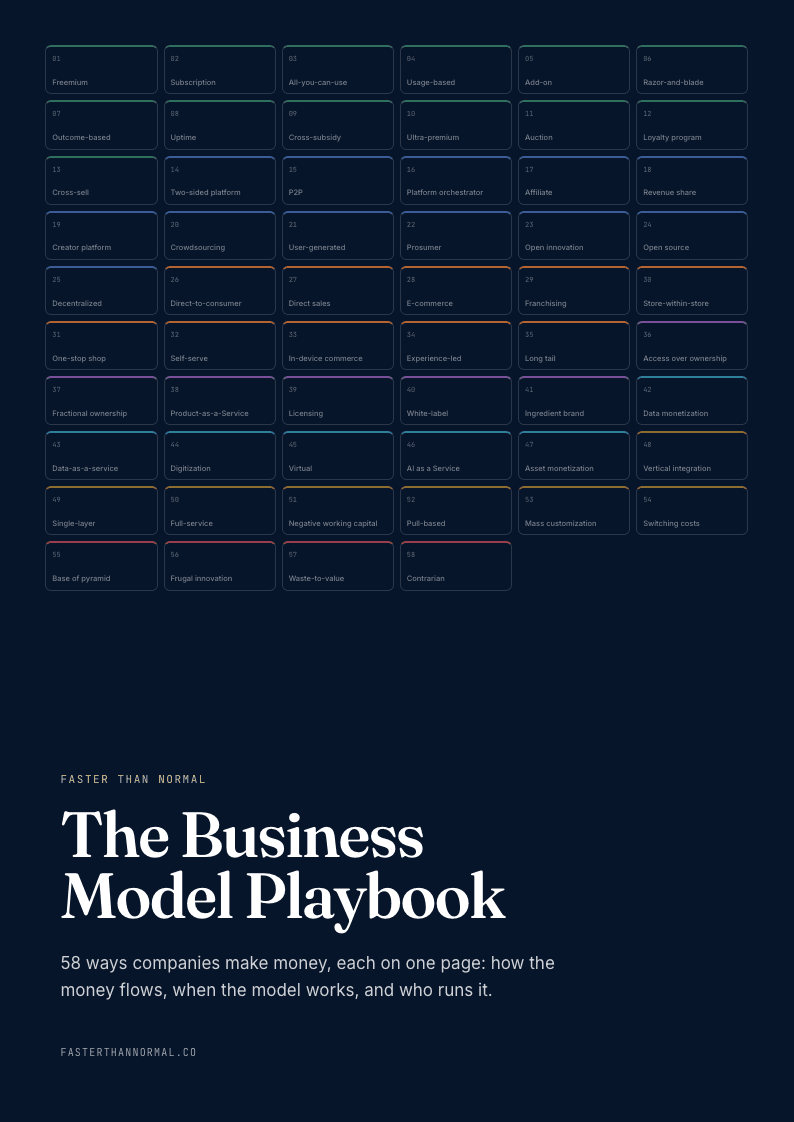
58 business models, one visual page each: how the money flows, the metrics that matter, and who runs it. Free when you join the Faster Than Normal email.
Free. No spam. Unsubscribe anytime.