

Indra Nooyi, Investing Principles and Uncertainty in Decision-Making
Indra Nooyi understood something most executives miss: transformation happens from within. "If you want to improve the organization, you have to improve yourself and the organization gets pulled up with you." During her 12-year tenure as CEO of PepsiCo, she proved this principle by driving net revenue up 80% to $63.5 billion while simultaneously reshaping one of the world's largest food and beverage companies toward health and sustainability.
The path wasn't obvious. Born in Chennai, Nooyi arrived at Yale for her MBA, then joined PepsiCo in 1994 — a woman of color entering a male-dominated industry at a time when such representation was virtually nonexistent at the C-suite level. But she had a theory about excellence that would define her approach: details matter more than vision statements.
The Architecture of Attention
"I pick up the details that drive the organization insane. But sweating the details is more important than anything else." Nooyi's obsession with granular execution wasn't micromanagement — it was strategic advantage. While competitors focused on broad market positioning, she was examining the nutritional profiles of individual SKUs, the environmental impact of packaging decisions, the long-term demographic shifts that would reshape consumer preferences.
This detail orientation created what she called "performance with purpose." Under her leadership, PepsiCo didn't just pursue growth; it pursued the right kind of growth. She pushed the company toward healthier products years before the wellness trend became obvious, recognizing that regulatory pressure and consumer behavior would eventually force the industry's hand. The company that once epitomized junk food began serious investment in better-for-you options — not as a marketing exercise, but as a core business strategy.
Her approach revealed a crucial leadership insight: most organizations fail not because they lack vision, but because they lack the operational discipline to execute against uncertainty. Nooyi excelled at both.
The Confidence Equation
"You can be very, very competent, but if you're not willing to speak out, have confidence based on your knowledge, what's the point?" This wasn't motivational rhetoric. Nooyi had identified a specific problem: competence without voice produces no results.
She described herself as "a bit of a rebel" — not the manufactured rebelliousness of startup culture, but the willingness to challenge assumptions when data suggested a different path. At PepsiCo, this meant questioning the industry's addiction to high-margin, high-sodium, high-sugar products even when those products drove quarterly earnings.
The tension was real. Wall Street rewarded short-term performance. But Nooyi was building for a different timeline. She understood that demographic shifts, regulatory changes, and evolving consumer preferences would eventually punish companies that failed to adapt. Her "rebellion" was actually rigorous long-term thinking disguised as contrarian positioning.
The JBL Playbook: Quality as Competitive Moat
James Bullough Lansing started JBL in 1946 with $10,000 and a simple thesis: audio quality could be a sustainable differentiator. The company began in Los Angeles focused on loudspeaker manufacturing, but Lansing understood that technical excellence alone wouldn't scale. He needed distribution, capital, and market positioning.
The breakthrough came in 1969 when Sidney Harman's Harman International acquired JBL for $8 million. This wasn't just a financial transaction — it was a strategic alignment that would define the next five decades of JBL's development. Harman provided the infrastructure for JBL to expand beyond professional audio into consumer markets without compromising on sound quality.
By the 1970s, JBL had become synonymous with premium audio in both professional and consumer segments. Recording studios used JBL monitors. Concert venues installed JBL sound systems. But the company's real insight was understanding that brand reputation in professional markets could be leveraged to command premium pricing in consumer markets.
The Samsung Acquisition: Scale Meets Quality
When Samsung acquired Harman International — including JBL — for $8 billion in 2017, it represented more than consolidation in the electronics industry. Samsung was purchasing decades of accumulated brand equity and technical expertise that couldn't be replicated through internal R&D.
JBL's evolution illustrates two principles that apply across industries. First, quality creates pricing power that persists across market cycles. Second, the right acquisition partner can accelerate growth without compromising core competencies.
The company's shift toward portable and lifestyle audio products in the 2000s demonstrated market adaptation without brand dilution. JBL Bluetooth speakers became ubiquitous not because they were cheap, but because they delivered professional-grade sound quality in consumer-friendly form factors. The technical heritage mattered.
Investment Principles Under Uncertainty
Charles Schwab's observation about rejection — "I quickly learned that if I kept at it and plowed right through the rejections I would eventually get somebody to buy my wares" — reveals something deeper about operating under uncertainty. Most people mistake rejection for market feedback. Schwab understood that initial rejection often reflects timing, positioning, or sample size rather than fundamental demand.
This principle applies beyond sales. When launching new products, entering new markets, or building strategic partnerships, the first response is rarely indicative of long-term viability. The key is distinguishing between rejections that signal fundamental problems and rejections that signal execution or timing issues.
Successful investors and operators develop what might be called "rejection calibration" — the ability to extract useful information from negative feedback without being paralyzed by it. They understand that in uncertain environments, persistence often separates successful outcomes from failed attempts.
The Day One Mentality
Jeff Bezos's "Day One" philosophy at Amazon provides a framework for maintaining urgency and adaptability as organizations scale. Day One companies maintain the hunger, flexibility, and customer obsession of startups. Day Two companies become complacent, bureaucratic, and ultimately irrelevant.
The distinction isn't about company age or size — it's about mindset. Day One companies treat every quarter as an opportunity to redefine their market position. They assume that today's competitive advantages will eventually erode, so they invest continuously in building tomorrow's competitive advantages.
This philosophy explains Amazon's willingness to cannibalize profitable business lines, invest in long-term projects with unclear payoffs, and maintain high reinvestment rates even as the company generates massive cash flows. It's not growth for growth's sake — it's growth as a defensive strategy against inevitable disruption.
Tactical Framework: Decision-Making Under Uncertainty
When facing uncertain decisions, most organizations default to analysis paralysis or premature commitment. Both approaches fail because they misunderstand the nature of uncertainty. Some variables can be analyzed; others must be experienced.
The key is identifying which uncertainties can be reduced through additional research and which uncertainties can only be resolved through action. Market demand for a new product category often falls into the second category. No amount of focus groups or surveys can predict how consumers will actually behave when faced with real purchasing decisions.
In these situations, the optimal strategy involves rapid experimentation with limited downside exposure. Launch small pilots. Test core assumptions with minimal investment. Scale what works; kill what doesn't. This approach treats uncertainty as information to be gathered rather than risk to be avoided.
The companies and leaders who excel under uncertainty share a common characteristic: they've developed systems for making good decisions with incomplete information. They don't wait for certainty because they understand that in dynamic markets, certainty often arrives too late to matter.
The Aesthetic Opportunity
What aesthetic is no one capturing? This question cuts to the heart of market opportunity identification. Most companies compete within existing aesthetic categories — minimalist tech, luxury fashion, industrial design, organic wellness. But the most significant opportunities often exist in the spaces between established categories.
Consider how Tesla created an entirely new automotive aesthetic that combined Silicon Valley minimalism with performance car aggression. Or how Glossier redefined beauty marketing by rejecting both traditional glamour and clinical functionality in favor of aspirational authenticity.
These companies didn't just create new products — they created new ways of seeing entire categories. They identified aesthetic territories that existing players had abandoned or never explored, then built entire business strategies around occupying those territories.
The question forces you to look beyond functional differentiation toward emotional and cultural positioning. In markets where functional parity becomes inevitable, aesthetic differentiation often provides the most sustainable competitive advantages.
Free playbook
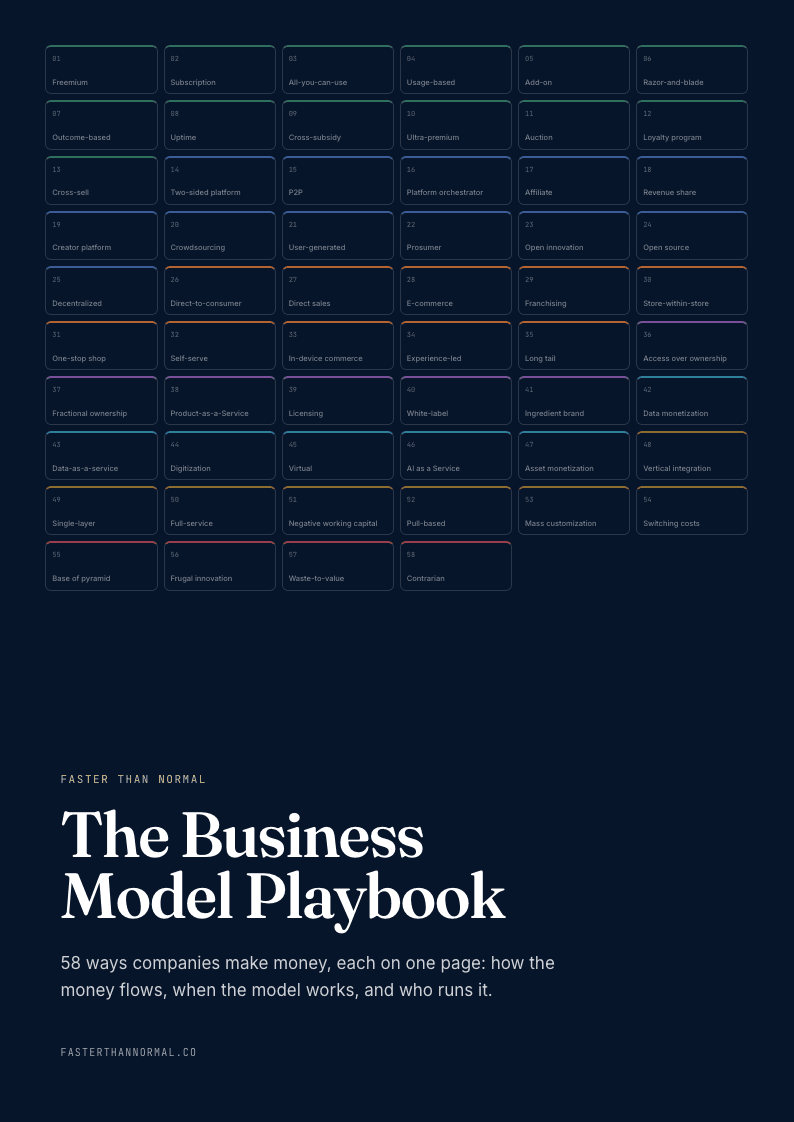
Get The Business Model Playbook
58 business models, one visual page each: how the money flows, the metrics that matter, and who runs it. Free when you join the Faster Than Normal email.
Free. No spam. Unsubscribe anytime.