

Iman Aubzeid, Seth Godin On Being Remarkable and Internal Metrics For Success
Iman Abuzeid exemplifies the intersection of domain expertise and entrepreneurial ambition. As CEO and co-founder of Incredible Health, she transformed her experience as a Stanford-educated physician into a $1.65 billion solution to healthcare's most persistent problem: staffing shortages.
Incredible Health operates as a career marketplace for healthcare workers, using AI to match nurses with hospitals. The company has raised over $100 million by solving a fundamental inefficiency in healthcare hiring. Abuzeid's approach combines rigorous data analysis with an obsessive focus on customer needs — a methodology that reflects her medical training applied to business building.
Her insights on confidence and geography reveal the strategic thinking behind her success. "You must have 100% confidence...but if you also have 100% competence then you're unstoppable," she observes. On relocating to the United States in 2009, she notes: "Moving to the U.S. was the biggest inflection point in my life because this country views entrepreneurs so positively and there's an entire ecosystem to support those entrepreneurs."
Intel's Blueprint for Industry Dominance
Intel's founding story reads as a masterclass in strategic timing and intellectual courage. When Gordon Moore and Robert Noyce left Fairchild Semiconductor on July 18, 1968, they brought $2.5 million in initial funding from Arthur Rock and a conviction that semiconductors would reshape computing.
Their first product, the 3101 Schottky TTL bipolar 64-bit static random-access memory chip, established technical credibility. But the breakthrough came in 1971 with the 4004 — the world's first microprocessor. While competitors focused on memory chips, Intel saw the potential in programmable logic.
The company went public in 1971, raising $6.8 million. By 1992, Intel had become the world's largest semiconductor manufacturer by revenue. Today, the company generates over $55 billion annually, validating Moore and Noyce's original thesis about the trajectory of computing power.
Intel's cultural innovations proved as important as its technical ones. The company institutionalized "constructive confrontation" — a policy encouraging employees to challenge ideas openly, regardless of hierarchy. As Robert Noyce advised: "Don't be encumbered by history. Go off and do something wonderful."
Seth Godin's Principles of Remarkability
Seth Godin's framework for achieving remarkability cuts through conventional wisdom about differentiation. His ten principles reveal why most attempts at standing out fail and what actually works.
Commitment over incrementalism. Half-measures won't suffice. The only path to growth involves abandoning yesterday's strategy, regardless of its past effectiveness. Incremental improvements maintain mediocrity.
External validation matters. Remarkability isn't self-assessed. If others aren't compelled to make remarks about your work, you're average. Average performance delivers average outcomes.
Substance over spectacle. Being noticed differs from being remarkable. Stunts generate attention but rarely create value. Running down the street naked gets noticed but accomplishes nothing.
Embrace extremism. Extremism in pursuit of remarkability isn't just acceptable — it's required. First-place performers, those considered best in their fields, secure disproportionate rewards. Rock stars attract groupies because they're stars, not because they're conventionally attractive.
Occupy the edges. Remarkability exists at extremes: biggest, fastest, slowest, richest, easiest, most difficult. The specific edge matters less than positioning at or beyond it.
Accept rejection. Most people won't appreciate your efforts to be remarkable. Most people avoid risk and can't help you anyway. Your goal isn't universal appeal but resonance with those who actually influence outcomes — the buyers, hirers, and advocates.
Avoid the manual. If your approach appears in accepted wisdom or instruction manuals, it's boring. Roger Bannister was remarkable for breaking the four-minute mile. The next runner to beat Bannister's time was merely faster.
Calculated risk-taking. Remarkability feels more frightening than it actually is. Mass layoffs eliminate the unremarkable, not the exceptional. Remarkable performers enjoy greater job security and opportunity access.
Test market appeal. If people wouldn't wear your message on a T-shirt, you're not remarkable at something people care about. A small group of intensely focused advocates beats thousands of mildly interested observers.
Continuous reinvention. Fashion cycles apply to remarkability. Today's remarkable becomes tomorrow's ordinary without reinvestment and reinvention. Success requires committing to remarkability repeatedly.
The Persistence Principle
Estée Lauder's reflection on persistence captures an essential truth about entrepreneurial success: "Persistence. It's that certain little spirit that compels you to continue just when you're at your most tired. It's that quality that forces you to persevere, find the route around the stone wall. It's the immovable stubbornness that will not allow you to cave in when everyone says give up."
Her insight reveals persistence as more than determination — it's strategic problem-solving under pressure. When conventional paths are blocked, persistence finds alternative routes. When consensus suggests surrender, persistence identifies overlooked opportunities.
Internal Metrics for Success
Warren Buffett's concept of the "inner scorecard" provides a framework for developing internal success metrics independent of external validation. Rather than measuring performance against others' expectations, the inner scorecard evaluates actions against personal principles and long-term objectives.
This approach proves particularly valuable for entrepreneurs and investors operating in environments where immediate feedback may not reflect ultimate outcomes. Early-stage ventures often appear to be failing before they succeed. Public market performance can disconnect from fundamental value creation. The inner scorecard maintains focus on controllable inputs rather than volatile outcomes.
Expected value calculations offer another tool for decision-making under uncertainty. Rather than evaluating individual outcomes, expected value analysis considers probability-weighted scenarios across all possible results. This methodology helps separate good decisions from good outcomes, a critical distinction in environments where luck influences results.
The combination of internal scorecards and expected value thinking creates a decision-making framework resilient to external noise and short-term volatility. Success becomes measurable through process adherence rather than outcome optimization.
Self-Assessment
Consider this question: What actions do you do repeatedly that don't align with the person you want to become?
This inquiry cuts to the heart of personal development — the gap between aspiration and behavior. Most people can articulate their ideal future selves but struggle to identify the specific actions undermining those aspirations.
The power lies in the word "repeatedly." Single instances of misalignment can be dismissed as exceptions. Repeated patterns reveal character and predict trajectory. Identifying these patterns creates opportunities for course correction before they compound into irreversible outcomes.
Free playbook
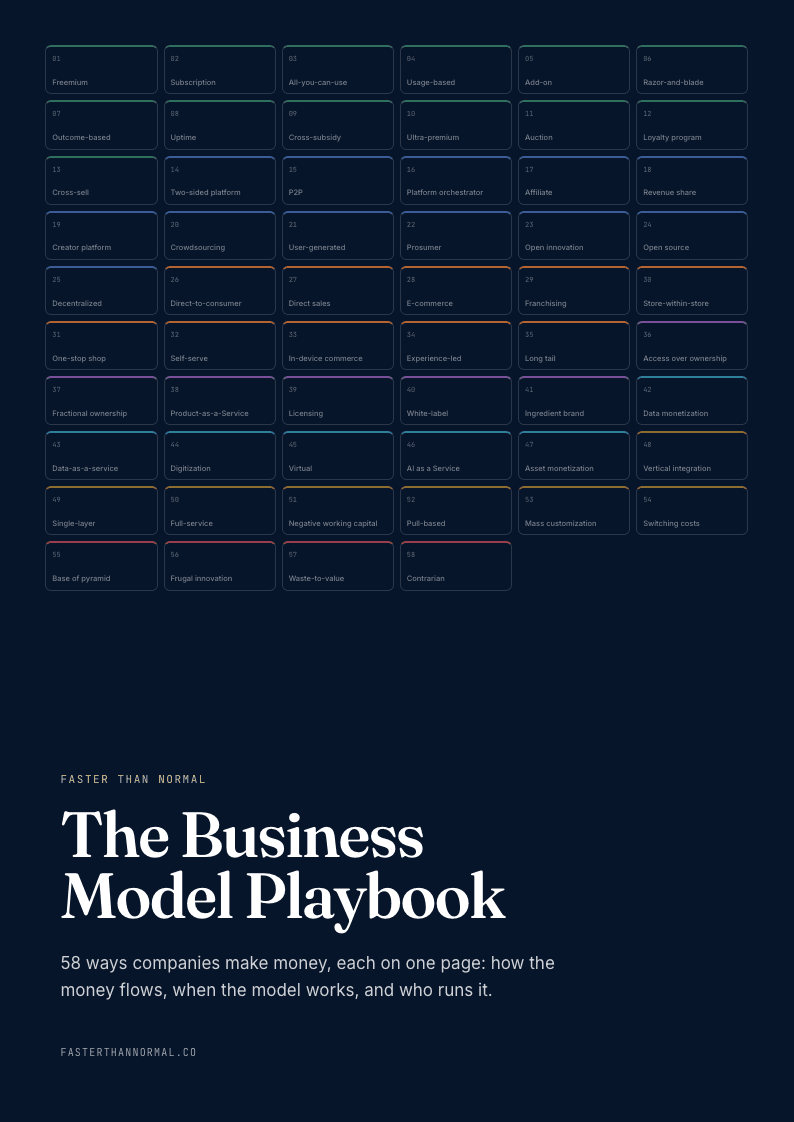
Get The Business Model Playbook
58 business models, one visual page each: how the money flows, the metrics that matter, and who runs it. Free when you join the Faster Than Normal email.
Free. No spam. Unsubscribe anytime.