

Hershey
On a winter afternoon in 1876, in a cramped Philadelphia storefront that smelled of burnt sugar and broken dreams, Milton Hershey swept the remnants of his first candy business into a dustpan. The nineteen-year-old had learned to make taffy and caramels from a confectioner named Joseph Royer, had scraped together enough capital to rent his own shop, and had watched it collapse within months. His second attempt, launched in Chicago during the 1893 World's Columbian Exposition, lasted slightly longer before meeting the same fate. New York City — strike three. By most measures, Hershey was a serial failure, the kind of man whose ambitions exceeded his apparent abilities. But he had developed something more valuable than immediate success: an obsessive understanding of what made candy work and what made it fail.
When Hershey returned to Lancaster, Pennsylvania, in 1883 and founded the Lancaster Caramel Company, he wasn't just trying again — he was applying everything those failures had taught him about sugar chemistry, customer preferences, and the brutal economics of confectionery. This time, the business took hold. Within a decade, the Lancaster Caramel Company was generating enough profit to make Hershey wealthy, but wealth wasn't the point. He had noticed something at the 1893 Chicago exposition that most visitors missed entirely: a German chocolate-making machine that could mass-produce what had always been a luxury product.
— Milton HersheyCaramels are just a fad. Chocolate is permanent. I am going to make chocolate.
The statement sounds prescient now, but in 1894 it was closer to heresy. Chocolate in America meant expensive imported bars from Europe, handcrafted luxuries that cost more than most workers made in a day. Hershey was proposing something that didn't quite exist: affordable chocolate for ordinary people. In 1900, he sold his caramel company for $1 million — roughly $36 million in contemporary currency — and invested every dollar in what seemed like commercial suicide.
The Machinery of Mass Production
The technical problem was formidable. European chocolatiers guarded their milk chocolate formulas like state secrets, and the process itself seemed to resist standardization. Fresh milk spoiled quickly, sugar ratios affected texture in unpredictable ways, and the tempering process — the controlled heating and cooling that gives chocolate its glossy finish and satisfying snap — had to be perfect every time. Hershey worked through nights in his experimental facility, adjusting temperatures by fractions of degrees, testing different milk sources, documenting every variable that affected the final product.
What emerged from those years of trial and error wasn't just a recipe but an entire manufacturing philosophy. Hershey had figured out how to make milk chocolate that was consistent, scalable, and — crucially — profitable at mass-market prices. The Hershey's Milk Chocolate bar, launched in 1905, cost five cents when imported chocolate cost fifty. By 1907, he had introduced the Hershey's Kiss, a portion-controlled morsel that solved both packaging and pricing challenges while creating a new category of impulse purchase.
But the real innovation was systemic. Hershey didn't just build a chocolate factory — he built an entire town around chocolate production. Hershey, Pennsylvania, wasn't a marketing gimmick but a calculated exercise in vertical integration. The company controlled its milk supply through relationships with local dairy farms, operated its own sugar refinery, and even ran the trolley system that brought workers to the plant. When competitors struggled with supply chain disruptions or labor shortages, Hershey's integrated model kept production running.
Wartime Pragmatism
World War II tested that integration in ways Hershey couldn't have anticipated. Sugar rationing threatened to shut down chocolate production entirely, but the company pivoted to manufacturing field rations for U.S. troops — high-calorie bars designed to withstand extreme temperatures while providing essential nutrition. The D-Ration chocolate bar became standard military equipment, and Hershey produced millions of units without compromising civilian supply lines. The wartime contract wasn't just profitable; it established Hershey as an American institution, a company that served national interests when called upon.
The post-war period brought different challenges. Consumer tastes were changing, new competitors were entering the market, and the mass-production approach that had defined Hershey's early success was becoming commonplace. William Dearden, who became CEO in the 1970s, articulated the situation with characteristic bluntness: "We must grow or die." Growth meant acquisition, diversification, and a willingness to move beyond the core chocolate business that had made the company's reputation.
— William DeardenWe must grow or die.
The 1963 acquisition of H.B. Reese Candy Company proved Dearden's point. Reese's Peanut Butter Cups had been a regional specialty — peanut butter encased in chocolate, a combination that struck many as either brilliant or bizarre. Under Hershey's distribution network and marketing muscle, Reese's became a national phenomenon and eventually the company's top-selling brand. The acquisition demonstrated something fundamental about Hershey's evolution: the company was learning to recognize and scale innovations it didn't invent.
The Snacking Revolution
By the 2020s, Hershey had transformed from a chocolate company into what CEO Michele Buck calls "a snacking powerhouse." The language shift reflected a strategic one. Chocolate remained central to Hershey's identity, but the company had expanded into pretzels, popcorn, and other categories where impulse purchasing and portion control created similar profit dynamics. The 2021 acquisition of Dot's Pretzels for $1.2 billion signaled that transformation was complete — Hershey was now competing not just with other chocolate companies but with the entire snacking ecosystem.
— Michele BuckWe're a snacking powerhouse. Our vision is to be the leader in fast-growing snacking.
That expansion came with complexities Milton Hershey never faced. Modern consumers demanded transparency about supply chains, sustainability practices, and labor conditions. Criticism over cocoa sourcing — particularly regarding child labor in West African plantations — forced Hershey to commit to 100% certified and sustainable cocoa by 2020, an expensive undertaking that required rebuilding relationships throughout the global cocoa supply chain. The company that had once controlled every variable through vertical integration now had to navigate international regulations, activist campaigns, and consumer expectations that extended far beyond product quality.
Yet the fundamental dynamics haven't changed. Hershey succeeds when it solves problems other companies can't or won't solve — mass-producing affordable luxury, creating emotional connections through food, and building distribution systems that make impulse purchases effortless. At $12 billion in annual revenue, the company Milton Hershey built from three consecutive failures has become precisely what he envisioned: not just a chocolate company, but a permanent part of how Americans experience sweetness, celebration, and the small indulgences that make ordinary moments memorable.
The dustpan in that Philadelphia storefront swept up more than sugar and disappointment. It cleared space for the kind of learning that only comes from watching something you've built fall apart, then asking why.
Free playbook
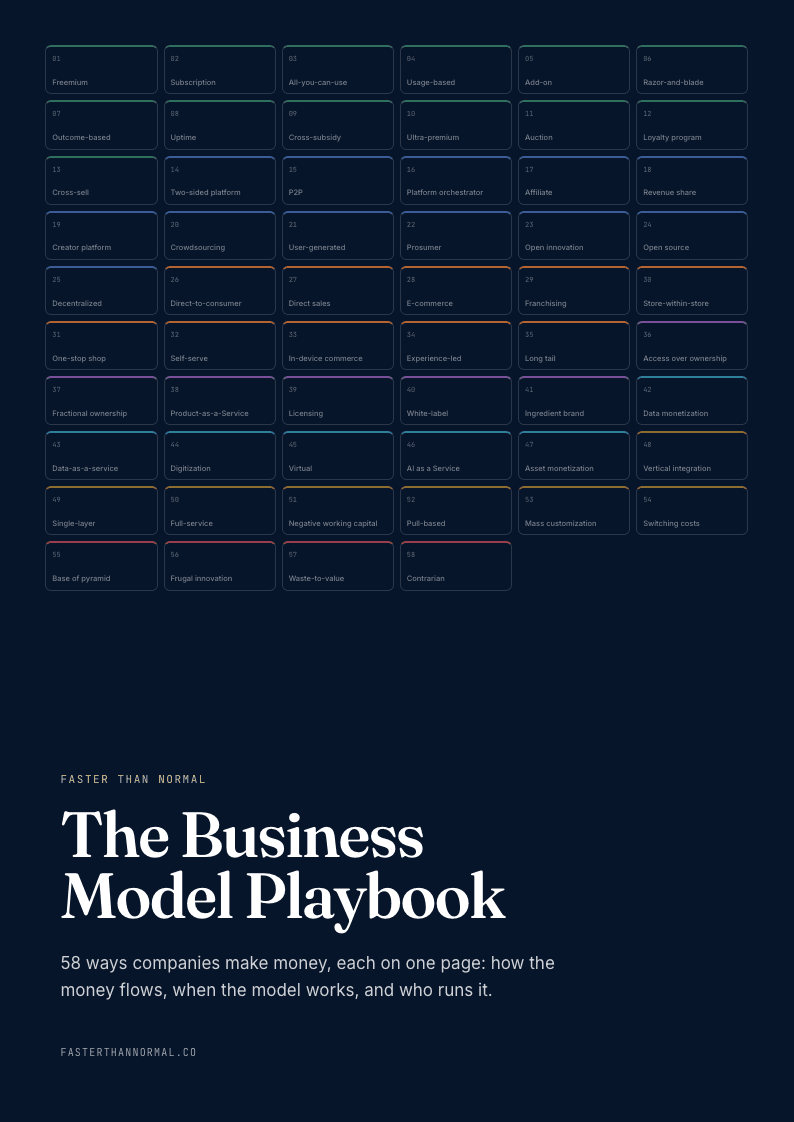
Get The Business Model Playbook
58 business models, one visual page each: how the money flows, the metrics that matter, and who runs it. Free when you join the Faster Than Normal email.
Free. No spam. Unsubscribe anytime.