

Herby Cohen, Thinking Gray and Decision-Making Frameworks to Uncertainty
The psychology of negotiation reveals itself in extremes. While most people approach deals seeking binary outcomes — win or lose, yes or no — master negotiators understand that all meaningful decisions exist in the gray spaces between certainty and chaos.
Herby Cohen spent five decades proving this principle. From government crisis rooms to corporate boardrooms, he demonstrated that the art of getting what you want depends less on aggressive tactics than on understanding how humans process uncertainty. His insight: "In business, you don't get what you deserve, you get what you negotiate." That gap between deserving and receiving? It's where fortunes are made and lost.
The Negotiator's Paradox
Cohen's approach challenged conventional wisdom. Born in 1932, he built his reputation not through intimidation or manipulation, but by recognizing that successful negotiation requires embracing ambiguity. His 1980 bestseller "You Can Negotiate Anything" codified a counterintuitive truth: the most powerful position in any negotiation is genuine uncertainty about the outcome.
Consider his three core principles, each designed to exploit cognitive biases:
Preparation as asymmetric warfare. "In a negotiation, knowledge is power," Cohen observed. But not just any knowledge — specific, granular intelligence about the other party's constraints, motivations, and alternatives. While opponents focused on their own position, Cohen mapped the entire decision-making ecosystem.
Strategic patience. "All things come to he who waits — provided he knows what he is waiting for." Time pressure creates desperation. Desperation creates mistakes. Cohen understood that the party most willing to walk away typically extracts the most value.
The 90/10 rule. "Effective negotiation is 90% listening and 10% talking." Most negotiators talk to persuade. Cohen listened to understand. The difference: persuasion operates on the surface; understanding penetrates to motivation.
These weren't feel-good platitudes. They were operational frameworks tested across decades of high-stakes situations.
Thinking Gray Under Pressure
The concept of "thinking gray" — resisting the urge to form opinions until all relevant information is processed — sounds simple until you're under pressure. Human brains evolved to make rapid threat assessments. In negotiations, this instinct becomes a liability.
Thinking gray requires suspending judgment while gathering data from multiple sources, including sources that contradict your initial hypothesis. It means holding competing possibilities in tension without rushing toward resolution. Most importantly, it means recognizing that your first impression is almost certainly incomplete.
This framework applies beyond formal negotiations. Every strategic decision — hiring, partnerships, investments — benefits from gray thinking. The leaders who excel at this approach share a common trait: they've learned to be comfortable with discomfort.
The Hitachi Long Game
Hitachi's 114-year survival offers a masterclass in applied patience. Founded in 1910 as a mining equipment repair shop, the company navigated the Great Depression, World War II, Japan's post-war rebuilding, and the digital revolution. Today it employs 350,000 people across IT, energy, mobility, and smart life solutions, generating $84.1 billion in annual revenue.
The key insight: Hitachi thinks in decades, not quarters.
This temporal expansion changes everything. Short-term volatility becomes noise. Market cycles become patterns. Competitive threats become data points in a longer story. When you extend your planning horizon, you can make different tradeoffs — investing heavily in R&D during downturns, maintaining relationships that won't pay off for years, building capabilities before you need them.
Hitachi's 100,000+ patents didn't emerge from a single breakthrough. They resulted from systematic, sustained investment in innovation infrastructure. The company created an environment where employees could experiment, fail, and iterate without career-ending consequences.
The lesson isn't that every company should operate like a Japanese conglomerate. It's that time horizon shapes strategic options. Most businesses optimize for the next funding round or earnings call. The exceptional ones optimize for decades.
Decision Frameworks for Uncertainty
When facing genuine uncertainty — not just complexity, but situations where the rules themselves are unclear — standard decision-making tools break down. You need frameworks designed for incomplete information and shifting contexts.
The OODA Loop
Developed by military strategist John Boyd, the OODA Loop (Observe, Orient, Decide, Act) provides a structure for rapid decision-making under uncertainty. The key insight: in fluid situations, decision speed matters more than decision perfection.
Observe: Gather information from multiple sources, including sources that challenge your assumptions.
Orient: Synthesize observations with existing knowledge, updating your mental models as new data arrives.
Decide: Choose a course of action based on current understanding, acknowledging that this understanding is provisional.
Act: Execute quickly, then return to observation to measure results and adjust.
The loop's power lies in its iterative nature. Each cycle improves your understanding while maintaining forward momentum. This approach works particularly well in competitive environments where delay equals defeat.
Firebreaks and Rapid Repairs
Military operations use "firebreaks" — predetermined decision points where commanders reassess strategy based on new information. Business applications include preset review dates, performance thresholds that trigger strategic pivots, and escape clauses in partnerships.
The principle: build safeguards into your decisions before you need them. When emotions run high and sunk costs mount, predetermined exit criteria provide objective guidance.
Rapid repair systems complement firebreaks. These are pre-planned responses to common failure modes — communication protocols for crises, cash reserves for unexpected opportunities, relationships that can be activated quickly when circumstances change.
The Courage to Be You
Jobs understood that authenticity isn't about comfort — it's about alignment. "Your time is limited, so don't waste it living someone else's life," he said. But authenticity under pressure requires preparation.
The leaders who maintain their identity during negotiations, crises, and major decisions share several characteristics:
They've done the work to understand their own values, priorities, and non-negotiables before entering high-pressure situations.
They recognize that consistency doesn't mean rigidity. Your core principles can remain stable while your tactics adapt to circumstances.
They understand that authenticity is a competitive advantage. When others are performing scripts, genuine responses stand out.
Fear Creates Fiction
The most dangerous decisions emerge from imaginary threats. Fear doesn't just cloud judgment — it manufactures problems that don't exist while obscuring problems that do.
The antidote: systematic interrogation of your assumptions. When facing a decision that generates anxiety, ask: "Is this thing I'm worried about actually a problem, or am I looking for problems to worry about because they make me feel in control?"
The distinction matters. Real problems require solutions. Imaginary problems require better thinking.
Decision-making under uncertainty isn't about eliminating ambiguity — it's about operating effectively within it. The practitioners who excel at this skill share a willingness to hold multiple possibilities in tension, to gather information without rushing to conclusions, and to act decisively based on incomplete data.
Whether you're negotiating a deal, building a company, or navigating a career transition, the frameworks remain consistent: think gray, extend your time horizon, build in safeguards, and maintain authenticity under pressure.
The gray spaces between certainty and chaos? That's where the work gets done.
Free playbook
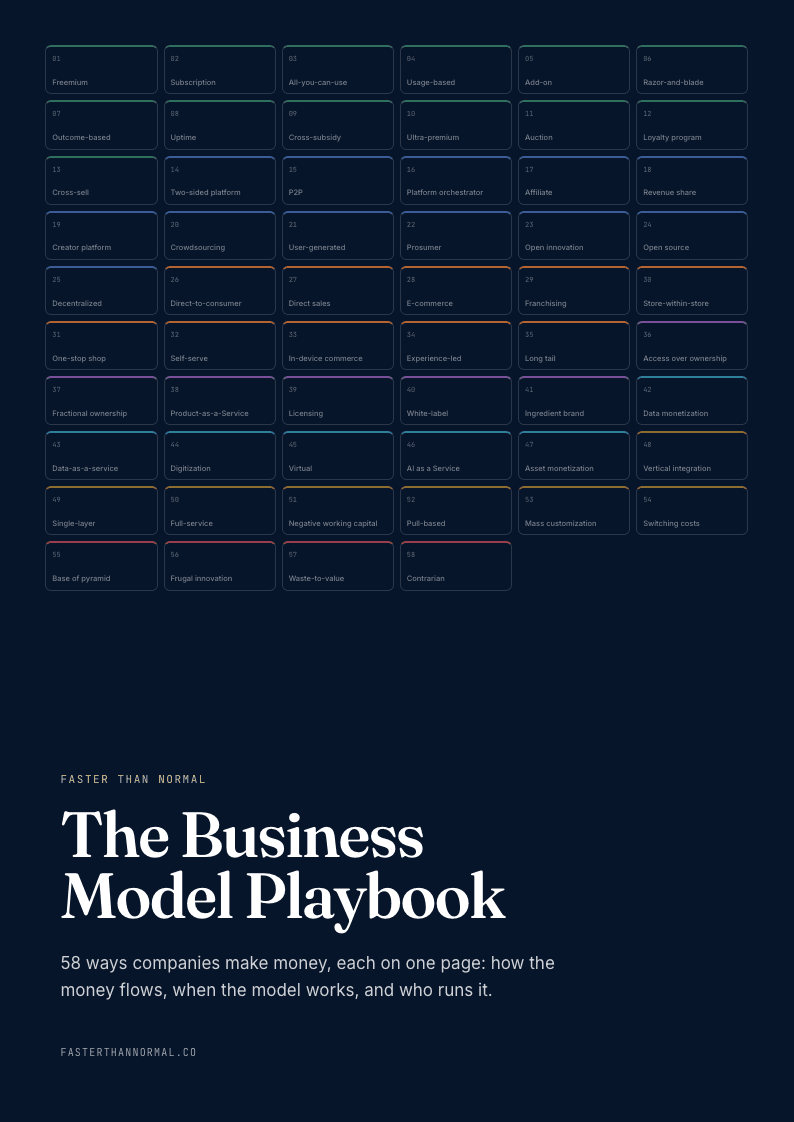
Get The Business Model Playbook
58 business models, one visual page each: how the money flows, the metrics that matter, and who runs it. Free when you join the Faster Than Normal email.
Free. No spam. Unsubscribe anytime.