

Edit Photo, Mailbrew, The Hive Index & More
The internet's signal-to-noise ratio is getting worse. Every platform floods you with content designed to capture attention, not deliver value. But scattered across the web are tools that actually solve problems — if you know where to look.
Here are ten websites that cut through the noise.
Edit.photo: Professional Photo Editing Without the Overhead
Photoshop costs $240 annually. Canva Pro runs $120. For most editing tasks, both are overkill.
Edit.photo runs entirely in your browser. No account creation, no subscription fees, no data harvesting. Upload an image and start editing immediately. The interface handles layers, filters, and adjustments with the same precision as desktop software, but loads in seconds instead of minutes.
The economics are simple: Adobe extracts rent from features most users never touch. Edit.photo strips away the bloat and delivers core functionality at zero cost.
Mailbrew: Taming the Information Firehose
Information abundance creates its own scarcity — the scarcity of attention. You follow hundreds of Twitter accounts, subscribe to dozens of newsletters, bookmark YouTube channels. The result is cognitive overload, not better decision-making.
Mailbrew consolidates everything into a single daily digest. Connect your email subscriptions, Twitter feeds, and YouTube channels. The platform curates content by relevance and delivers it in one organized email.
The insight: aggregation without curation is just more noise. Mailbrew applies filtering algorithms to surface what matters, reducing dozens of daily notifications to one actionable summary.
The Hive Index: Finding Your Tribe
Online communities are the new professional networks. Discord servers replace industry conferences. Reddit forums become research hubs. Slack groups function as private equity deal flow channels.
The problem: discovery. Most valuable communities are invitation-only or buried in search results.
The Hive Index catalogues online communities across all major platforms — Discord, Slack, Reddit, Facebook. Search by topic, member count, or activity level. Each listing includes community guidelines, member demographics, and engagement metrics.
The directory reveals something interesting: the most active communities cluster around three themes — professional development, niche hobbies, and local organizing. Everything else fragments quickly.
Upstract: The Internet on One Page
Information arbitrage works at every scale. Day traders profit from millisecond price differences. Journalists break stories by monitoring multiple sources simultaneously. Investors spot trends by tracking signals across industries.
Upstract aggregates headlines from major news sources onto a single page — Reddit, Reuters, New York Times, YouTube, Vice, BuzzFeed. Real-time updates show what's trending across different audiences simultaneously.
The interface reveals media ecosystem dynamics in real time. Stories break on Reddit hours before traditional media coverage. YouTube trends predict mainstream adoption. Vice covers cultural shifts that won't reach the Times for months.
Throttle: Email Inbox Management
Digital subscriptions multiply like compound interest. Sign up for one newsletter, get added to three more lists. Create an account, start receiving promotional emails. The result: inbox paralysis.
Throttle generates unique email addresses for each subscription and consolidates everything into a daily digest. Instead of 50 scattered emails, you receive one organized summary with the option to unsubscribe from individual sources.
The service addresses a specific failure in email infrastructure: subscription management was never built into the protocol. Throttle adds that layer retroactively.
ADPList: Free World-Class Mentorship
Traditional mentorship operates through informal networks — alumni connections, industry conferences, personal introductions. If you lack access to these networks, you're locked out.
ADPList democratizes mentorship by connecting 9,000+ vetted mentors with mentees globally. Browse by expertise, book sessions directly, meet via video call. All sessions are free.
The platform works because it aligns incentives correctly. Mentors gain visibility and potential hiring leads. Mentees access knowledge typically restricted to insider networks. The matching algorithm optimizes for compatibility, not just availability.
Atlas Obscura: Discovering the Undiscovered
Mass tourism follows predictable patterns. Rome, Paris, Tokyo. The same landmarks, the same restaurants, the same experiences. Real discovery happens in the spaces between guidebook recommendations.
Atlas Obscura catalogues the world's most unusual places and foods. Underground rivers in Mexico. Abandoned Soviet monuments. Regional dishes that exist nowhere else.
Each entry includes historical context, access instructions, and cultural significance. The database reveals how much of the world remains genuinely unexplored, even in the age of GPS and Google Maps.
Web Whiteboard: Collaborative Thinking Made Simple
Remote collaboration tools suffer from feature bloat. Miro has 200+ templates. Figma requires design expertise. Most sessions need nothing more than a shared drawing space.
Web Whiteboard strips collaboration down to essentials: a shared canvas, drawing tools, real-time updates. No signup required. Share a link, start sketching ideas.
The simplicity is strategic. Complex tools create barriers to participation. When everyone can contribute immediately, conversations move faster and generate more ideas.
Harvard's Atlas of Economic Complexity: Predicting Industrial Evolution
Economic development isn't random. Countries that export textiles develop capabilities in garments, then fashion, then luxury goods. The progression follows predictable patterns based on skill overlap and capital requirements.
Harvard's Atlas visualizes these economic pathways for every country. Input any nation and see which industries are likely to emerge or decline based on current capabilities and global trade patterns.
The tool reveals something counterintuitive: economic diversification follows biological principles. Industries evolve like species, adapting existing capabilities to new opportunities. Countries that understand these patterns can direct development strategically instead of hoping for random breakthroughs.
Documentary Storm: Curated Educational Entertainment
Netflix algorithms optimize for engagement, not learning. The result: endless true crime series and reality TV. Educational content gets buried under entertainment designed to maximize watch time.
Documentary Storm curates the best documentary films available online, organized by topic and educational value. Each entry includes quality ratings and learning objectives.
The curation philosophy: great documentaries combine Hollywood-level production with Ivy League-level education. Pure entertainment teaches nothing. Pure education bores audiences. The intersection creates lasting impact.
These tools share common characteristics. They solve specific problems without unnecessary features. They prioritize functionality over monetization. Most importantly, they exist because their creators identified inefficiencies in existing solutions and built alternatives.
The best digital tools don't just automate existing processes — they enable entirely new ways of working.
Free playbook
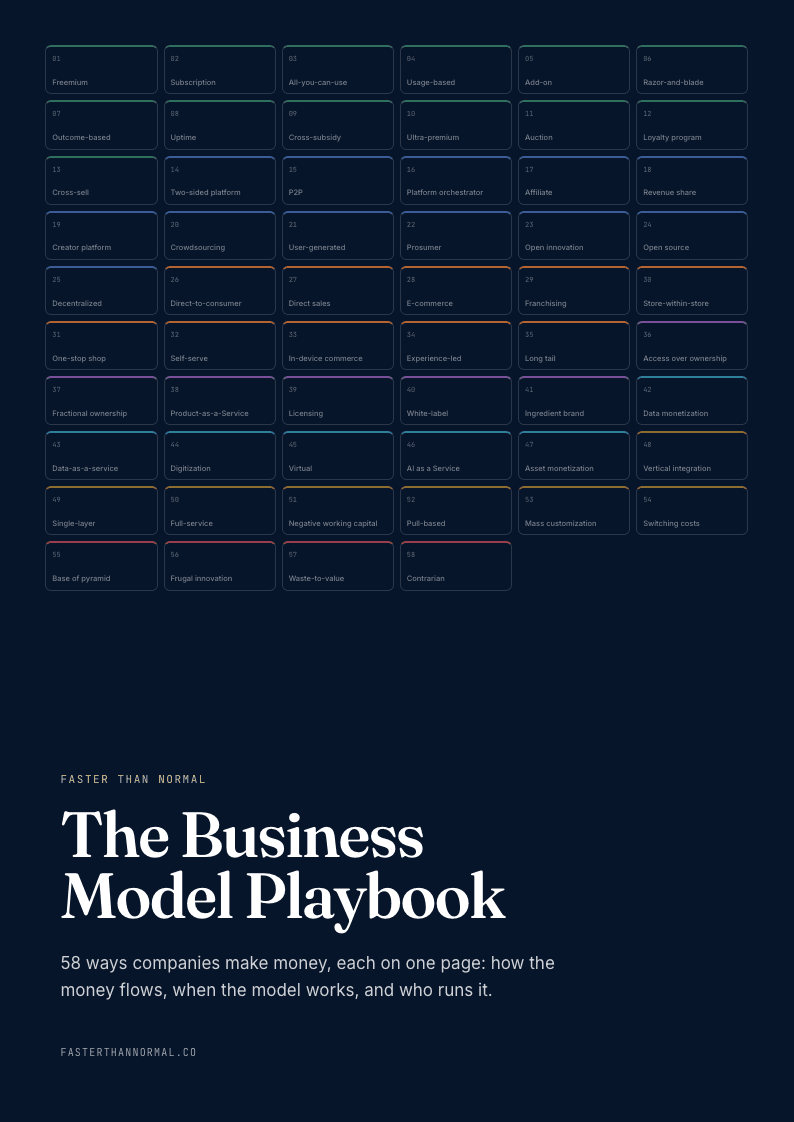
Get The Business Model Playbook
58 business models, one visual page each: how the money flows, the metrics that matter, and who runs it. Free when you join the Faster Than Normal email.
Free. No spam. Unsubscribe anytime.