

Doug Leone
Doug Leone's ascent from an 11-year-old immigrant who couldn't speak English to managing partner of Sequoia Capital represents more than personal triumph—it demonstrates how outsider status can become competitive advantage in venture capital's insider game.
Arriving in Mount Vernon, New York, Leone faced the brutal arithmetic of adolescent social hierarchies. He couldn't throw or hit a baseball. The cultural codes were foreign. But this early marginalization taught him to read environments with unusual precision—a skill that would prove invaluable when evaluating founders decades later.
"I couldn't throw or hit a baseball. You had to develop thick skin and have your eyes wide open."
The trajectory from immigrant survival to venture capital mastery wasn't linear. After excelling academically and cutting his teeth in technical sales, Leone cold-called Don Valentine at Sequoia in 1988. Valentine gave him a chance, but Leone's early performance was rough. After one particularly aggressive presentation, Valentine left a handwritten note in green ink: "Doug – not fit to listen to founders."
That feedback could have ended his career. Instead, Leone used it to calibrate his approach—maintaining his directness while learning when to deploy it strategically.
The Making of a Venture Titan
Leone made partner in 1993 and became Managing Partner in 1996, inheriting Sequoia's already formidable reputation. Under his leadership, the firm expanded globally and backed companies that would define the internet era: Google, LinkedIn, WhatsApp. The returns were staggering—$12.5 million in Google became $3 billion, $60 million in WhatsApp returned $3 billion when Facebook acquired it.
But Leone's real innovation wasn't just picking winners. He systematized the art of founder evaluation, developing frameworks that could be taught and replicated across Sequoia's growing partnership.
His core insight: look for "spiky" founders—people who stand out in specific, often uncomfortable ways. Leone prefers extreme outcomes over consistent mediocrity: "I'd rather have someone who gets A, F, F, A than someone that gets B+, B+, B+, B+." This philosophy reflects his immigrant experience—survival often requires taking calculated risks that more comfortable people avoid.
Pattern Recognition at Scale
Leone's approach to due diligence reflects hard-won street wisdom. He believes character reveals itself in unguarded moments: "If you really want to understand someone, it probably takes two to three hours, including a dinner when people relax and start showing you things." Watch how they treat waitstaff. Notice the small behaviors that reveal true nature.
His definition of trust is precise: "Trust is the combination of intention and competence. You have great intention but no competence, no one's going to trust you. Likewise, if you have great performance and lousy intentions, nobody is going to trust you either."
This framework helps explain Sequoia's ability to back controversial founders who other firms avoided. When a founder is described as "insufferable, maniacal, doesn't listen," Leone doesn't dismiss them—he digs deeper to understand context. Often, those rough edges signal the obsessive focus required to build category-defining companies.
Operational Philosophy
Leone's view of leadership centers on obstacle removal. He sees a CEO's primary job as clearing the path for their team: "It's a river. There are rocks in the river. Your job as a Chief Executive Officer is to remove as many rocks as possible so that water can flow."
This perspective shapes his advice to portfolio companies. Don't just architect your product—architect your organization with equal rigor. Many founders obsess over technical details while neglecting the human systems that determine execution velocity.
Market size remains paramount in Leone's investment thesis: "A tremendous chief executive in a small market will never be great. All great companies start with great markets." But within large markets, he hunts for founders with what he calls "humble backgrounds and a need to win"—people whose personal stakes mirror his own immigrant hunger.
The Paradox of Success
At 65, Leone claims to be "still hungry as hell," embodying the immigrant's perpetual unease that success might be temporary. This anxiety, rather than limiting him, drives continuous evolution. As he puts it: "You have to be willing to put yourself out of business by trying new things, before someone else does."
Leone's legacy extends beyond financial returns—though those have been extraordinary. He helped establish the modern venture capital playbook, demonstrating that systematic founder evaluation could coexist with intuitive pattern recognition. His approach influences how Silicon Valley thinks about risk, character assessment, and the relationship between personal background and entrepreneurial potential.
The man who once couldn't fit in on Mount Vernon playgrounds learned to identify others who didn't fit—and bet on their ability to reshape entire industries. That's the whole trick.
Core Operating Principles
Cultivate controlled aggression. Leone's directness sometimes creates friction, but he's learned to modulate intensity based on context. Push hard when stakes are high, but know when to pull back.
Prioritize intention and competence. Trust requires both elements. High performers with poor intentions are as dangerous as well-meaning incompetents.
Focus on removing obstacles. Executive energy should flow toward barrier elimination, not task execution. Clear the path for your team to operate at maximum velocity.
Architect your company, not just your product. Apply the same design rigor to organizational structure that you bring to technical architecture.
Judge character over dinner. Extended, informal interactions reveal personality traits that formal meetings obscure. Watch for unguarded moments.
Notable Perspectives
"If a founder is described as 'insufferable, maniacal, doesn't listen,' you should always dive deeper to understand the context."
"Nothing builds a great culture like winning."
"If you want to move faster, simple is your friend."
"We look for humble backgrounds and a need to win."
"'Hope' is the worst word for business."
"Not every investor dollar you take is worth the same."
"Invest in outliers."
Leone's story validates a counterintuitive truth: the struggle to belong can become the foundation for exceptional pattern recognition. His immigrant perspective, rather than being overcome, was weaponized into competitive advantage. The kid who couldn't hit a baseball learned to spot the founders who would hit it out of the park.
Free playbook
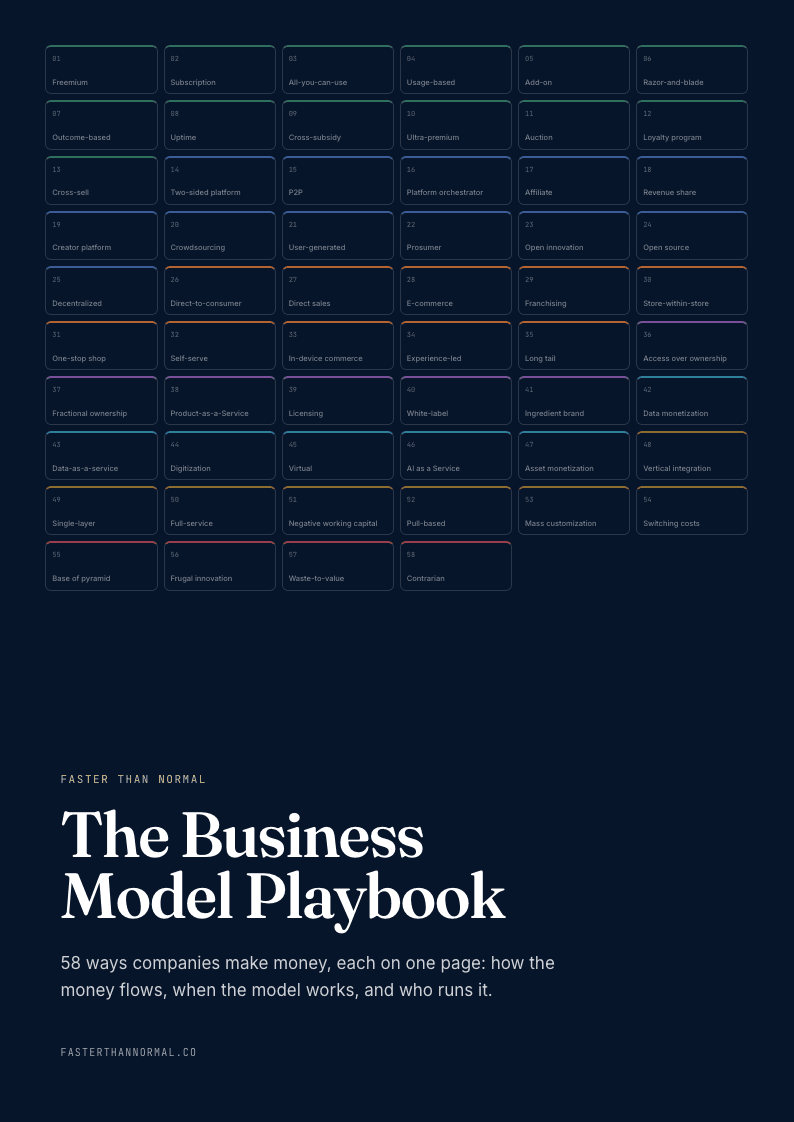
Get The Business Model Playbook
58 business models, one visual page each: how the money flows, the metrics that matter, and who runs it. Free when you join the Faster Than Normal email.
Free. No spam. Unsubscribe anytime.