

Chipotle
Chipotle didn't invent fast food, and it didn't invent Mexican cuisine. What Steve Ells invented in 1993 was something more valuable: proof that Americans would pay premium prices for premium ingredients, assembled quickly, in front of their eyes. That insight — buried inside a modest Denver burrito shop — would eventually reshape an entire industry and create a $40 billion empire.
The accidental nature of Chipotle's origin story contains the first lesson. Ells, a classically trained chef, opened his burrito shop as a means to an end. He needed capital to fund his real ambition: a high-end restaurant. Within a month, the single location was moving over 1,000 burritos daily. The fine dining dream died quickly. The burrito business had revealed itself.
The Category Creation
What Ells stumbled into was category creation — though the term "fast casual" wouldn't emerge for years. Traditional fast food optimized for speed and cost. Traditional casual dining optimized for experience and quality. Chipotle found the gap: high-quality ingredients, customizable orders, fast service, and reasonable prices.
The formula seems obvious in retrospect. Fresh guacamole made daily. Meat raised without antibiotics. Locally sourced produce when possible. But in 1993, this positioning was radical. Fast food meant frozen patties and heat lamps. Chipotle meant watching your burrito assembled from scratch.
The constrained menu was deliberate. While McDonald's offered dozens of permutations, Chipotle offered thousands — through just seven core ingredients. Customers could create 65,000 different combinations from a menu that fit on one page. Complexity through simplicity.
The McDonald's Partnership
Growth stalled in the late 1990s. Regional tastes appeared to be a real barrier — investors questioned whether Mexican food could scale nationally. The breakthrough came in 1998 when McDonald's invested $50 million for a minority stake. The capital solved the expansion problem, but the partnership offered something more valuable: operational expertise.
McDonald's understood systems. They knew how to replicate processes across thousands of locations while maintaining consistency. Under their guidance, Chipotle grew from 16 locations in 1998 to over 500 by 2006. The IPO in January 2006 saw shares double on opening day — from $22 to $44.
But the McDonald's relationship created tension. The fast food giant wanted to expand the menu, add drive-throughs, and implement traditional fast food economics. Ells resisted. He understood that Chipotle's differentiation depended on maintaining its core promise: fresh, customizable, fast.
Crisis and Recovery
The E. coli outbreak of 2015 nearly destroyed everything. Over 500 customers across 14 states fell ill after eating at Chipotle. Sales collapsed 30% year-over-year. The stock price fell from $750 to $400. The brand that had built its reputation on food safety was now synonymous with foodborne illness.
The crisis revealed both Chipotle's vulnerability and its resilience. CEO Steve Ells appeared on the Today Show to personally apologize. The company closed stores nationwide to retrain employees. They implemented new food safety protocols that exceeded industry standards. Most importantly, they didn't abandon their core positioning — they doubled down on it.
Recovery took three years. Same-store sales didn't return to pre-outbreak levels until 2018. But the company emerged stronger, with better systems and a clearer understanding of its operational requirements. Brian Niccol, hired as CEO in 2018, accelerated the turnaround through digital innovation and menu simplification.
Digital Transformation
The shift to digital ordering — accelerated by the COVID-19 pandemic — validated Chipotle's model. Digital sales now represent nearly half of total revenue. The company's investment in delivery, mobile ordering, and "Chipotlanes" (drive-through lanes for digital orders) created new revenue streams without compromising food quality.
This digital transformation highlighted a key insight: Chipotle's assembly line model was perfectly suited for the digital age. Unlike burger chains that struggled to maintain food quality through delivery, Chipotle's bowls and burritos traveled well. The same operational system that enabled in-store customization enabled digital customization.
The Culture Machine
Chipotle's most durable advantage isn't its food — it's its people development system. The company promotes almost exclusively from within, creating a pathway from $15-an-hour crew member to six-figure general manager in under four years. This internal mobility creates loyalty and institutional knowledge that competitors struggle to replicate.
Former co-CEO Monty Moran built this system deliberately. He believed that if you invested in making your people successful, they would invest in making your customers successful. The data supports this: stores with internally promoted managers consistently outperform those with external hires on both sales and customer satisfaction metrics.
Strategic Lessons
Constraint drives creativity. Chipotle's limited menu forces innovation within boundaries. Rather than adding complexity through new products, they add value through execution excellence and customization options.
Systems enable scale. The assembly line model isn't just about speed — it's about standardization. Every burrito is built using the same process, regardless of location. This consistency allows for rapid expansion without quality degradation.
Brand meaning drives premium pricing. "Food with Integrity" isn't marketing copy — it's operational reality. Chipotle sources from suppliers that meet specific standards for animal welfare and sustainable farming. This commitment justifies premium pricing and creates customer loyalty.
Crisis management requires authenticity. The 2015 E. coli outbreak could have destroyed the company. Recovery required genuine acknowledgment of failure, systemic operational changes, and consistent execution over time. Marketing alone couldn't solve the problem.
Current Position
Today's Chipotle bears little resemblance to the single Denver location that started it all. Over 3,000 restaurants across three countries. Annual revenue exceeding $7 billion. Market capitalization of $40 billion. Yet the core promise remains unchanged: fresh ingredients, made to order, served fast.
The company continues to innovate within its constraints. New menu items are tested rigorously but added rarely. Operational improvements focus on speed and consistency rather than complexity. Digital initiatives enhance the core experience rather than replace it.
This disciplined approach to growth has created what few restaurant chains achieve: a business that scales without losing its soul. Chipotle proved that fast food and high quality weren't mutually exclusive — they just required different thinking about operations, sourcing, and customer experience.
The burrito shop that Steve Ells opened to fund his restaurant dreams ended up creating something more valuable: a new category, a new set of customer expectations, and a $40 billion proof point that Americans were ready for better food, served faster.
Free playbook
Get The Business Model Playbook
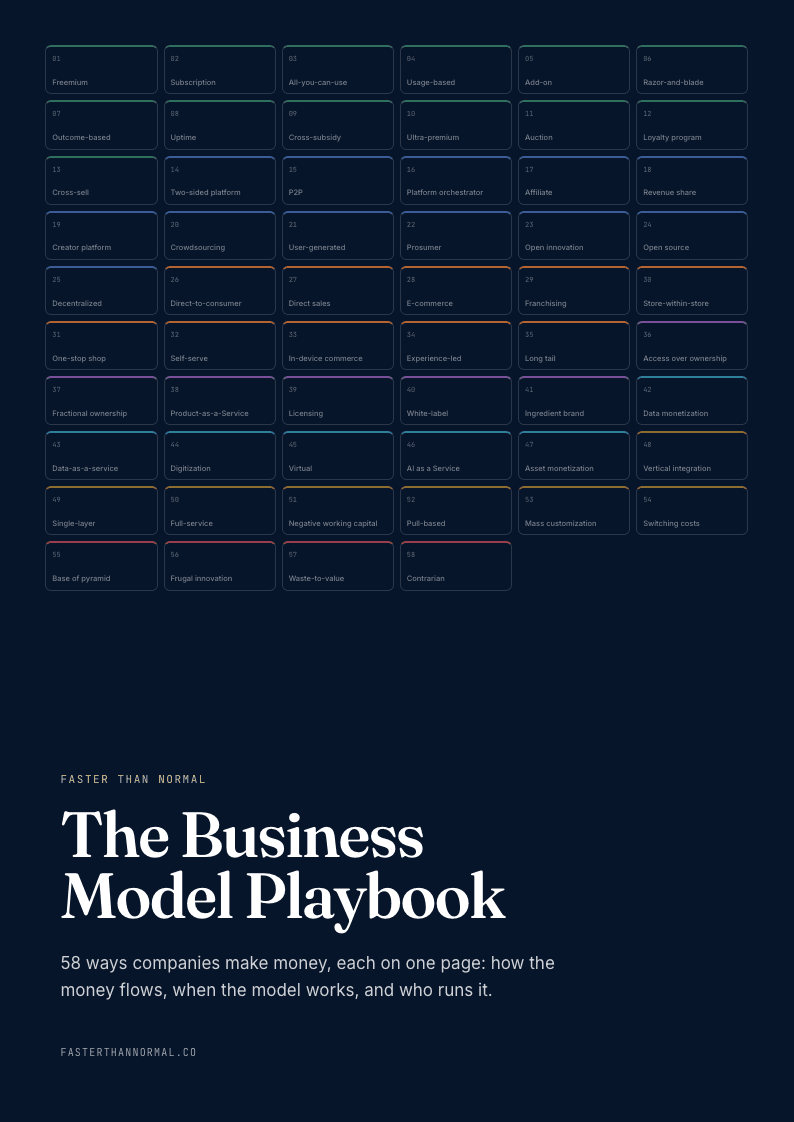
58 business models, one visual page each: how the money flows, the metrics that matter, and who runs it. Free when you join the Faster Than Normal email.
Free. No spam. Unsubscribe anytime.