

Question Mimetic Desire, Inversion, Solid On Vision, Flexible On Details & More
Finding work that feels like play requires more than optimizing for salary or status. It demands a systematic interrogation of your true desires, stripped of the social programming that shapes most career decisions. Here's how the highest performers think about building careers that compound over decades.
Question Mimetic Desire
Most career choices aren't choices at all — they're inherited preferences. Mimetic desire, our tendency to want what others want, drives decisions from law school applications to startup pivots. The investment banker chasing Goldman because that's what Harvard classmates do. The founder building SaaS because that's what gets funded.
René Girard identified this pattern: we don't desire objects directly, but through the desires of others. Your career becomes a mirror of your models — parents, peers, cultural heroes. The trap is subtle. You optimize for external validation while your internal compass spins wildly.
Before choosing what to pursue, ask what influenced that choice. Was it your father's unfulfilled ambition? Your MBA cohort's consensus? The startup ecosystem's current obsession? Strip away the inherited desires. What remains is often smaller, stranger, and more authentic than what you started with.
Inversion: Start With the End
Charlie Munger's favorite mental model applies to career design. Instead of asking "What job should I take next?", ask "What do I want my life to look like in 20 years?" Work backward from there.
The exercise reveals constraints and possibilities that forward-thinking misses. If you value deep relationships, eliminate careers that require constant travel. If you want to build generational wealth, factor in equity upside. If you want intellectual stimulation, avoid roles that plateau quickly.
Debbie Millman's "10-Year Plan for a Remarkable Life" forces this type of clarity. Write in detail about your ideal future — where you live, how you spend your days, what you've accomplished. Then trace the career paths that make that future possible. The path becomes clearer when the destination is specific.
Solid on Vision, Flexible on Details
Vision provides direction; rigidity kills opportunities. The most successful careers combine long-term clarity with tactical adaptability. Reid Hoffman calls this "planning and opportunism" — having a thesis about where you're going while staying alert to unexpected openings.
Consider Brian Chesky's path to Airbnb. His vision was "democratizing belonging," but his tactics shifted constantly — from air mattresses to global hospitality platform. The north star stayed fixed; the execution evolved with market feedback.
This approach requires comfort with ambiguity. Your 20-year vision might involve building companies, but the specific industry, business model, and timing remain fluid. Opportunities emerge that you can't predict today.
Explore to Exploit
The explore-exploit tradeoff governs resource allocation across industries and careers. Early in your career, optimize for exploration — gathering data about your interests, talents, and the opportunity landscape. Later, exploit what you've learned by going deep in high-leverage areas.
Exploration looks like trying different roles, industries, and company stages. Working at a startup, then a big tech company, then consulting. Each experience provides data about what energizes you and what you're naturally good at. The goal isn't to maximize short-term income but to maximize long-term information value.
The key is knowing when to switch from explore to exploit. Too much exploration and you never build deep expertise. Too little and you optimize for a local maximum based on limited information.
Most people stop exploring too early, locking into careers based on their first few experiences. The highest performers extend their exploration phase deliberately, even when it means lower short-term compensation.
Local vs. Global Maxima
Career landscapes have peaks and valleys. A local maximum is the best option within a narrow domain — the highest-paying role at your current company, the most prestigious position in your industry. A global maximum is the best option across all possible domains — the career path that maximizes long-term fulfillment and impact.
Moving from local to global maxima often requires taking apparent backward steps. Leaving the VP role at McKinsey to join a Series A startup. Stepping away from investment banking to start a newsletter. The move looks irrational from a local perspective but rational from a global one.
This is why most people get trapped in local maxima. The immediate social and financial costs of switching are visible; the long-term opportunity costs of staying are hidden. Status anxiety keeps you climbing hills instead of seeking mountains.
Love as Competitive Advantage
"Follow your passion" sounds like career cliché until you understand the competitive dynamics. When you love what you do, effort doesn't feel like effort. You naturally put in more hours, think about problems in your spare time, and persist through obstacles that make others quit.
This creates a compounding advantage over time. The person who finds marketing intellectually fascinating will outperform the person who does it for the paycheck, given equal starting talent. The gap widens with time as one person's natural curiosity drives deeper learning while the other person's attention drifts.
Warren Buffett calls this "tap-dancing to work" — finding something so engaging that it doesn't feel like work. When that alignment exists, you're not just competing on talent but on enthusiasm, persistence, and attention. Those advantages are difficult to replicate.
The highest-performing careers aren't built on a single decision but on a framework for making career decisions. Question inherited desires, invert from your end goals, stay flexible on tactics while remaining solid on vision, explore before you exploit, and seek the global maximum even when it requires short-term sacrifice.
Most importantly, find work that you'd do even if you weren't paid for it. That's not naive idealism — it's ruthless competitive positioning.
Recommended Reading
Make Your Point and Get Out of the Way — Morgan Housel on the power of brevity in communication
A Founder's Guide to Writing Well — First Round's comprehensive framework for startup communication
Writing Well — Julian Shapiro's systematic approach to clear writing
Free playbook
Get The Business Model Playbook
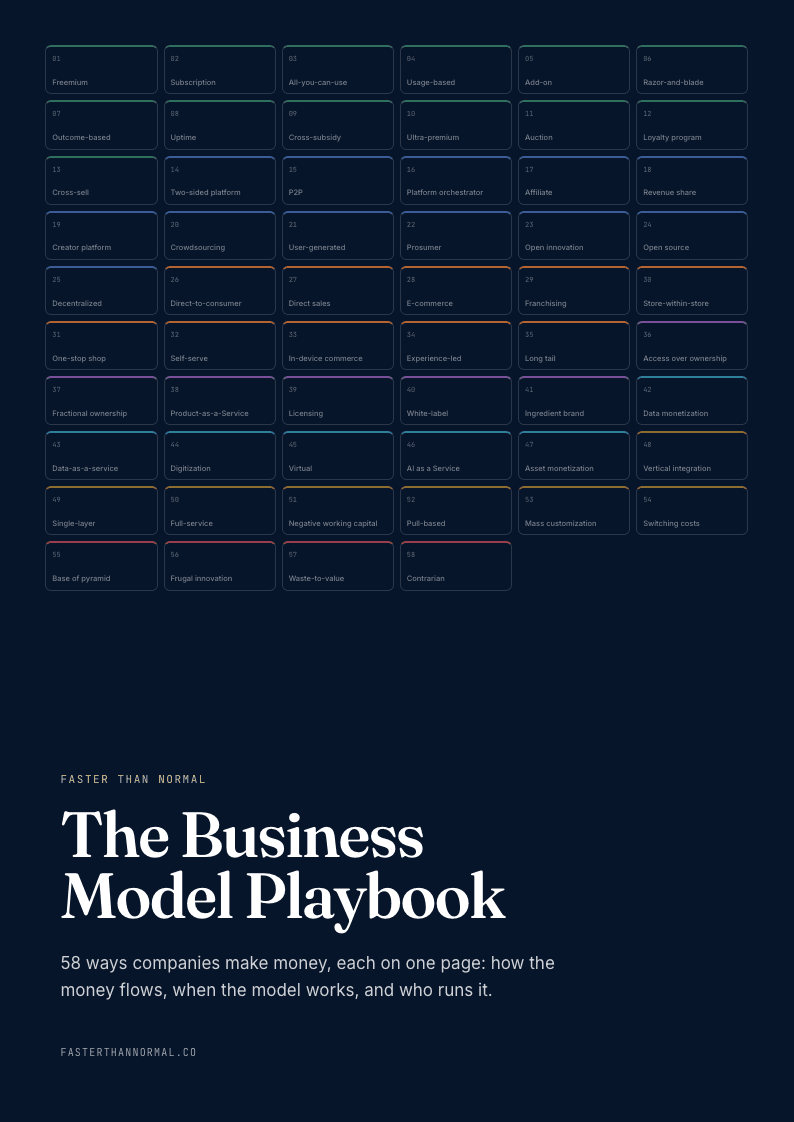
58 business models, one visual page each: how the money flows, the metrics that matter, and who runs it. Free when you join the Faster Than Normal email.
Free. No spam. Unsubscribe anytime.