

Antifragility, Slow and Steady, & More
Most systems break under pressure. Antifragile systems grow stronger from it. The distinction matters more than founders realize — particularly when building for long-term competitive advantage in volatile markets.
The Antifragile Framework
Nassim Taleb's concept of antifragility transcends simple resilience. Fragile systems shatter under stress. Robust systems endure it. Antifragile systems actively benefit from disorder, volatility, and unpredictable events. They don't just survive chaos — they harvest it for growth.
The implications for high-performing operators are immediate. Traditional risk management focuses on avoiding downside. Antifragile systems flip the equation: they engineer upside from uncertainty itself.
Personal Antifragility
J.K. Rowling's trajectory illustrates the principle at the individual level. As a struggling single mother on government assistance, she faced repeated publisher rejections for Harry Potter. Each rejection became data for iteration. The setbacks didn't break her writing system — they refined it. The final breakthrough emerged directly from the accumulated learning of multiple failures.
This isn't survivorship bias. It's systems design. Rowling structured her approach to benefit from rejection: each "no" narrowed the target market, improved the pitch, and strengthened conviction. The rejections weren't obstacles to overcome but inputs to optimize against.
Career antifragility requires four structural elements:
- Continuous skill acquisition that compounds across disciplines
- Growth mindset infrastructure that converts failures into learning systems
- Diverse professional networks spanning industries and frameworks
- Strategic adaptability that treats role changes as portfolio optimization
Business Model Antifragility
Netflix demonstrates antifragile business design. The company didn't just pivot from DVD-by-mail to streaming — it engineered a business model that benefits from technological disruption. Each new viewing technology (broadband, mobile, smart TVs) expanded Netflix's addressable market rather than threatening it.
The antifragile principle: Netflix built distribution-agnostic content systems. The company invested in content creation capabilities that could monetize across any delivery mechanism. Technological change became a growth accelerant, not an existential risk.
Most companies structure themselves to be disrupted by technology. Netflix structured itself to be enhanced by it.
Investment Antifragility
Ray Dalio's "All Weather" portfolio architecture embodies antifragile investing. Rather than betting on specific market conditions, the strategy benefits from volatility itself. The portfolio allocates across assets that perform differently under various economic regimes: stocks for growth, bonds for deflation, commodities for inflation, cash for liquidity.
The system profits from being wrong about specific predictions. Market volatility — regardless of direction — creates relative performance differences that the diversified structure captures. The strategy doesn't require forecasting accuracy. It requires structural positioning that benefits from forecast errors.
Implementation Frameworks
Financial Antifragility
Emergency fund construction: Not just expense coverage, but optionality creation. Cash reserves enable aggressive moves when opportunities emerge from market dislocations.
Multiple income streams: Revenue diversification across uncorrelated sources. Professional services, investment returns, business ownership, intellectual property licensing — each responding differently to economic cycles.
Dynamic portfolio adjustment: Regular rebalancing that captures volatility rather than avoiding it. Systematic selling of outperforming assets to buy underperforming ones creates antifragile returns.
Health Antifragility
Exercise variation: Rotating between endurance, strength, and mobility training. Each stressor type creates different adaptation responses. The combination builds comprehensive resilience.
Stress inoculation: Controlled exposure to manageable stressors (cold therapy, intermittent fasting, challenging workouts) builds systematic stress response capabilities.
Recovery optimization: Strategic rest periods that enable supercompensation. The downtime becomes productive input for subsequent performance gains.
Relationship Antifragility
Conflict as information: Disagreements reveal preference misalignments before they become relationship-ending issues. Early conflict resolution strengthens long-term stability.
Vulnerability infrastructure: Creating psychological safety that enables honest feedback loops. Relationships that can process difficult truths become more resilient over time.
Network diversification: Relationships spanning different contexts (professional, personal, intellectual) provide varied support during different life phases.
The Compound Effect
Antifragile systems create compound advantages because they improve their improvement rate over time. Each stressor doesn't just make the system stronger — it makes the system better at getting stronger from future stressors.
The most successful operators don't just build antifragile businesses. They build antifragile learning systems, antifragile decision-making processes, and antifragile strategic frameworks. They engineer their entire operational stack to harvest uncertainty rather than merely survive it.
The Incremental Advantage
Success compounds through consistent small advances, not dramatic breakthroughs. The insight seems obvious until you examine how most high performers actually allocate their optimization efforts.
Most focus on the spectacular: the perfect strategy, the game-changing hire, the transformative product launch. But sustained competitive advantage emerges from mundane consistency applied systematically over extended periods.
Consider weight loss. Losing 10 pounds over three months through daily dietary adjustments and regular exercise creates lasting behavioral change. The same 10-pound loss through an extreme two-week intervention typically reverses within months. The difference isn't just outcome durability — it's system sustainability.
The principle scales across domains. Revenue growth, skill development, relationship building, and operational improvement all follow similar patterns. Incremental progress builds infrastructure for future progress. Dramatic changes often consume the resources needed for continued advancement.
The tactical implication: optimize for consistency over intensity. Design systems that can operate at 70% forever rather than 100% briefly.
Independent Perspective
"In the arts, the critic is the only independent source of information. The rest is advertising."
Pauline Kael's observation extends beyond film criticism to information architecture generally. Most inputs in business and investing come filtered through motivated sources: employees protecting positions, vendors selling solutions, media seeking engagement, competitors misdirecting attention.
Independent analysis becomes a scarce resource precisely when you need it most — during high-stakes decisions where everyone has incentives to influence your conclusions.
The critical question: If I were to step outside of my current perspective and observe my life as an outsider, what subtle patterns and habits might become more visible?
External perspective reveals optimization opportunities invisible from inside the system. The daily routines that seem necessary, the relationships that drain energy, the business processes that exist only because they've always existed, the investment biases that compound over time.
Strategic value comes from systematically creating distance from your own operations. Regular external audits of time allocation, decision patterns, and resource deployment. The patterns visible to outsiders often represent your highest-leverage improvement opportunities.
Resource Allocation
Three frameworks worth systematic attention:
Writing systems: Griffin's approach to organizational writing demonstrates how communication infrastructure scales operational capacity. Clear writing creates clear thinking. Clear thinking enables better decisions. Better decisions compound over time.
Negotiation frameworks: Systematic negotiation capability affects every business interaction — hiring, partnerships, customer agreements, vendor relationships, fundraising. The skill multiplies across all other capabilities.
Confidence architecture: The Scoreboard Method transforms insecurity into systematic improvement. Rather than avoiding areas of weakness, create measurement systems that turn deficits into optimization targets.
Each framework builds capacity that applies across multiple operational contexts. The investment compounds because it improves your rate of improvement in other areas.
Free playbook
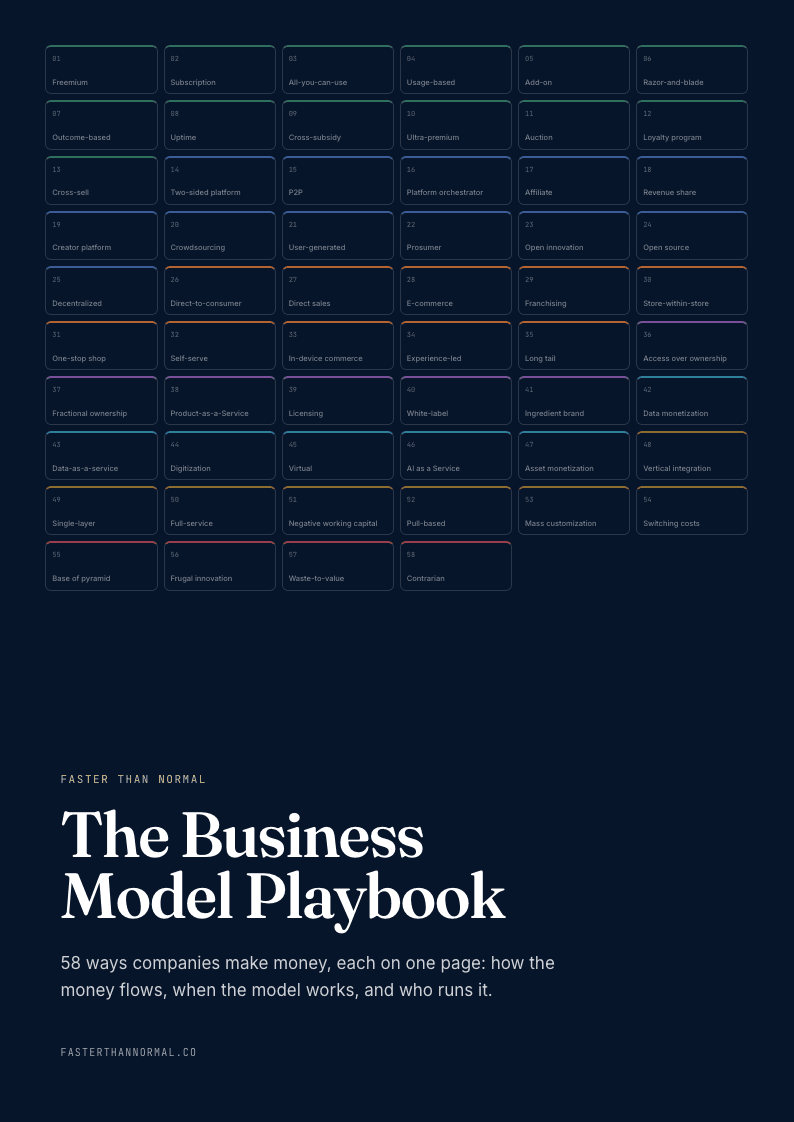
Get The Business Model Playbook
58 business models, one visual page each: how the money flows, the metrics that matter, and who runs it. Free when you join the Faster Than Normal email.
Free. No spam. Unsubscribe anytime.