

A System for Learning Intelligently, 10 Common Logical Fallacies, & More
Intelligent learning isn't about consuming more information. It's about making deliberate choices before you begin, then engineering a system that makes continuation inevitable.
Most learning fails at the selection stage — you start with vague intentions and insufficient stakes, then wonder why motivation evaporates after two weeks. The solution lies in systematic preparation and forced commitment.
A System for Learning Intelligently
Learning Selection
Before you consume a single piece of content, answer these filtering questions:
Is there a concrete need for this skill? Define it precisely. "I want to learn Python" is wishful thinking. "I need to automate my team's weekly reporting process, which takes 6 hours manually" is a real constraint that creates urgency.
How urgent is this need? Learning Spanish for a hypothetical trip someday will always lose to learning Excel for Monday's presentation. Urgency creates focus.
Is this the right time? Context matters. Don't learn graphic design when you're launching a product next month. Don't start German when you're changing jobs. Timing determines persistence.
Why will you stick with this when it gets difficult? Because it will get difficult. If your answer involves abstract personal growth, choose something else. If your answer is "my job depends on it" or "my business needs it," you might survive the hard middle.
Would you learn this if no one ever knew? Strip away the signaling value. Remove the LinkedIn post about your new certification. What remains is your true motivation.
Deconstruction
Every complex skill fractures into teachable components. Every subject can be mapped. Your job is to find the structure before diving into details.
Step 1: Define the scope. Search for mind maps, university curricula, Reddit threads, textbook tables of contents. Find three different sources that outline what you need to know. Look for patterns in their organization.
Step 2: Categorize what you find:
- Concepts: The big ideas you need to understand
- Facts: Definitions, formulas, key data points
- Examples: Cases that illustrate the concepts
- Procedures: If it's a skill, the step-by-step processes
Step 3: Interview an expert. Find someone who has the skill you want and ask them what matters most. One 30-minute conversation will save you hours of confused wandering through tangential content.
Selection and Compression
Here's where intelligence separates from busywork: Which 20% of what you identified will generate 80% of the results you need?
Ask yourself: If I only had two weeks to learn this, what would I focus on? That's your core curriculum. Everything else is nice-to-have.
Most subjects have a small number of fundamental principles that generate most of the complexity. Find those principles first.
Sequencing
Learning has prerequisites. You can't understand regression analysis without basic statistics. You can't debug code without understanding syntax. Map the logical dependencies.
What must you learn before you can learn the next thing? This isn't about following someone else's curriculum — it's about identifying the minimum viable knowledge needed for each step forward.
Walk before you run. But be precise about what "walking" means in your domain.
Resources and Learning Styles
Now choose your materials. If you learn better from video, don't force yourself through dense textbooks out of some misplaced academic reverence. If you need hands-on practice, don't spend weeks on theory.
The VARK model identifies four learning preferences:
- Visual: Diagrams, charts, mind maps
- Auditory: Lectures, podcasts, discussion
- Read/Write: Books, notes, written practice
- Kinesthetic: Hands-on work, experimentation
Match your resources to your strengths. Learning is hard enough without fighting your natural preferences.
Schedule and Stakes
Vague intentions produce vague results. "I'll work on this when I have time" means you'll never work on it.
Commit to specific hours per week. Block time in your calendar. Set a completion deadline. Make it concrete.
But here's the crucial step most people skip: Create real consequences for failure.
Tell colleagues you'll teach them what you learned by a specific date. Pre-pay for a course that starts in six weeks. Make a public commitment with a penalty for non-completion. Put money or reputation at risk.
A goal without consequences is wishful thinking. Make failure expensive.
Ten Common Logical Fallacies
Clear thinking requires recognizing flawed reasoning — both in others and yourself. These ten fallacies appear everywhere from boardroom presentations to family arguments.
Anecdotal Evidence
Using personal experience or isolated examples instead of systematic data. Humans love stories, but your experience isn't universal. What happened to you once doesn't predict what will happen to others consistently.
Begging the Question
Circular reasoning where the conclusion is assumed in the premise. "Smoking causes cancer because cigarette smoke is carcinogenic" assumes what it claims to prove. The argument provides no independent evidence.
Probable/Plausible Confusion
Probable fallacy: Assuming that because something is possible, it's likely.
Plausible fallacy: Assuming that because something sounds reasonable, it's true.
Possibility, plausibility, and truth are three different standards. Don't conflate them.
Inverse Fallacy
Confusing conditional probabilities. "Terrorists often have engineering backgrounds, therefore engineers are likely to be terrorists." The percentage of engineers who are terrorists is vastly different from the percentage of terrorists who are engineers.
Post Hoc Fallacy
"After this, therefore because of this." Event A preceded event B, so A must have caused B. The rooster crows before sunrise, but doesn't cause it. Correlation doesn't equal causation — even temporal correlation.
Texas Sharpshooter Fallacy
Cherry-picking data to support your argument. Named after a Texan who shoots at a barn, then paints a target around the tightest cluster of bullet holes and claims expert marksmanship.
You see this everywhere: companies highlighting their one successful quarter, investors showcasing their best picks, experts citing studies that support their position while ignoring contrary evidence.
Middle Ground Fallacy
Assuming the truth lies between two extreme positions. Sometimes one side is simply wrong, and a compromise with falsehood is still false. Halfway between truth and lie is still lie.
No True Scotsman
Defending a generalization by changing the definition when faced with counter-examples. "No successful entrepreneur takes vacations." "But Richard Branson takes lots of vacations." "No true successful entrepreneur takes vacations."
Common Belief Fallacy
Assuming popularity proves validity. "Everyone believes X, so X must be true." The number of people who hold a belief has no bearing on whether that belief corresponds to reality.
Democracy is a political system, not an epistemological one.
Genetic Fallacy
Judging ideas by their source rather than their merit. "That proposal comes from a competitor, so it must be bad." "This research was funded by the industry, so it's biased."
Sources matter for evaluation, but they don't determine truth. Bad actors sometimes have good ideas. Good actors sometimes have bad ideas.
Ten Mental Models for Making Sense of the World
Goodhart's Law
"When a measure becomes a target, it ceases to be a good measure."
Reward salespeople for number of cars sold, and they'll sell cars at a loss. Measure teachers by test scores, and they'll teach to the test. Focus on daily active users, and you'll optimize for addiction over value.
The moment you optimize for a metric, people game the metric rather than improve the underlying reality you care about.
The Paradox of Abundance
Information abundance decreases average quality while improving peak quality. More content means more garbage, but also more gems for those who can filter effectively.
The conscious consumer benefits enormously. The passive consumer drowns in mediocrity. Curation becomes the scarce skill.
Chronological Snobbery
Assuming newer is automatically better. Yes, technology progresses. But wisdom, principles, and human insights don't expire. Ancient Stoics understood psychology. Medieval craftsmen understood quality.
Progress in one domain doesn't invalidate insight in others. Test ideas on merit, not vintage.
Sturgeon's Law
"Ninety percent of everything is crap."
Most books, movies, articles, courses, and advice are mediocre. This isn't pessimism — it's resource allocation. Spend time finding the exceptional 10% before you start consuming.
Nirvana Fallacy
Rejecting good solutions because they're not perfect solutions. "This marketing campaign only increased sales 15%, but we need 25%, so it's a failure."
Perfect solutions rarely exist. Compare available options to each other, not to an impossible ideal. Take the option with the most bearable trade-offs.
Network States
Geography no longer determines community. Balaji Srinivasan's concept: future organizations may consist of like-minded people scattered globally, connected by internet-native coordination mechanisms.
Your tribe might live across six continents. Your local neighbors might share nothing with you beyond zip code.
Cumulative Culture
Human success comes from cultural knowledge, not individual intelligence. Culture accumulates the best ideas across generations. The insights you inherit from society are often older and wiser than you are.
Respect tradition not because it's old, but because it survived. Time is a brutal filter.
Via Negativa
When facing problems, our instinct is addition — new habits, new purchases, new systems. But subtraction often works better.
The foods you avoid matter more than the foods you eat. Removing distractions creates productivity better than adding productivity apps. Sometimes the solution is what you stop doing.
Hock's Principle
Simple principles generate complex, intelligent behavior. Complex rules generate simple, stupid behavior.
Trust clear guidelines over detailed procedures. Empower judgment over compliance. Give people principles and let them figure out applications.
All Models Are Wrong
Every model is a simplification. Every framework leaves out details. Every theory has exceptions.
But some models are useful. Judge them not by perfection, but by utility. A flawed map that gets you to your destination beats perfect terrain knowledge that keeps you paralyzed at home.
The goal isn't truth — it's better decisions.
Free playbook
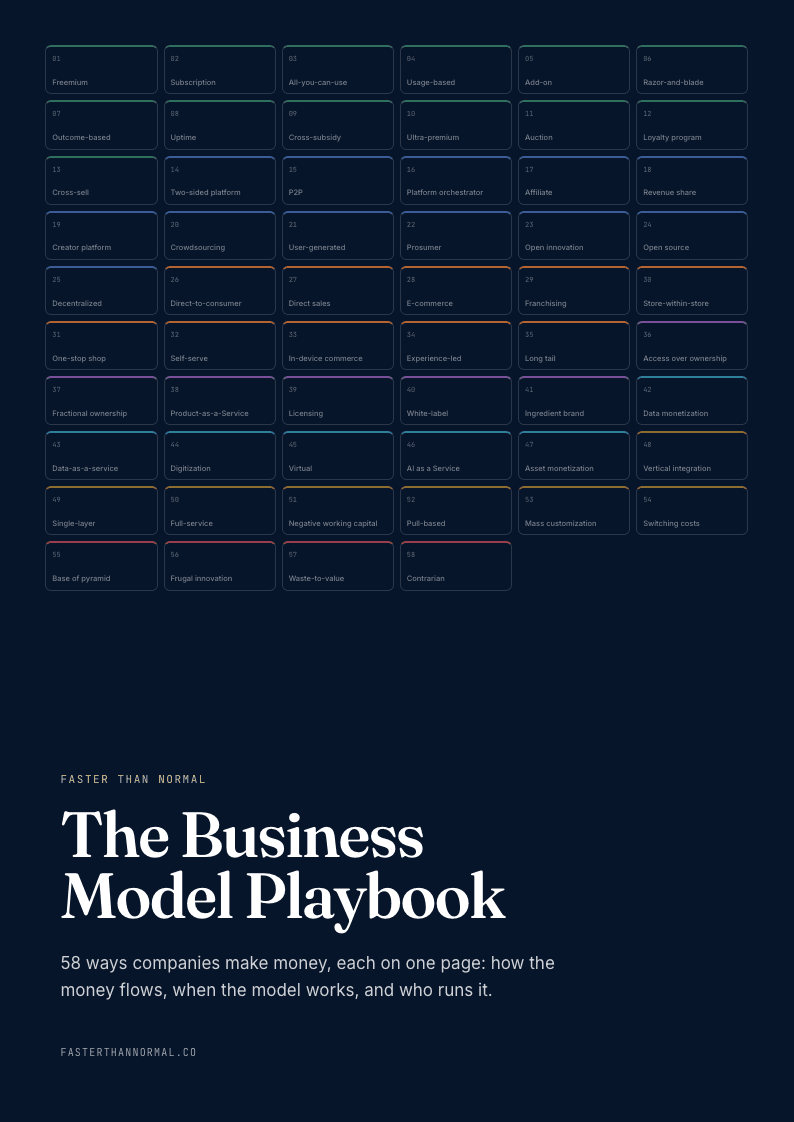
Get The Business Model Playbook
58 business models, one visual page each: how the money flows, the metrics that matter, and who runs it. Free when you join the Faster Than Normal email.
Free. No spam. Unsubscribe anytime.