

A Simple Framework To 10x Your Network, Framework For Evaluating Startup Ideas, Subtraction As The Antidote To Abundance & More
Most high-performers mistake networking for a contact-collection contest. They attend events, exchange cards, and wonder why relationships never materialize into opportunities. The missing piece isn't strategy—it's psychology.
The Help-First Framework
Every encounter with another person should trigger a single question: "How can I help this person?"
This isn't altruism. It's the most effective form of self-promotion ever devised.
When you see someone you'd rather not engage, ask how they're doing and what they're working on. Find something obvious you can help with. When interviewing someone you won't hire, tell them halfway through. Use the remaining time to problem-solve their career trajectory. You'll become their most memorable rejection.
The framework works because it shifts your mindset from scarcity to abundance. Instead of extracting value from interactions, you create it. People remember helpful, constructive, dependable individuals. They think of you for job opportunities, investment deals, and situations requiring trust. They tell others about these qualities, compounding your reputation.
Yes, some bad actors succeed. But that requires extraordinary intellect or skill to overcome their character deficits. For those with functioning hearts, helping others is the only sustainable path to success.
The difficulty: delayed gratification. You might spend months helping others without immediate returns. But human behavior doesn't change—we're hardwired to reciprocate kindness. Over long time periods, your investment will return 10x.
Remember: helpful people don't ask "how can I help?" They just help.
Beyond the Minimum Viable Product
Gagan Biyani co-founded Udemy, a billion-dollar company, then raised $20 million from Andreessen Horowitz for Maven. His approach to startup validation diverges from Silicon Valley orthodoxy.
The traditional method: build a Minimum Viable Product quickly, see if users find value, iterate until they do. Biyani uses Minimum Viable Testing instead.
An MVT tests critical hypotheses—assumptions that must be true for the business to survive. Airbnb had to prove strangers would pay to stay in others' homes. Rather than building software, they tested this with air mattresses in their living room, offering free wifi and breakfast to conference attendees when hotels were booked. They validated the core assumption with real data, minimal risk, and negligible cost.
MVT vs MVP: The Strategic Difference
MVP approach: No strategy—throw things at the wall until something sticks. Iterate from an initial product.
MVT approach: Take time to discover strategy, then move forward with conviction. Build with confidence.
MVPs overemphasize building when products succeed on core insights, not feature counts. They make founders obsess over customer opinions, leading to incremental improvements instead of breakthrough innovations. They accumulate technical debt from the start.
The MVT Framework
First, immerse yourself in the industry. Determine user jobs-to-be-done. Identify your value proposition.
Then execute the MVT process:
List your riskiest assumptions. Common failure modes include building unwanted products, execution complexity, distribution challenges, insufficient market size, or unprofitability.
Test assumptions creatively. Pick your riskiest assumption and devise a specific test. Disregard the future solution's appearance. Focus on the lowest-risk, lowest-cost validation you can deliver quickly, leveraging existing assets.
Once you've validated enough assumptions to have confidence, build your initial product. Iterate until you achieve product-market fit. Then scale.
The Power of Subtraction
Productivity advice misses the point. Achieving more in less time requires one focus: minimizing distractions.
Turn off notifications. Quiet your environment. Delete social media apps. Block distracting websites. Leave your phone in another room.
Subtraction is abundance's antidote.
Decision-Making Frameworks
The 10:10:10 Strategy
Before important decisions, ask: How will I feel 10 minutes from now? 10 months from now? 10 years from now?
This forces long-term thinking beyond immediate gratification.
Four Principles for Better Decisions
Consider unintended consequences. What unplanned outcomes could occur? Focus on second-order effects. Can you live with all of them?
Preserve optionality. Make choices that keep future options open. When possible, delay decisions until you have maximum information. Higher certainty leads to better paths.
Avoid short-termism. Excessive focus on short-term results damages long-term interests. Companies prioritizing quarterly earnings over innovation demonstrate this trap. Optimize for the long term when possible.
Apply the precautionary principle. Sometimes taking no action is better than risking bad or unintended results. Pause to increase certainty that decisions will be safe.
"We make choices, but we don't always choose the consequences." —Sean Covey
"Precaution is better than cure." —Johann Wolfgang von Goethe
Free playbook
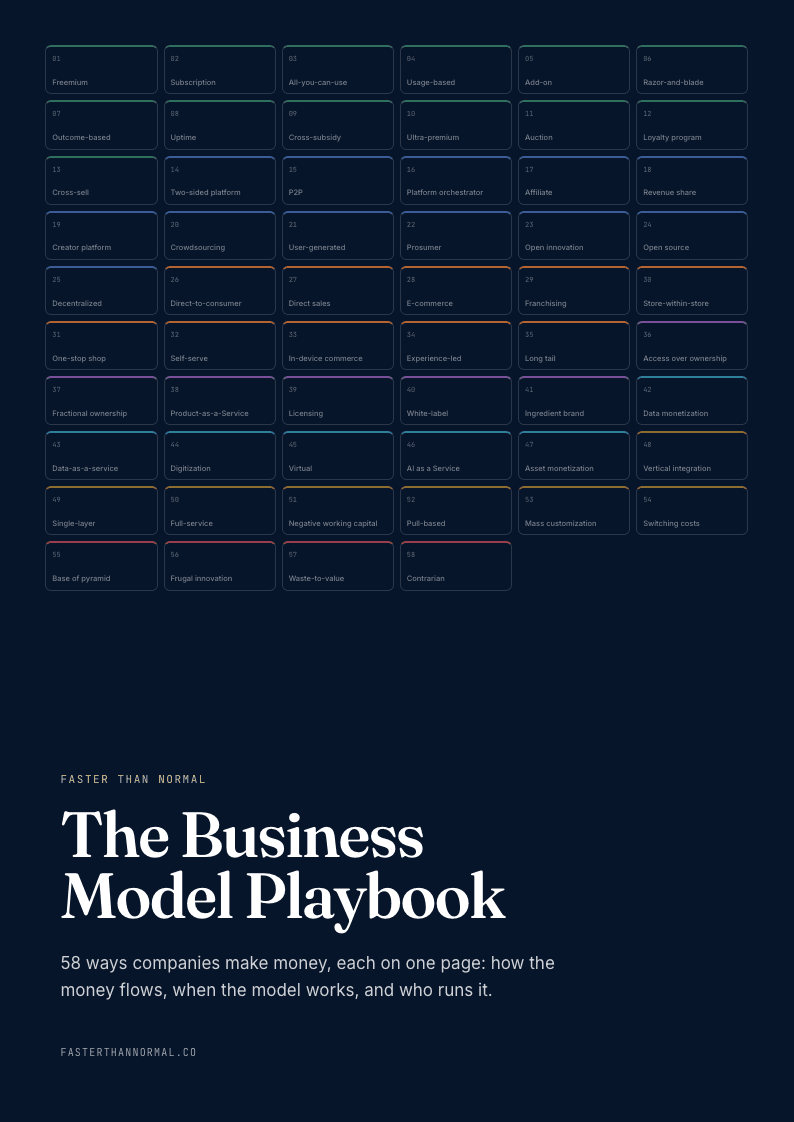
Get The Business Model Playbook
58 business models, one visual page each: how the money flows, the metrics that matter, and who runs it. Free when you join the Faster Than Normal email.
Free. No spam. Unsubscribe anytime.