

9 Things You Can Do Today That Will Extend Your Lifespan
The promise of extending human lifespan has never been more scientifically grounded. While Silicon Valley chases longevity moonshots through technology and bioengineering, the most effective interventions remain surprisingly mundane — and available today. What follows are nine evidence-backed practices that don't require venture funding or FDA approval. Just discipline.
Sleep as a Non-Negotiable
Human beings are the only species that deliberately deprive themselves of sleep. This evolutionary anomaly carries steep costs.
Research accumulated over the past decade delivers an unambiguous verdict: sleep is the single most effective daily intervention for resetting both brain and body health. Not supplements. Not biohacking gadgets. Sleep.
The mechanism is straightforward. During deep sleep, your brain's glymphatic system activates — essentially a cleaning crew that flushes out metabolic waste accumulated during waking hours. Skip this process consistently, and you're accumulating neurological debt that compounds over decades.
The financial parallel is exact. You can defer maintenance on critical infrastructure for years. Eventually, the bill comes due.
The Blue Zone Diet Architecture
Five regions around the world — Sardinia, Okinawa, Nicoya, Icaria, and Loma Linda — produce an unusual concentration of centenarians. Dan Buettner's Blue Zones research identified a consistent dietary pattern across these geographically dispersed populations.
Plant-based foods comprise roughly 95% of their caloric intake. This isn't ideology. It's data.
Walter Willett from Harvard School of Public Health frames the tradeoff bluntly: "Meat is like radiation: We don't know the safe level." The statement reflects genuine uncertainty about dosage effects, not moral positioning. The Blue Zone populations resolved this uncertainty through near-complete avoidance.
You don't need to adopt their exact approach. But the directionality is clear.
Heavy Lifting as Insurance
Weight training delivers three distinct longevity benefits, each operating through different biological pathways.
First, heavy lifting increases bone mineral density. This matters because bone fractures — particularly hip fractures — often trigger a cascade of complications in older adults. Building bone density in your 30s and 40s is insurance against vulnerability decades later.
Second, muscle mass elevation increases resting metabolic rate. More muscle burns more calories at rest, making weight management easier across decades.
Third, coordination improves. This isn't just about athletic performance. It's about reducing fall risk and maintaining independent mobility as you age.
The prescription is specific: lift weights heavy enough that you can only complete 6-8 repetitions with proper form. Twice per week minimum.
Intermittent Fasting as Cellular Maintenance
The human digestive system evolved during periods of food scarcity. Constant food availability is a recent historical anomaly, and our bodies haven't adapted to process continuous nutrient input efficiently.
Intermittent fasting triggers beneficial stress responses that don't activate during fed states. These include increased antioxidant production, enhanced DNA repair mechanisms, and autophagy — the cellular process that removes damaged or dysfunctional components.
David Sinclair's research at Harvard demonstrates that fasting activates longevity genes that remain dormant during constant feeding cycles. The intervention is simple: create consistent periods where you're not consuming calories. A 16-hour daily fast is sufficient to trigger these pathways.
Movement as Daily Maintenance
Office work has created an environmental mismatch. Human bodies are designed for regular movement throughout the day, not sustained static positioning.
This mismatch creates predictable problems: joint stiffness, muscle imbalances, and movement restrictions that compound over decades. Mobility work — yoga, stretching, basic movement patterns — functions as preventive maintenance.
The goal isn't flexibility for its own sake. It's maintaining the movement capacity to navigate daily life without injury as you age. Ten minutes of daily mobility work is more valuable than hours of weekly intensive sessions.
Alcohol as Strategic Limitation
Alcohol presents a classic optimization problem. Small amounts may support social connections, which independently correlate with longevity. Larger amounts damage multiple organ systems and impair cognitive function.
The research suggests a narrow optimal zone. Light consumption — particularly red wine — shows neutral to slightly positive health effects in some populations. Heavy consumption shows universally negative effects on cardiovascular health, cognitive function, and all-cause mortality.
Beyond physiological effects, alcohol impairs motivation and decision-making capacity. This creates secondary effects that compound over time. The cost isn't just biological. It's opportunity cost.
Stress Management as Biological Necessity
Chronic stress accelerates cellular aging through measurable biological pathways. It shortens telomeres, increases inflammatory markers, and impairs immune function. The effect is dose-dependent: more stress, more aging.
The mechanism involves cortisol dysregulation. Short bursts of cortisol are beneficial — they mobilize resources during challenges. Chronic elevation becomes toxic, particularly to brain structures involved in memory and executive function.
Stress management isn't wellness theater. It's biological maintenance. Meditation, exercise, and social support all demonstrate measurable effects on stress biomarkers.
Social Connection as Longevity Infrastructure
Social isolation correlates with mortality risk comparable to smoking or obesity. This isn't about happiness or life satisfaction, though those matter. It's about survival.
Research from Harvard's Grant Study — the longest-running study of human development — identified relationship quality as the strongest predictor of late-life wellbeing. People with strong social ties show lower rates of cognitive decline, better cardiovascular health, and reduced all-cause mortality.
The relationship appears bidirectional. Social connection reduces stress, which improves immune function. It also creates accountability systems that support other healthy behaviors.
Weak social ties produce the opposite effect: increased inflammation, accelerated cognitive decline, and higher mortality rates.
Exercise as Genetic Activation
Physical activity functions as hormetic stress — beneficial stress that activates adaptive responses. These responses include the upregulation of longevity genes that remain dormant in sedentary individuals.
The mechanism involves cellular signaling pathways that interpret physical stress as an environmental challenge requiring adaptation. The body responds by strengthening multiple systems: cardiovascular, muscular, neurological, and immune.
The dose matters less than the consistency. Daily movement — even at moderate intensity — produces greater longevity benefits than sporadic intense exercise. The Blue Zone populations don't run marathons. They walk daily, work physically, and maintain consistent low-level activity throughout their lives.
These interventions share a common characteristic: they're all available today, require no special equipment or expertise, and cost nothing to implement. The barrier isn't access. It's prioritization.
The data is clear. The only question is whether you'll act on it.
Free playbook
Get The Business Model Playbook
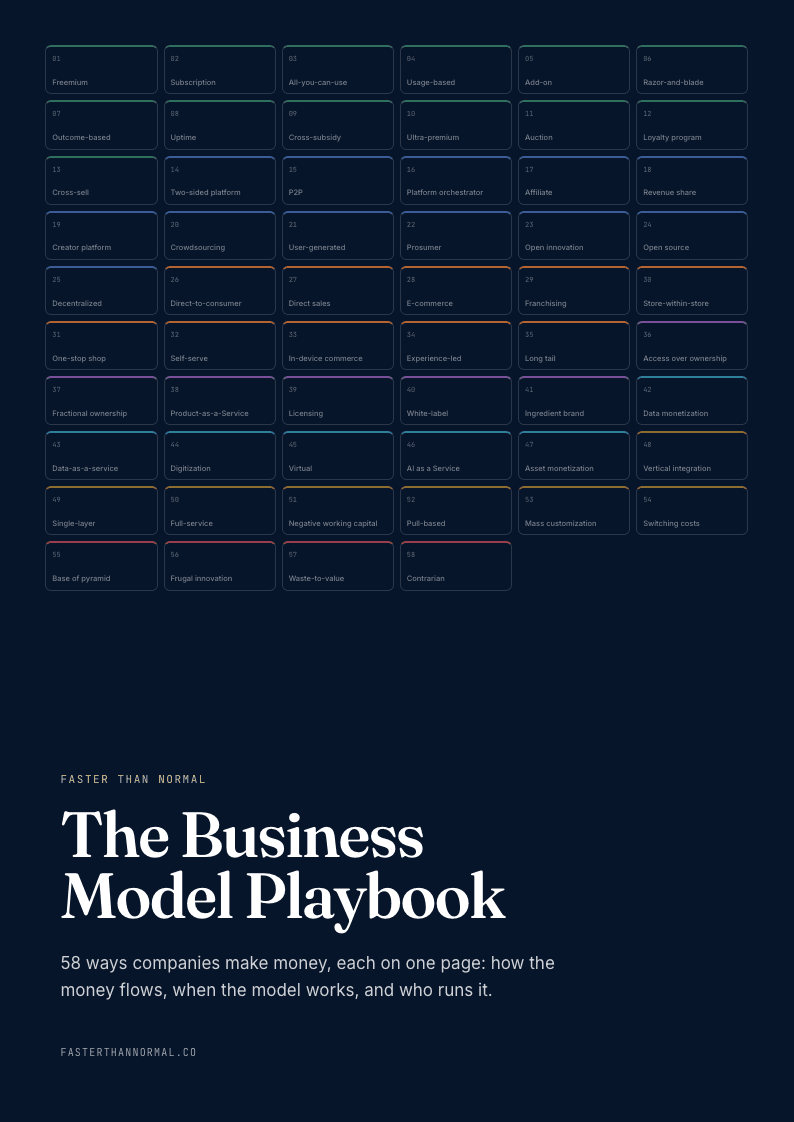
58 business models, one visual page each: how the money flows, the metrics that matter, and who runs it. Free when you join the Faster Than Normal email.
Free. No spam. Unsubscribe anytime.