

9 Of The Best Decision-Making Resources On The Internet
9 of the best decision-making resources on the internet
Good decisions compound like interest. Bad ones pile up like debt. The difference between high performers and everyone else isn't intelligence — it's decision architecture.
Most operators treat decision-making as intuitive. They rely on gut feel, past experience, or whatever framework worked last quarter. This approach breaks down under complexity. Under pressure. Under the weight of consequences that extend beyond the next board meeting.
The resources below represent years of research from operators who've learned this lesson the expensive way. They're not academic theories. They're battle-tested frameworks from people who've made decisions that moved markets, built companies, and occasionally lost fortunes.
The Foundation: Process Over Outcome
Junto Investments cuts to the core insight: decision quality and outcome quality are different variables. A good decision can produce a bad outcome. A terrible decision can get lucky. Most operators confuse the two, then optimize for the wrong thing.
Their framework starts with a simple question: How much does this decision matter? High-stakes, irreversible decisions get the full treatment — research, stakeholder input, scenario planning. Everything else gets delegated or decided quickly.
The multiplier effect is real. As Junto notes: "In the same way compounding interest increases wealth, good decisions produce exponentially better results the more of them we make."
Product Management as Decision Factory
Brandon Chu, writing from his experience at Shopify, frames product management as a decision production system. His insight: the most important decision is deciding how important a decision is.
This sounds recursive until you see it in practice. Product managers who can't distinguish between reversible door-one decisions and irreversible door-two decisions burn cycles on the wrong problems. They over-engineer solutions to tactical questions while under-investing in strategic ones.
Chu's framework forces explicit classification. Reversible decisions get made fast with incomplete information. Irreversible decisions get the full process — stakeholder alignment, data gathering, option analysis.
The result: decision velocity where it matters, decision quality where it counts.
Naval's Heuristics: Rules for the Infinite Game
Naval Ravikant's three decision heuristics operate at a different level — the meta-principles that guide choice architecture:
-
If you can't decide, the answer is no. This applies to everything from hiring decisions to product features. Enthusiasm should be obvious.
-
Run uphill. Choose the path with more short-term pain but better long-term positioning. Most people optimize for comfort; you optimize for capability.
-
Praise specifically, criticize generally. When building systems (teams, processes, cultures), this asymmetry shapes behavior in your favor.
These aren't decision frameworks in the traditional sense. They're decision filters — ways to eliminate options before formal analysis begins.
Mauboussin's Error Prevention System
Michael Mauboussin approaches decisions from the opposite direction: error prevention rather than optimization. His research at BlueMountain Capital identified five systematic mistakes that destroy decision quality:
Narrow framing, confirmation bias, short-term emotion, overconfidence, and group dynamics. Each has specific countermeasures. Process beats talent when the process addresses these failure modes directly.
His insight: "You gain more by not being stupid than you do by being smart. Smart gets neutralized by other smart people. Stupid does not."
This is particularly relevant in competitive markets where everyone has access to similar information and similar talent. The edge comes from avoiding unforced errors, not from finding brilliant insights.
The Checklist Advantage
Atul Gawande's research on checklists reveals why even experts need structured decision support. Under complexity, human cognition fails predictably. We skip steps. We forget context. We assume others checked what we didn't.
Junto's application to decision-making creates a forcing function: important decisions must pass through a standardized review. The checklist doesn't make the decision — it ensures the decision-maker has considered the right variables.
This matters more as organizations scale. Individual judgment doesn't scale. Process does.
Decision Journals: The Learning System
Farnam Street's decision journal approach attacks the feedback problem. Most decisions have delayed outcomes. By the time you know if a decision was good or bad, you've forgotten your reasoning process.
The journal captures four elements: the situation, the options considered, the decision made, and the reasoning behind it. Six months later, you review both process and outcome.
This creates a feedback loop that's otherwise missing. You start to see your own patterns — which mental models you over-rely on, which situations trigger poor judgment, which types of decisions you should delegate.
The meta-insight: decision-making skill is trainable, but only with deliberate practice and feedback.
Organizational Decision Architecture
Ben Johnston's thread on organizational decision-making reveals how high-performing companies structure choice at scale. The framework distinguishes between decision types, assigns clear ownership, and creates escalation paths that preserve both speed and quality.
Key insight: most organizational dysfunction stems from unclear decision rights. Who decides what, when, and with whose input? Without explicit answers, every choice becomes a political negotiation.
Johnston's companies use RACI matrices (Responsible, Accountable, Consulted, Informed) for significant decisions. This sounds bureaucratic until you realize the alternative — endless alignment meetings and decision paralysis.
The Human Element
Both Lifelessons resources emphasize what the frameworks miss: how you live with decisions matters as much as how you make them. Perfect decision-making is impossible. Perfect decision-making processes can become analysis paralysis.
The psychological component is real. Regret, second-guessing, and decision fatigue all compound over time. Sometimes the "right" decision is the one you can execute with confidence, not the theoretically optimal one.
The pattern across these resources is consistent. Good decision-making isn't about being smarter. It's about being more systematic. The best operators don't rely on intuition — they build intuition into their systems.
That's the real edge. While others agonize over individual choices, you're optimizing the choice-making machinery itself.
Free playbook
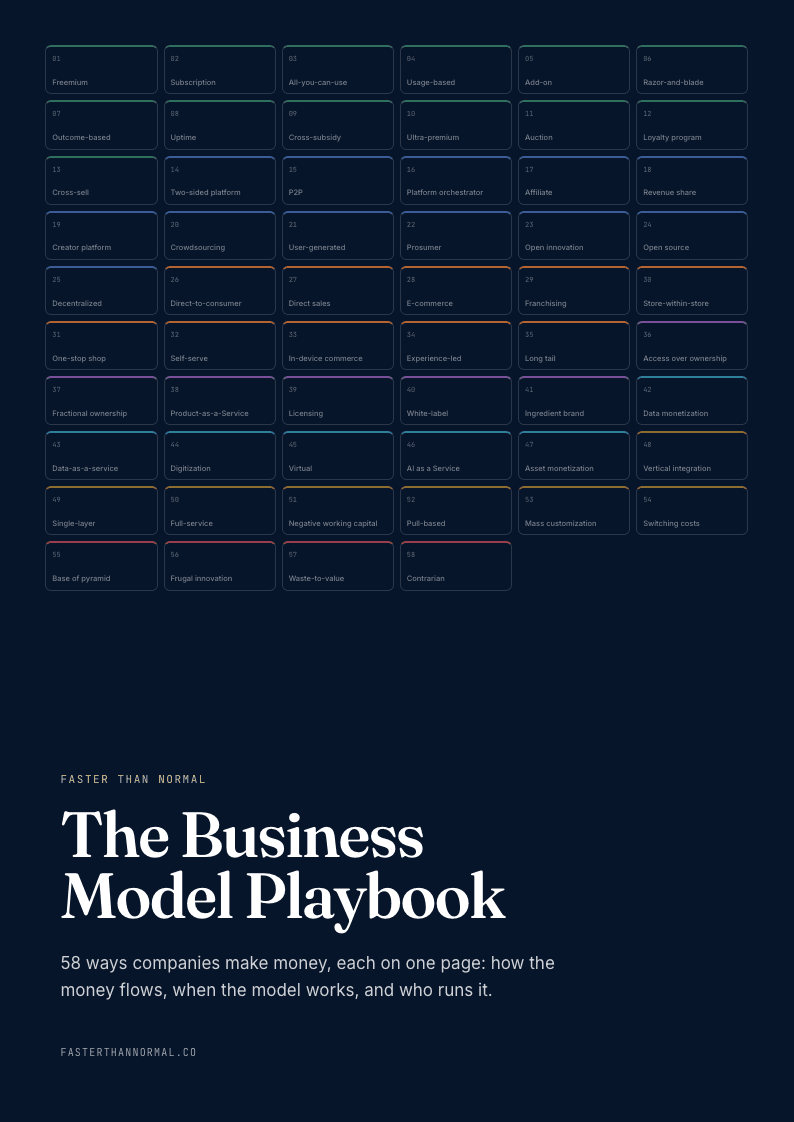
Get The Business Model Playbook
58 business models, one visual page each: how the money flows, the metrics that matter, and who runs it. Free when you join the Faster Than Normal email.
Free. No spam. Unsubscribe anytime.