

Wrong-Side-of-Maybe Fallacy, Load Theory, Luxury Beliefs, & More
Most people misunderstand probability in a predictable way. When a weather forecast calls for a 70% chance of rain and it doesn't rain, they declare the forecast "wrong." When it rains, they call it "right." This is the wrong-side-of-maybe fallacy — judging probabilistic predictions based solely on which side of 50% they land, rather than their actual calibration over time.
Philip Tetlock identified this pattern in his research on forecasting accuracy. The fallacy reveals a fundamental confusion between confidence and correctness, between being directionally right and being precisely calibrated. A 70% forecast that fails to materialize wasn't wrong — it was telling you that 3 out of 10 times, it wouldn't rain.
The same logic applies to business decisions. Venture capitalists who back companies with a 30% success rate aren't failing when 7 out of 10 investments don't work. They're operating within expected parameters, assuming their 30% winners generate sufficient returns to compensate for the 70% that don't.
The Paradox of Attention
Attention operates under load theory: you have a fixed amount, but how it gets deployed depends on situational demands — not necessarily your conscious choices. When cognitive load increases through fatigue, stress, or competing priorities, your attention becomes less responsive to intentional direction.
Neuroscientist Amishi Jha's research shows this isn't a failure of willpower. It's a predictable redistribution. Under high load, attention defaults to processing immediate threats and urgent stimuli rather than longer-term strategic thinking. The executive function that normally governs where you focus becomes compromised, not eliminated.
This explains why late-day decisions tend toward the expedient rather than the optimal. Why entrepreneurs burn out not from working too much, but from context-switching too frequently. Why meditation practitioners report improved decision-making — not because they think more, but because they preserve cognitive resources for when thinking matters most.
The practical implication: structure your environment to reduce load rather than relying on discipline to overcome it.
Status Through Ideas
Rob Henderson coined "luxury beliefs" to describe how cultural elites signal status when traditional luxury goods lose their differentiating power. These are ideas and opinions that confer status on the wealthy at minimal personal cost while imposing real burdens on lower-income populations.
Consider the belief that marriage is outdated or that standardized testing is harmful. Wealthy families can navigate relationship instability through extensive support networks and legal resources. They can compensate for educational gaps through private tutoring and elite connections. The direct costs of these beliefs — family instability, reduced educational assessment — fall disproportionately on families without such resources.
Luxury beliefs spread precisely because they're intellectually sophisticated and morally appealing to educated audiences. They offer a way to signal enlightened thinking without personal sacrifice. The divorced investment banker pays no social penalty for advocating against marriage norms, while working-class families experience the actual consequences of relationship breakdown without equivalent safety nets.
The pattern extends beyond social policy. In business, luxury beliefs might include skepticism toward metrics, celebration of "authentic" communication over professional polish, or dismissal of traditional business education. These positions cost little for those with established networks and proven track records, but can disadvantage those still building professional credibility.
The Backwards Law and Strategic Pursuit
Alan Watts identified the backwards law: the more directly you pursue feeling better, the less satisfied you become. The act of pursuit reinforces the perception of lack. Wanting what you have proves as valuable as having what you want.
This principle maps onto business psychology in counterintuitive ways. Companies that optimize explicitly for employee happiness often create cultures where people feel pressure to perform contentment. Organizations that chase growth metrics sometimes sacrifice the operational fundamentals that generate sustainable growth.
The backwards law suggests indirect approaches often prove more effective. Netflix succeeded not by trying to make people happy, but by solving the specific problem of convenient entertainment access. Amazon grew not by optimizing for scale, but by obsessing over customer experience at current scale.
For individual operators, the implication is tactical: focus on building systems and capabilities rather than pursuing outcomes directly. Revenue follows from solving genuine problems. Influence accumulates through consistent value creation. Happiness emerges from engagement with meaningful work, not from trying to feel better.
Bulverism and Argument Structure
C.S. Lewis named bulverism: assuming someone is wrong because of their personal characteristics, then explaining why they hold their mistaken views. "You're only saying that because you're a [insert demographic category]." The error lies in the sequence — explanation without demonstration.
Bulverism appears frequently in business contexts disguised as strategic analysis. "They're only pursuing that market because they're desperate for growth." "She's only advocating remote work because she lives in the suburbs." "They're only skeptical of AI because they're threatened by technological change."
Each statement might contain truth, but starting with motivation rather than evaluating the underlying claim weakens the analysis. Better sequence: first establish whether the strategic position is sound, then consider why someone might hold it.
This matters for internal decision-making. When evaluating proposals, separate the quality of the idea from your assessment of the proposer's motives. A mediocre performer can still identify genuine market opportunities. A strong cultural fit can still advocate for the wrong strategic direction.
The discipline: engage with the strongest version of opposing arguments before dismissing them based on their source.
Necessity Versus Sufficiency
Necessary conditions must be present for an outcome, but alone they're insufficient. Sufficient conditions actually produce the result.
Capital is necessary for scaling a business but insufficient — plenty of well-funded companies fail to scale. Product-market fit is necessary for sustainable growth but insufficient — companies with great products still fail in execution. Technical competence is necessary for engineering leadership but insufficient — management requires different skills entirely.
The confusion between necessity and sufficiency creates predictable strategic errors. Hiring for necessary qualifications without ensuring sufficient capabilities. Raising funding (necessary) without building distribution (sufficient). Achieving technical milestones (necessary) without validating market demand (sufficient).
For operators, the framework clarifies resource allocation. Identify what's truly sufficient for your next milestone, not just what's obviously necessary. Sufficiency often requires combinations of factors rather than single elements — technical capability plus market timing plus distribution advantage plus team execution.
The Toxoplasma of Rage
Scott Alexander observed that controversial ideas spread further than universally accepted ones. Controversy provides opportunities for tribal signaling and individual differentiation that consensus cannot offer.
This explains why obviously good advice — "work hard," "treat people well," "focus on customers" — generates minimal social media engagement while provocative contrarian takes go viral. The controversial position allows both agreement and disagreement to feel meaningful, while obvious truths offer no opportunity for social positioning.
The phenomenon creates perverse incentives for thought leadership. The most spreadable ideas are often edge cases, exceptions, or deliberately contrarian positions rather than broadly applicable principles. The content that builds audiences isn't necessarily the content that builds businesses.
For builders, this suggests focusing on implementation over ideas. The unsexy fundamentals — consistent execution, operational discipline, genuine customer focus — matter more than having opinions about industry trends. The latter generates attention; the former generates results.
Cultural Parasitism
Some ideologies function as cultural parasites — they propagate not because they're true, but because they're structured for easy transmission and belief. The ideas change behavior in ways that ensure their own spread, independent of their accuracy or utility.
Cultural parasitism explains why certain business philosophies persist despite mixed evidence. "Move fast and break things" spreads because it's memorable and gives permission for preferred behaviors, not because it's optimal for all contexts. "Follow your passion" propagates because it's emotionally appealing, not because passion reliably precedes expertise.
The pattern appears in investment themes, management fads, and strategic frameworks. Ideas that are easily believable and ideologically satisfying often outcompete ideas that are more accurate but less convenient.
The defense requires intellectual skepticism toward ideas that feel too aligned with existing preferences. The most dangerous beliefs are those that confirm what you already wanted to believe and give intellectual cover for actions you already wanted to take.
Beware of frameworks that are both ideological and easily transmissible. They may be optimizing for spread rather than truth.
Free playbook
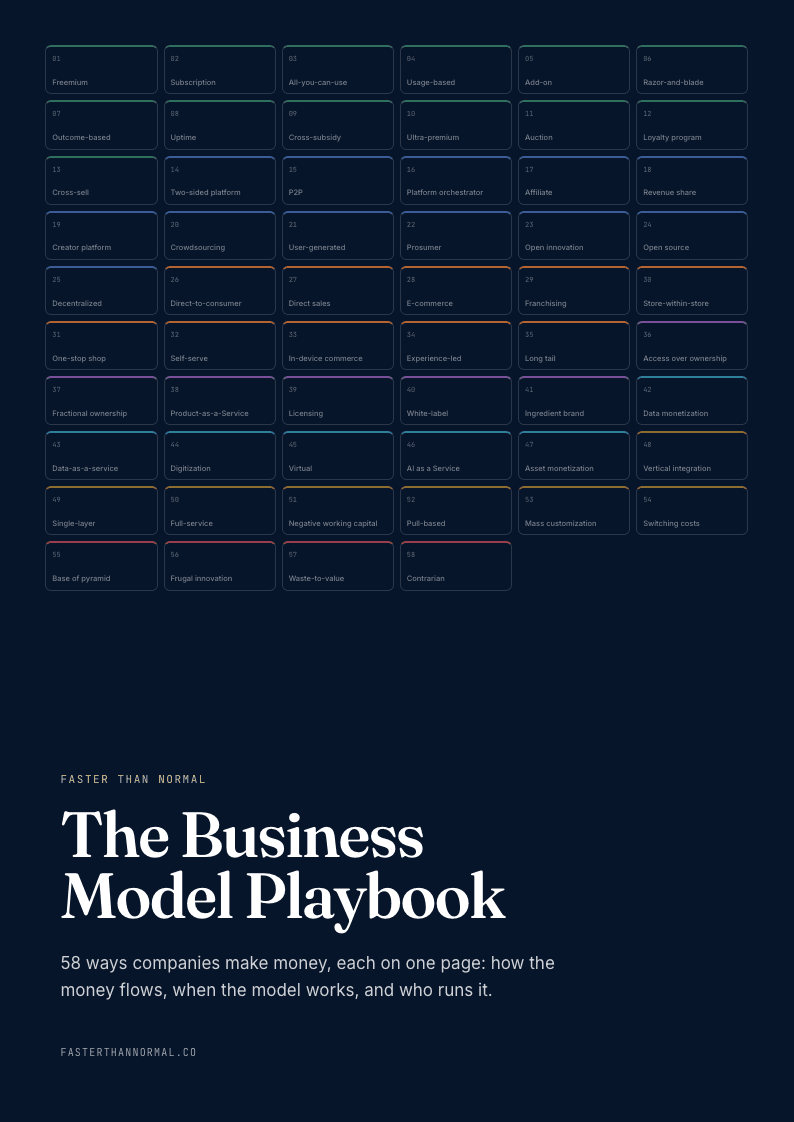
Get The Business Model Playbook
58 business models, one visual page each: how the money flows, the metrics that matter, and who runs it. Free when you join the Faster Than Normal email.
Free. No spam. Unsubscribe anytime.