

The Paradox of Unanimity, The Great Temptation, Centrality, & More
The Faster Than Normal roster includes 300 new subscribers this week alone — a signal that serious operators recognize the compounding value of rigorous mental models. What follows are nine frameworks that reveal hidden patterns in markets, organizations, and human behavior. Each one should shift how you see the world.
The Paradox of Unanimity
Ancient Jewish courts operated under a counterintuitive principle: if every judge voted to convict a defendant, the case was dismissed. Perfect consensus suggested systematic blindness, not clarity.
Too much agreement signals groupthink. When everyone reaches the same conclusion, it often means critical dissenting voices were either absent or silenced. The most dangerous decisions emerge from rooms where nobody disagrees.
Modern applications are everywhere. Venture partnership meetings where every partner loves a deal. Board rooms where no director raises concerns. Leadership teams that see only upside in a strategic pivot.
Real insight requires friction. If your inner circle always agrees with you, you don't have advisors — you have an echo chamber.
The Great Temptation
The Fermi Paradox haunts astrobiology: given the vast number of potentially habitable planets, where is everybody? One answer lies in what evolutionary biologist Robin Hanson calls "the Great Temptation" — the tendency for intelligent civilizations to optimize for pleasure rather than expansion.
Consider the pattern closer to home. Declining birth rates across developed nations. The rise of virtual worlds more compelling than physical reality. Technology designed to capture attention rather than extend human capability.
The Great Temptation manifests whenever immediate gratification crowds out long-term survival imperatives. Social media dopamine hits replace meaningful relationship building. Streaming services substitute for skill development. Virtual achievements replace real-world accomplishment.
For individuals and organizations alike, the temptation is always present: optimize for what feels good now versus what enables growth tomorrow.
Centrality
In network theory, centrality measures how connected a node is to other nodes. High centrality means more information flow. Information flow translates to influence. Influence becomes power.
The most successful people and companies aren't necessarily the most talented — they're the most central. They occupy structural positions that give them first access to information, opportunities, and relationships that others want.
Marc Benioff built Salesforce's dominance partly by making himself central to the broader SaaS ecosystem. Reid Hoffman leveraged his centrality in Silicon Valley networks to create LinkedIn. Naval Ravikant's influence stems from his position at the intersection of technology, philosophy, and investing.
Centrality is engineered, not accidental. It requires intentional relationship building, consistent value creation, and strategic positioning at the intersection of important trends.
Personal Monopoly
David Perell's concept cuts against conventional wisdom: while corporations reward conformity, the internet rewards uniqueness. The goal isn't to be better than your competition — it's to be the only person who does exactly what you do.
Personal monopolies emerge from the intersection of your skills, interests, and market gaps. Tyler Cowen owns the intersection of economics and eclectic cultural commentary. Ben Thompson dominates technology strategy analysis. Morning Brew captured the millennial business news market.
The framework applies beyond content creation. In any field, the highest returns go to people who combine skills in ways that create unique value propositions. A developer who understands both machine learning and fashion. A lawyer who specializes in cryptocurrency regulations. A consultant who bridges Silicon Valley and Wall Street cultures.
Find your unique combination. Then amplify it relentlessly.
Confusopoly
Scott Adams coined this term to describe industries where companies eliminate price competition by making their offerings impossibly complex to compare. Insurance policies with dozens of variables. Mobile phone plans with different data limits, overage charges, and network restrictions. Enterprise software with countless feature tiers and add-ons.
The genius is strategic obfuscation. When customers can't easily compare options, they default to brand recognition, sales relationships, or simply give up and pick randomly. Competition shifts from price and quality to marketing spend and distribution reach.
Confusopolies are expanding. Healthcare, financial services, and even consumer products increasingly rely on complexity as a competitive moat. The antidote is relentless simplification — either in how you buy from confusopolies or how you compete against them.
Pre-Suasion
Robert Cialdini's research reveals that the moment before you make your request often matters more than the request itself. Pre-suasion is about priming your audience to be receptive before you ask for what you want.
Restaurants that ask "How was everything?" before presenting the check receive higher tips than those that simply drop the bill. Fundraising emails that begin with "You are a generous person" generate more donations than those that lead with the cause itself.
The principle scales to strategic contexts. Before proposing a new initiative, prime stakeholders with success stories from similar projects. Before negotiating a contract, establish criteria for success that favor your position. Before launching a product, shape market expectations around the problem it solves.
What you present first changes how people experience what comes next.
Hypernovelty
Evolutionary biologists Bret Weinstein and Heather Heying argue that the pace of environmental change now exceeds our ability to adapt. Our biological systems evolved for gradual change over generations, not the radical shifts we experience within decades or years.
The mismatch manifests everywhere. Social media exploits neural pathways designed for small group dynamics. Financial markets move at speeds that overwhelm human decision-making capabilities. Information volumes exceed our cognitive processing limits.
Organizations face the same challenge. Management structures designed for stable industries prove inadequate in rapidly shifting markets. Strategic planning horizons shrink as competitive cycles accelerate.
The response isn't to slow down change — it's to build systems that can operate effectively amid constant novelty. This means embracing uncertainty, building adaptive capacity, and designing for resilience rather than optimization.
The Rich Ratio
Most discussions about wealth focus on absolute numbers. The Rich Ratio reframes the question: how much do you earn relative to how much you need?
The formula is simple: Earn ÷ Need = Rich Ratio. Once your ratio exceeds 1.0, you've achieved financial security. Everything above that is optionality.
The insight is that "rich" is contextual. A software engineer earning $150K in San Francisco with a $200K lifestyle has a ratio of 0.75 — technically poor. A freelancer earning $60K in Bangkok with $40K in expenses has a ratio of 1.5 — technically wealthy.
The ratio highlights two paths to wealth: increase earnings or decrease needs. Most people focus exclusively on the numerator while ignoring the denominator. The smartest optimize both simultaneously.
Surveillance Society Nightmare
The internet's ability to aggregate, analyze, and act on personal data creates unprecedented opportunities for behavior modification at scale. The nightmare scenario isn't Big Brother — it's persuasive technology that shapes choices while maintaining the illusion of autonomy.
We're already there in many domains. Recommendation algorithms determine what content we see. Dynamic pricing adjusts what we pay based on our perceived willingness to spend. Targeted advertising influences what we buy, often without our conscious awareness.
The stakes extend beyond consumer choice. Political messaging, career opportunities, and social connections increasingly depend on algorithmic intermediaries that optimize for engagement, not truth or wellbeing.
The defense isn't to opt out — it's to understand the game. Recognize when you're being influenced. Diversify your information sources. Make intentional choices about the platforms and services you trust with your attention and data.
These nine models share a common thread: they reveal the gap between how systems appear to work and how they actually operate. Master them, and you'll see patterns that others miss. That's the whole trick.
Free playbook
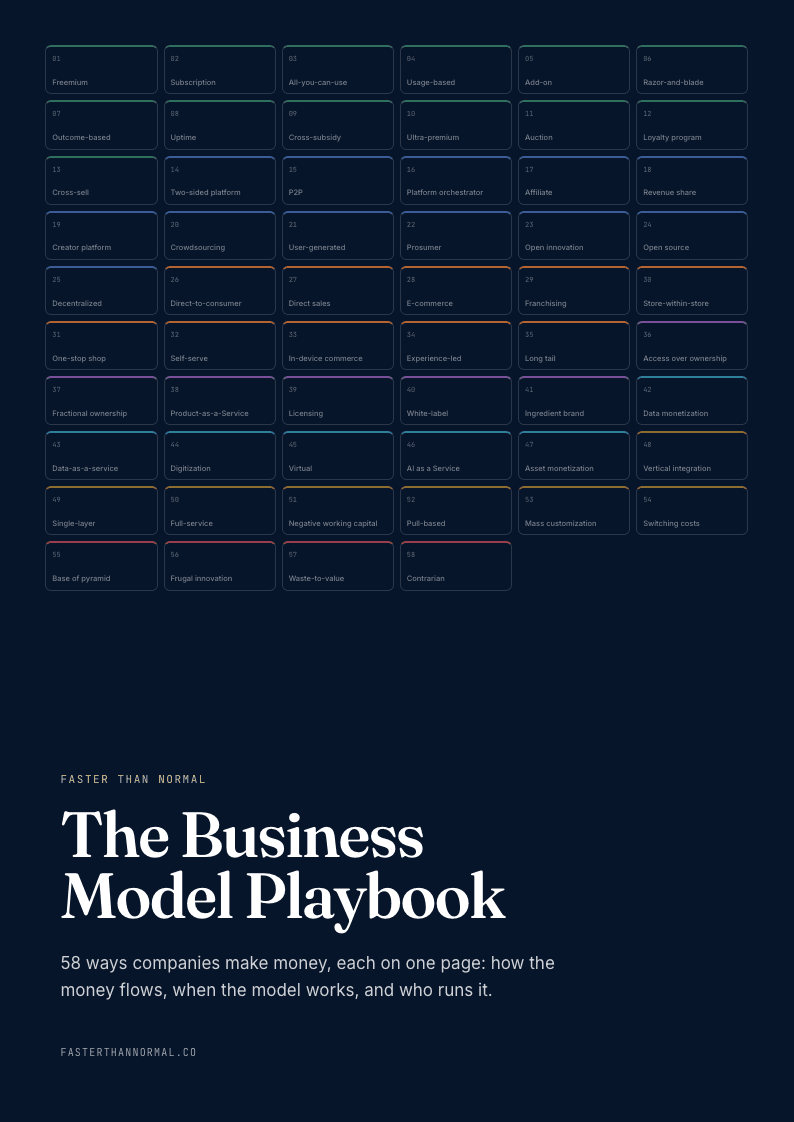
Get The Business Model Playbook
58 business models, one visual page each: how the money flows, the metrics that matter, and who runs it. Free when you join the Faster Than Normal email.
Free. No spam. Unsubscribe anytime.