

6 Techniques to Learn Faster, 10 Rules of Thumb for Better Decisions, & More
High-performing operators share a counterintuitive truth: the frameworks that accelerate learning matter more than raw intelligence. The difference between someone who compounds knowledge and someone who merely accumulates information lies in their systematic approach to acquisition, retention, and application.
What follows are the cognitive tools that separate rapid learners from everyone else — six techniques to accelerate skill development, ten decision-making heuristics that cut through complexity, and the philosophical razors that enable consistent critical thinking.
Six Techniques for Accelerated Learning
Deliberate Practice
Regular practice is mindless repetition within your comfort zone. Deliberate practice is focused attention on the micro-components of a skill, with specific goals and expert feedback on performance.
The distinction matters. A tennis player hitting balls against a wall for hours isn't practicing deliberately. A tennis player working specifically on their backhand crosscourt shot, receiving immediate correction from a coach, and pushing beyond their current capability — that's deliberate practice.
Comfort is the enemy of improvement. The discomfort signals you're operating at the edge of your ability, where growth happens.
The ADEPT Method
A framework for teaching yourself difficult concepts or explaining them to others. Make explanations ADEPT: use an Analogy, create a Diagram, provide an Example, give a Plain-English description, then add the Technical details.
The method forces you to understand a concept from multiple angles. If you can't explain something with an analogy, you don't understand it well enough. If you can't draw it, you haven't grasped its structure.
Spaced Repetition
Memory follows a predictable decay pattern — the forgetting curve. Without reinforcement, we lose most new information within days.
Spaced repetition combats this through systematic re-exposure over increasing intervals. You review new material after one day, then three days, then a week, then two weeks. Each review strengthens the memory trace and extends the interval before the next review.
The technique leverages how memory actually works rather than fighting against it.
Chunking
The process of grouping individual pieces of information into larger, more memorable units. Your brain can hold roughly seven items in working memory — but those items can be single digits or complex concepts, depending on how you chunk them.
Phone numbers demonstrate this perfectly: 8541324987 is nearly impossible to remember as individual digits, but 854-132-4987 becomes manageable as three chunks.
Master practitioners in any field develop sophisticated chunking patterns that let them process information more efficiently than novices.
Elaborative Interrogation
Generate explanations for why stated facts or concepts are true. Don't just learn what — learn why.
This technique involves asking yourself questions about how and why things work, then producing detailed answers. Learning isolated facts creates fragile knowledge. Learning the underlying reasons creates robust understanding that transfers to new situations.
The "why" provides the connective tissue that makes knowledge stick.
The Textbook Method
Write your own textbook chapter on a topic you're learning. This forces deep understanding of concepts and how they interconnect.
You can't hide behind knowledge gaps when you're required to explain everything clearly and concisely. The method reveals exactly what you don't understand and creates a mental structure for organizing the information.
There's no more demanding test of comprehension than teaching.
Ten Decision-Making Heuristics
Taleb's Hiring Heuristic
When choosing between two seemingly equal candidates, pick the one with less prestigious educational credentials. They've succeeded despite having fewer advantages, suggesting stronger underlying capability.
The logic: someone who reached the same level with fewer institutional advantages likely possesses superior skill or drive. Credentials can mask ability; results reveal it.
Growth Razor
The harder the activity, the more likely it leads to growth. The easier the activity, the more likely it leads to stagnation.
One uncomfortable hour generates more improvement than ten comfortable hours. Growth and comfort cannot coexist — discomfort is the price of development, and comfort is the cost of stagnation.
Chekhov's Gun
Every element in a story should be essential. If it's not going to matter, don't include it.
"One must never place a loaded rifle on the stage if it isn't going to go off. It's wrong to make promises you don't mean to keep."
The principle extends beyond storytelling to any form of communication. Every detail should serve a purpose.
Walt Disney's Imagery Principle
Clarity comes through visualization. Complex strategies become simple when drawn.
Humans process visual information more effectively than text. Disney's hand-drawn strategy diagram — showing how movies, merchandise, and theme parks would reinforce each other — captured his company's entire business model in a single image.
If you can't draw your strategy, you don't understand it well enough.
Schwarzenegger's Wisdom
Never depend financially on the work that brings you the most meaning. Maintain alternative income sources so you can refuse projects that compromise your standards.
Before becoming Hollywood's highest-paid action star, Schwarzenegger made millions through real estate and bodybuilding. This financial independence meant he never had to accept roles he didn't want.
Creative freedom requires economic freedom.
Naval's Razor
Calculate your aspirational hourly rate. For any task, ask whether it's worth more or less than this rate.
If it's worth less, outsource it, automate it, or eliminate it. Time is your only non-renewable resource — allocate it accordingly.
Munger's Razor
Never hold an opinion unless you can articulate the opposing argument better than its advocates can.
This is the antidote to confirmation bias. Doing the intellectual work required to hold a defensible opinion means you can argue against yourself better than others can argue against you.
Hitchens' Razor
What can be asserted without evidence can be dismissed without evidence. The burden of proof lies with whoever makes the claim.
Extraordinary claims require extraordinary evidence. Don't waste mental energy on unfounded assertions.
Newton's Flaming Laser Sword
If a question can't be answered through experimentation or observation, it's not worth debating.
Pick your intellectual battles. Focus on questions that can be resolved through evidence rather than endless theorizing.
Joe Rogan's Razor
When unsure what action to take, behave as if your life were a movie and you were the hero.
Make choices your future self would respect. Act in ways that would make your children proud.
Critical Thinking Through Philosophical Razors
These mental models are rules of thumb that eliminate unlikely explanations. They're not correct 100% of the time, but they're right more often than not — making them valuable shortcuts for faster, more accurate thinking.
Sagan Standard
Extraordinary claims require extraordinary evidence. If someone says their name is Bob, that's ordinary — minimal evidence suffices. If someone claims they saw a UFO, that's extraordinary and demands correspondingly stronger proof.
Scale your skepticism to the boldness of the claim.
Hume's Razor
Causes must be sufficiently powerful to produce their assigned effects. A fallen power line can't cause a national blackout. If a proposed cause seems inadequate, eliminate it or identify what additional factors would be required.
Match the magnitude of explanations to the magnitude of effects.
Popper's Falsifiability Principle
For a theory to be scientific, it must be possible to disprove it. "All swans are white" is falsifiable — one black swan would refute it.
Claims that can't be tested should usually be dismissed. Unfalsifiable assertions are intellectual dead ends.
Grice's Razor
Address what the speaker actually meant rather than the literal meaning of their words. Don't get trapped in semantic arguments that miss the substantive point.
Focus on intent, not just content.
Duck Test
If it looks like a duck, swims like a duck, and quacks like a duck, it probably is a duck.
Usually, appearances reflect reality. While deception is possible, there's generally no need to deny obvious patterns.
Tarzwell's Razor
High emotion leads to high bias. Both science and justice systems recognize that dispassion is essential for accurate judgment.
"Where there is passion the truth cannot be trusted." —James Tarzwell
Strong feelings corrupt clear thinking. The more you care about an outcome, the more carefully you should examine your reasoning.
Common Logical Fallacies to Avoid
Appeal to Authority
Claiming something is true because a high-status person believes it. Authority has no bearing on truth — assess the argument, not its source.
Composition or Division Fallacy
Arguing that what's true of parts is true of the whole, or vice versa. Individual saving is good for a person; universal saving might be bad for an economy.
Scale changes everything.
Circular Argument
Restating a claim instead of providing evidence. "You should invite your uncle because it would be mean not to" explains nothing — it just repeats the conclusion.
Appeal to Nature
Claiming that "natural" equals good. Antibiotics are unnatural but beneficial; poison ivy is natural but harmful.
The natural world includes both medicine and toxins.
Black-and-White Thinking
Assuming only two alternatives exist when multiple possibilities are available. People aren't simply good or bad — they're complex, with behaviors that vary by context.
Plain Folks Fallacy
Claiming your ideas are correct because you're "just like everyone else." Common origins don't validate arguments.
Poisoning the Well
Presenting irrelevant negative information before making an argument to make the argument seem untrustworthy. Past mistakes don't automatically invalidate present claims.
Appeal to Consequences
Arguing that something is true or false because the consequences would be desirable or undesirable. Reality doesn't care about your preferences.
Loki's Wager
Insisting that concepts can't be defined and therefore can't be discussed. This avoids difficult conversations by getting lost in semantics.
Perfect definitions aren't required for meaningful dialogue.
Hasty Generalization
Making broad claims based on insufficient evidence. One or two examples can't support sweeping conclusions.
Sample size matters.
Memory and Learning Mechanisms
Active Reading
Reading with the purpose of deep understanding and retention, not just completion. It's the difference between building real knowledge and chauffeur knowledge.
Chauffeur knowledge is surface-level familiarity that gives the appearance of understanding. Real knowledge comes from doing the intellectual work — engaging with material until you truly comprehend it.
Ribot's Law
Newer memories are more vulnerable to forgetting than older memories. Each time you recall a memory, you integrate it more deeply into your existing network of knowledge.
Lesson: Attach new memories to established ones for better retention.
Elaborative Encoding
Making new information memorable by connecting it to existing knowledge. This activates multiple brain regions and creates more retrieval pathways.
Example: To remember someone named Fisher, visualize them wearing a fish hat and holding a fishing rod while repeating their name. The visual and conceptual links make the name harder to forget.
The Forgetting Curve
Memory decay follows a predictable pattern. Without reinforcement, you lose most new information within days.
Spaced repetition is the systematic antidote — reviewing material at increasing intervals to strengthen memory traces.
Imposter Syndrome
The feeling that you don't deserve your achievements or will be exposed as less capable than others believe. Surveys show 70% of people experience this during their careers.
Recognition: If you feel like an imposter, you're probably pushing yourself appropriately. Competent people question their abilities; incompetent people rarely do.
Baker/Baker Paradox
Show two groups the same photo. Tell one group the person is a baker; tell the other his surname is Baker. Days later, the first group remembers "baker" much better than the second remembers "Baker."
Why? The profession "baker" connects to a network of associations — bread, white hats, flour, early mornings. The surname "Baker" connects only to the face.
Rich associations create stronger memories. To remember better:
- Connect new information to existing knowledge
- Make information vivid and emotionally engaging
- Engage multiple senses when possible
- Use visual and spatial memory, which are strongest
Curse of Knowledge
Once you know something, you assume everyone else knows it too. This explains why experts struggle to teach beginners and why people hoard knowledge that could benefit others.
Remember: There are always people to teach and people to learn from. Your "obvious" insight might be someone else's breakthrough.
The frameworks that accelerate learning aren't secrets — they're systems. The operators who compound knowledge fastest aren't necessarily the smartest; they're the most systematic about how they acquire, retain, and apply information.
Free playbook
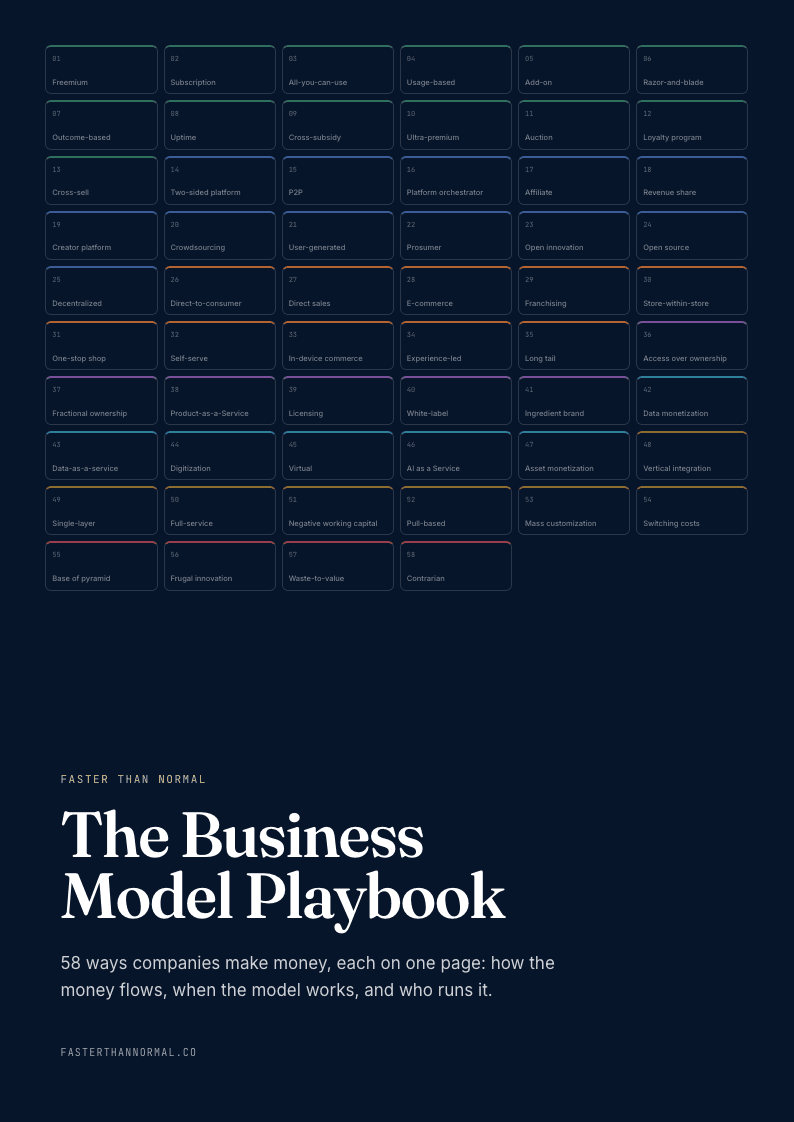
Get The Business Model Playbook
58 business models, one visual page each: how the money flows, the metrics that matter, and who runs it. Free when you join the Faster Than Normal email.
Free. No spam. Unsubscribe anytime.