

2 Short Frameworks To Improve Conversations, The Minimum Viable Test (MVT), Creator Vs Reactor Schedule & More
Decision-making quality deteriorates when we move too fast. Two frameworks can fix this.
Wait, What?
The impulse to respond immediately is the enemy of thoughtful engagement. When someone presents an idea, opinion, or belief, ask "Wait, What?" before you react.
This two-word question forces deceleration. It creates space between stimulus and response — the space where understanding lives. You avoid the trap of defending positions you haven't fully considered or attacking arguments you haven't truly heard.
James E. Ryan developed this framework after observing how quickly conversations devolve into advocacy battles. The pattern is predictable: someone speaks, you mentally compose your counter-argument while they're still talking, then you fire back. Information gets lost. Nuance disappears.
"Wait, What?" breaks the cycle.
Scout vs Soldier Mindset
Julia Galef's framework reveals why some people consistently make better decisions than others. It's not intelligence. It's orientation.
Soldier mindset treats every conversation as a battle to be won. You defend your positions at any cost, marshal evidence selectively, and interpret challenges as attacks. The goal is victory, not truth.
Scout mindset treats every conversation as reconnaissance. You map the terrain accurately, note your blind spots, and update your position when you discover new information. The goal is understanding, not winning.
The difference shows up immediately in how you handle being wrong. Soldiers see correction as defeat. Scouts see it as valuable intelligence. This makes scouts more memorable — people trust someone who can change their mind when presented with evidence.
The paradox: soldiers rarely win the wars that matter.
The Minimum Viable Test
Most startups die from building products nobody wants. The Minimum Viable Product framework attempts to solve this but often misses the point — you're still building before you know if you should.
The Minimum Viable Test flips the sequence. Instead of building a complete MVP, identify your riskiest assumptions first. List everything that must be true for your business to succeed. Rank by risk and uncertainty. Then test assumptions, not products.
AirBnB's founders understood this intuitively. Their riskiest assumption wasn't technical — it was social. Would people sleep in strangers' homes? Rather than build a platform, they tested the core behavior: they advertised rooms during a sold-out conference and tracked bookings.
One weekend, minimal cost, maximum learning. They de-risked the fundamental assumption before writing a line of code.
Creator vs Reactor Schedule
Your calendar reveals your priorities more accurately than your stated goals. Most knowledge workers live on reactor schedules — fragmented time blocks optimized for rapid task completion and external inputs. Meetings, emails, calls, interruptions.
Creator schedules demand the opposite: extended periods of uninterrupted focus. The work requires deep thinking, not fast responses. Writing, designing, coding, strategizing — activities that can't be rushed or multitasked.
The highest performers embed creator time into reactor-heavy roles. They block mornings for deep work before the day's chaos begins. They batch meetings into specific time blocks. They protect their cognitive peak hours from interruption.
The rule is simple: the less you're reacting, the more proactive you can be.
Rumsfeld's Rule
Secretary of Defense Donald Rumsfeld's most famous quote contains a powerful insight about action under uncertainty:
You go to war with the army you have, not the army you might want or wish to have at a later time.
This applies beyond military strategy. Most people wait for perfect conditions before starting important work. They need more money, more time, more skills, more certainty. They're waiting for the army they wish they had.
Rumsfeld's Rule says: start with what you have right now. The conditions will never be perfect. The resources will always feel insufficient. The timing will never seem optimal.
This isn't about lowering standards — it's about recognizing that action creates information, and information improves conditions. You can't think your way to perfect preparation. You have to start.
Herd Instinct
Humans evolved in small groups where conformity increased survival odds. That same instinct now works against independent judgment in complex environments.
Herd instinct manifests as following majority behavior without individual analysis. You align your choices to perceived group expectations rather than evaluating options independently. The urge to belong overrides the discipline to think.
This shows up everywhere: investment decisions that track market sentiment, career choices that follow family expectations, political opinions that match social circles.
The antidote isn't contrarianism — automatically doing the opposite of the crowd. It's conscious evaluation. Ask: am I choosing this because it makes sense, or because others are choosing it?
Independence requires vigilance. Your natural tendency is to merge with your environment.
Common Thinking Errors
These fifteen cognitive traps appear in high-stakes decisions daily:
False Cause
Assuming correlation implies causation. "Sales dropped after we changed the logo — the new design must be hurting conversions." Always consider alternative explanations and common causes.
Appeal to Emotion
Using feelings to substitute for logic. Emotion can motivate action, but it shouldn't replace analysis. The most persuasive arguments combine both.
The Fallacy Fallacy
Rejecting a conclusion because the argument was poorly made. Bad reasoning doesn't automatically make the claim false — it just means you need better evidence.
Slippery Slope
Claiming small actions lead to extreme consequences without proving the connection. This leverages fear to shut down discussion of reasonable options.
Ad Hominem
Attacking the person instead of addressing their argument. Character assassination is easier than intellectual engagement but reveals the weakness of your position.
Burden of Proof
Avoiding responsibility for supporting your claims. "Prove I'm wrong" isn't an argument — it's an abdication of reasoning.
Loaded Question
Embedding assumptions into questions so any answer appears to confirm your position. "Are you naive enough to trust the media?" forces the respondent to defend themselves rather than address the actual issue.
Special Pleading
Moving goalposts when your position is challenged. When evidence contradicts your belief, you create exceptions to preserve the original claim rather than updating your view.
Personal Incredulity
Rejecting explanations because you don't understand them. Your comprehension limitations don't determine objective truth.
Tu Quoque
Deflecting criticism by pointing out the critic's flaws. "You did something similar" doesn't address whether your current behavior is justified.
Appeal to Credentials
Dismissing advice based on the advisor's formal qualifications rather than evaluating the content. Credentials indicate training, not expertise.
Gambler's Fallacy
Believing past random events affect future probabilities. Each coin flip has 50/50 odds regardless of previous results.
Moral Equivalence
Treating different levels of wrongdoing as identical. Context and severity matter in ethical evaluations.
Ambiguity
Using unclear language to mislead. Politicians master this art — saying things that can be interpreted multiple ways depending on the audience.
Red Herring
Deliberately changing the subject to avoid difficult questions. This tactic seeks to exhaust the challenger rather than address their point.
These frameworks and error patterns compound. Master them individually, then watch how they interact. The goal isn't perfect thinking — it's better thinking under pressure, which is where most important decisions get made.
Free playbook
Get The Business Model Playbook
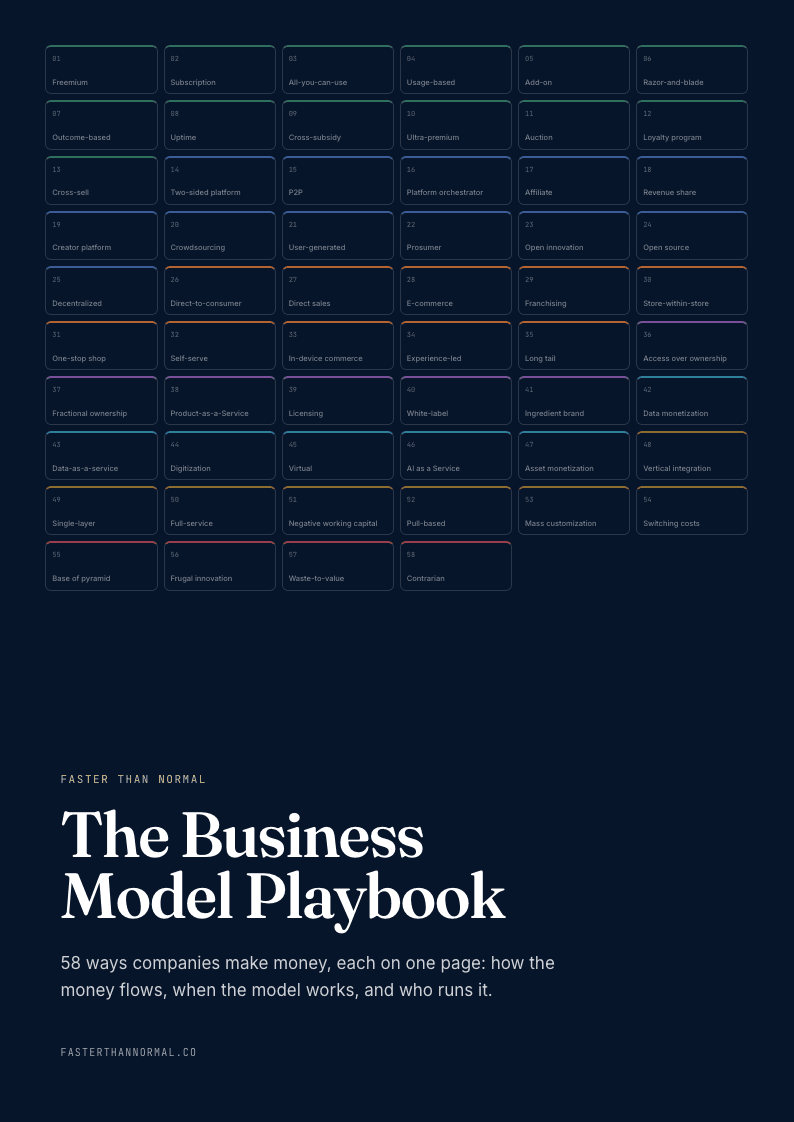
58 business models, one visual page each: how the money flows, the metrics that matter, and who runs it. Free when you join the Faster Than Normal email.
Free. No spam. Unsubscribe anytime.