

Agenda-Setting Theory, The Ergodic Switch, Convexity, & More
The news isn't neutral. Every story selection, every headline, every minute of airtime represents an editorial choice about what deserves your attention. This is Agenda-Setting Theory — the recognition that mainstream media doesn't just report reality, it actively shapes which issues the public considers important.
The mechanism is straightforward: increased coverage drives increased perceived importance. Climate change disappears from public consciousness for months until a dramatic hurricane brings it back to front pages. Immigration surges as a voter priority precisely when cable networks decide to lead with border stories. The agenda precedes the opinion.
What's not being discussed often matters more than what is. While media cycles obsess over quarterly earnings, they systematically ignore the structural forces reshaping entire industries. The silence is the signal.
The Ergodic Switch
Most systems we encounter are taught as ergodic — meaning the average outcome for a group equals the average outcome for any individual over time. Flip a coin 1,000 times, and you'll get roughly 500 heads. Have 1,000 people each flip once, same result. Group average equals individual average over time.
Real life operates differently. Consider entrepreneurship: 90% of startups fail, but those that succeed can generate life-changing returns. The group average — modest failure — tells you nothing about what any individual entrepreneur should expect over multiple attempts. Some will fail repeatedly and exit the game. Others will hit exponential success on their third try.
Non-ergodic systems punish naive averaging. The median day trader loses money, but this statistic is meaningless for someone developing genuine skill. The average writer earns little, but this ignores how a single breakthrough book can redefine a career trajectory.
The switch happens when you stop optimizing for the group average and start thinking about individual paths through time.
Convexity: The Asymmetric Upside
Convex payoffs deliver larger gains than losses — the potential upside exceeds the downside. A pharmaceutical company developing a new drug faces binary outcomes: either the compound fails clinical trials (loss capped at R&D investment) or it succeeds (uncapped upside measured in billions).
Most professionals choose concave careers. Management consulting offers predictable progression from analyst to partner, but the salary band is narrow and the upside is capped. You minimize downside risk by conforming to established hierarchies, but you also eliminate the possibility of exponential returns.
The calculation seems rational until you realize that career safety is often an illusion. Industries disappear, companies restructure, and "safe" roles become automated. The perceived stability comes at the cost of antifragility — the ability to benefit from volatility rather than merely survive it.
Smart operators build convexity into their portfolio. They maintain a stable base (limiting downside) while allocating time and capital to asymmetric bets. The key insight: you only need to be right once if the upside is large enough.
The Map is Not the Territory
Every model is wrong. Some are useful. The more complex the system, the greater the distance between our representations and reality itself. Financial models assume rational actors and efficient markets — clearly false assumptions that nonetheless generate workable predictions under specific conditions.
Understanding a model means understanding its breaking points. Black-Scholes revolutionized options pricing but failed catastrophically during the 1987 crash because it assumed normal distributions in a world of fat tails. The model worked until it didn't.
Maps become dangerous when we forget they're simplified versions of reality. The organizational chart shows clear reporting lines but misses the informal networks where decisions actually get made. The business plan projects linear growth but ignores the recursive feedback loops that make growth exponential or cause it to stall completely.
The most sophisticated operators hold models lightly — useful tools that illuminate certain aspects of reality while obscuring others.
Wisdom of the Crowd
Properly constituted groups consistently outperform individual experts, but the conditions matter enormously. Francis Galton observed this at a county fair where 787 people guessed the weight of an ox. The median guess was 1,207 pounds. The actual weight: 1,198 pounds.
The magic requires diversity, independence, and decentralization. Each person must form their judgment independently, without knowing others' guesses. Introduce discussion or hierarchy, and the advantage disappears. GroupThink replaces collective intelligence.
Markets demonstrate this principle at scale. No individual analyst consistently predicts stock prices, but the aggregated betting of millions creates remarkably efficient price discovery. The crowd's wisdom emerges from the collision of different information sets and reasoning processes.
Applied intelligently, you can harness this effect. Instead of seeking consensus in meetings, collect independent judgments first. Instead of following expert predictions, look for what diverse participants are actually betting on with their money and time.
The Paradox of Abundance
Information abundance creates a quality bifurcation. The average gets worse while the best gets better. Ten thousand newsletters launched this year, but 99% add no unique insight. Meanwhile, the top 1% become exponentially more valuable because they synthesize signal from ever-expanding noise.
The median consumer suffers. Overwhelmed by options, they default to whatever algorithm serves them. The conscious consumer wins. Armed with filters and frameworks, they access higher-quality information than any previous generation.
This explains why some people seem to get smarter faster while others plateau despite having access to the same resources. The difference isn't information access — it's information architecture. How do you decide what deserves your attention? What frameworks do you use to synthesize inputs? How quickly do you recognize and abandon low-value sources?
Abundance rewards the discerning and punishes the passive.
Google Scholar Effect
Highly cited papers appear in top search positions, generating more citations in a reinforcing loop. Position drives citations more than citations drive position. New research, regardless of quality, struggles to break through without initial momentum.
This cumulative advantage operates everywhere. LinkedIn profiles with more connections get shown to more people. Investment funds with early returns attract more capital, making larger returns possible. Cities with initial advantages attract more talent, creating self-reinforcing growth.
The pattern suggests strategic implications: early visibility matters more than most people realize. Getting to the first page of search results, the first round of funding, or the first wave of attention creates compounding advantages that quality alone cannot overcome.
Recognition isn't meritocratic. It's path-dependent.
Curse of Knowledge
Expertise becomes a communication barrier. Once you internalize complex concepts, you forget how difficult they were to learn initially. You assume others share your knowledge base and speak in shorthand that excludes beginners.
This explains why brilliant researchers make terrible teachers and why startup founders struggle to pitch their ideas clearly. The curse intensifies with competence. The better you understand something, the harder it becomes to remember not understanding it.
The solution requires conscious effort. Before explaining anything, identify what background knowledge you're assuming. Start further back than feels natural. Watch for glazed eyes and confused expressions — they signal that you've lost your audience.
There are always people to teach and people to learn from. The curse prevents both.
Predictive Coding
Your brain constructs reality by predicting what comes next, then updating those predictions based on new information. You experience not the world as it is, but the world as you expect it to be, adjusted for surprising inputs.
This creates profound implications for decision-making. Your predictions shape your perceptions, which influence your actions, which affect outcomes, which reinforce your predictions. The loop can be virtuous or vicious.
Andy Clark puts it directly: "You experience, in some sense, the world that you expect to experience." Pessimists find evidence for pessimism. Optimists discover reasons for optimism. Both are right within their constructed reality.
The question becomes: What might you be over-predicting? What assumptions are you making that limit what you can perceive? How might different expectations open different possibilities?
Locus of Control
Internal locus: You believe outcomes result from your actions and decisions. External locus: You believe outcomes result from luck, circumstances, or other people's choices.
The difference affects everything. People with internal locus of control take more risks, work harder, and adapt faster to changing circumstances. They resist conforming to status quo arrangements because they believe they can create better alternatives.
Those with external locus of control seek security in established systems. They follow proven paths because they doubt their ability to create new ones. They optimize for predictability rather than potential.
Neither perspective is completely accurate — outcomes result from both personal agency and external forces. But believing in control, even when partly illusory, consistently produces better results than believing in helplessness.
Seek to believe in control. The belief becomes self-fulfilling.
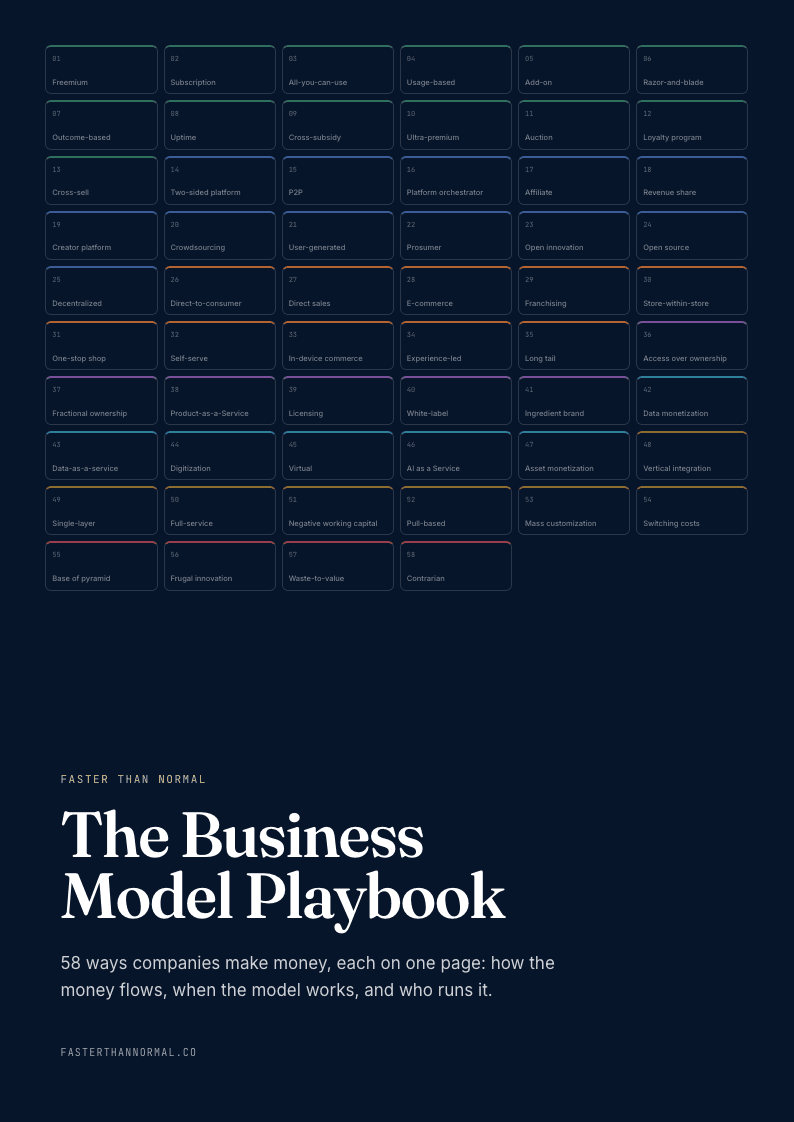
Free playbook
Get The Business Model Playbook
58 business models, one visual page each: how the money flows, the metrics that matter, and who runs it. Free when you join the Faster Than Normal email.
Free. No spam. Unsubscribe anytime.