
Contents
Core Idea
Free playbook
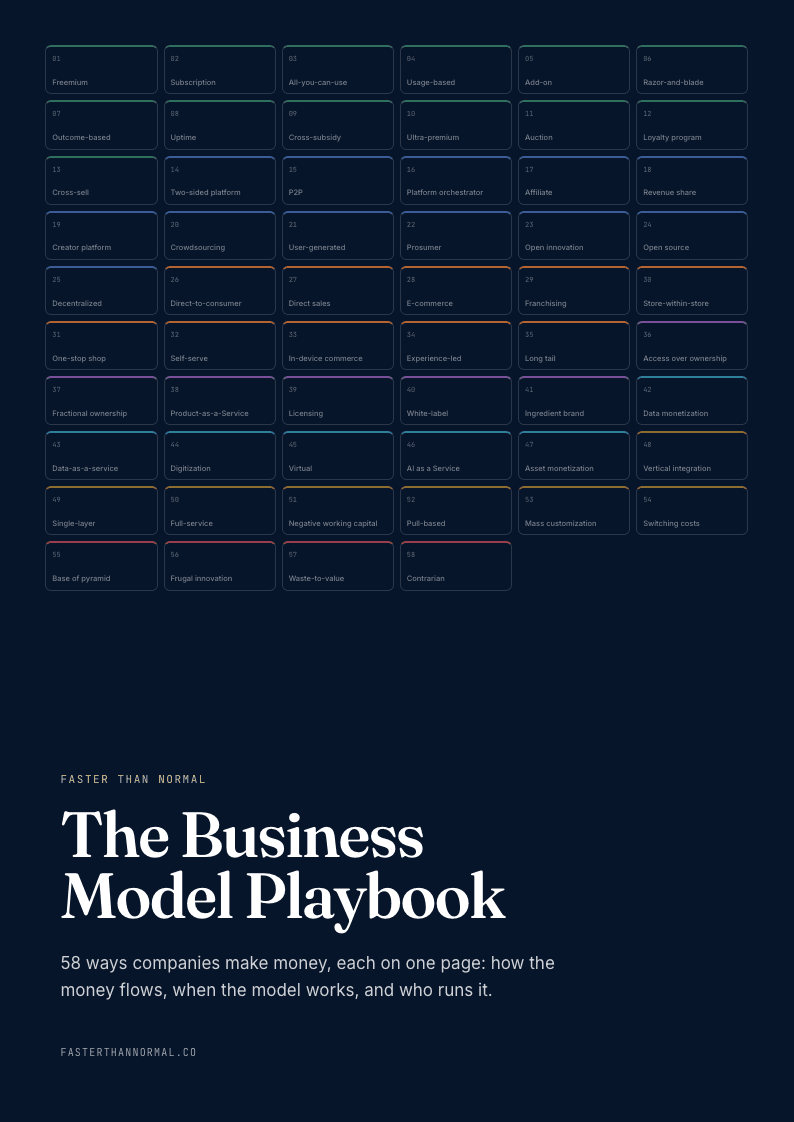
Get The Business Model Playbook
58 business models, one visual page each: how the money flows, the metrics that matter, and who runs it. Free when you join the Faster Than Normal email.
Free. No spam. Unsubscribe anytime.
How to See It
How to Use It
Founders & Leaders
Connected Models
One Key Quote
— [Claude Shannon](/people/claude-shannon)"The fundamental problem of communication is that of reproducing at one point a message selected at another point."
Summary & Further Reading
Why this matters next
Shannon-Hartley Law applied the Packet Switching mental model
Shannon-Hartley Law applied the Slack mental model
Shannon-Hartley Law applied the Signal vs Noise mental model
Shannon-Hartley Law applied the Simplify mental model
Shannon-Hartley Law applied the Information Asymmetry mental model
Shannon-Hartley Law applied the Entropy mental model
Frequently asked questions
What is Shannon-Hartley Law?
Shannon-Hartley Law is a mental model used for better thinking and decision-making.
How do you apply Shannon-Hartley Law?
To apply Shannon-Hartley Law, identify situations where this framework is relevant, then use it as a lens to evaluate your options and decisions. The model is most useful when combined with other complementary mental models.
What category does Shannon-Hartley Law fall under?
Shannon-Hartley Law falls under the Natural Sciences category of mental models. Other models in this category can be found on the Natural Sciences hub page.
Why is Shannon-Hartley Law important?
Shannon-Hartley Law is important because it provides a structured way to think about problems that would otherwise be approached with intuition alone. Understanding this model helps you avoid common reasoning errors and make better decisions.
Where does Shannon-Hartley Law come from?
Shannon-Hartley Law is discussed in the tradition of Shannon & Hartley.
Continue exploring
Mental model
Adaptation & Red Queen Effect
In competitive environments, continuous adaptation is required just to maintain
Mental model
Complex Adaptive Systems
Systems composed of many interacting agents that self-organise, adapt, and produ
Mental model
Critical Mass
The minimum threshold of resources, users, or energy needed for a process to bec
Mental model
Entropy
All ordered systems tend toward disorder over time unless energy is continuously
Mental model
Flywheel
A self-reinforcing cycle where each push builds momentum — no single action crea
Mental model
Incentives
People respond to what they are rewarded or punished for — not to what they are
Free playbook
Get The Business Model Playbook
58 business models, one visual page each: how the money flows, the metrics that matter, and who runs it. Free when you join the Faster Than Normal email.
Free. No spam. Unsubscribe anytime.